Join us Oct. 26-28 in Newport Beach for the Digiday Media Buying Summit
Future of TV Briefing: TikTok Shop success = small creators + more videos
This Future of TV Briefing covers the latest in streaming and TV for Digiday+ members and is distributed over email every Wednesday at 10 a.m. ET. More from the series →
This week’s Future of TV Briefing looks at how “more videos from smaller creators” is the recipe for success on TikTok Shop.
- Shopping small
- Justice Department’s press pool probe, TV’s diversity backslide and more
Shopping small
More and more influencer marketing resembles traditional advertising. There’s the programmatic-ification of influencers’ sponsorship deals. There’s the price of a MrBeast sponsored segment creeping toward the cost of a Super Bowl spot. And there’s the TikTok Shop affiliate model exemplifying the creator economy’s version of direct-response advertising.
The optimal recipe for a brand to generate sales on TikTok’s e-commerce platform is pretty simple and fairly familiar: long-tail scale, a surplus of content and performance-based pricing. That’s because TikTok Shop success is largely a game of shots on goal, albeit with brands needing to take better aim at the creators they send products to, based on a new report from Omnicom-owned Flywheel using data from TikTok Shop affiliate software provider Reacher.
“You’ve got to send out thousands of samples to affiliates [i.e. creators in the TikTok Shop program] at the very beginning, at least, to get a broad enough pool of affiliates to work with. And then you narrow that down over time into that concept of long-term, repeatable creator relationships,” said Deren Baker, CEO of Flywheel Ventures.
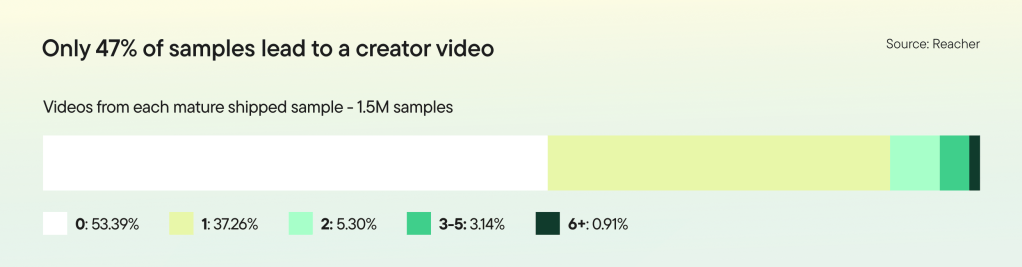
When brands send product samples to TikTok creators in hopes of the creators posting videos to promote the products’ TikTok Shop listings, only 47% of the time do those creators actually make a video, and only 14% of creators generate sales, per the report, which is based on 1.5 million samples sent by brands.
As a result, the best bet for brands is to send product samples to smaller creators and incentivize those creators to post several videos promoting the products by paying them a cut of each sale. Which sounds to me a lot like advertisers placing affiliate links across a ton of niche sites under direct-response advertising’s original affiliate model.
“It’s literally the same affiliate thing that you and I who have been doing this for a too long would think of in the past,” Baker said.
Case in point: smaller creators are likely to generate a disproportionately higher gross merchandise value (i.e. sales in dollar amounts) per 1,000 followers versus creators with larger followings.
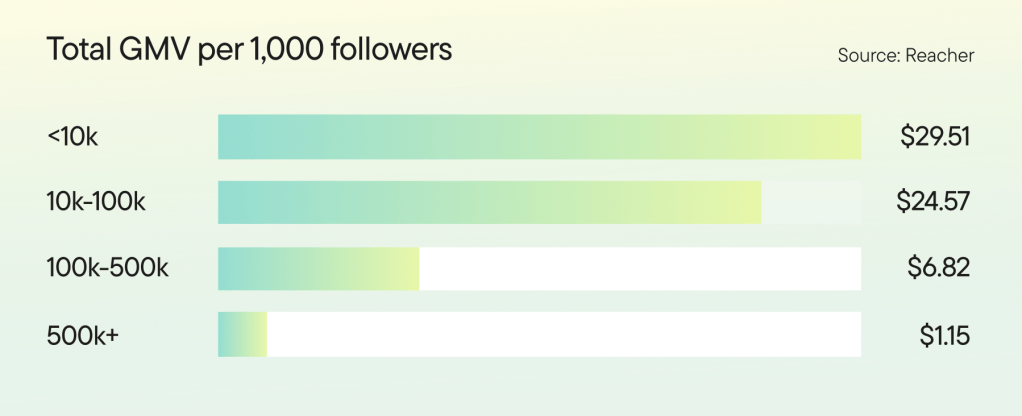
Looking at that chart, I asked Baker if the report illustrates the direct-response side of the creator economy. The idea being that these smaller TikTok creators are the influencer equivalent to recipe sites and momblogs in the online ad market, whereas larger creators are akin to major publishers that are more predisposed to brand awareness plays. “Absolutely. I think you nailed it,” he said.
“We’re not saying if you pay a creator with 500,000 followers to create a [TikTok] Shop video for you, you’re not going to generate any money. It’s just the efficiency side of it is a lot lower because their audience is used to brand things,” Baker said. He added, “Direct response is a much more efficient way to generate sales if that’s your goal.”
And if generating sales on TikTok Shop is the goal — and why wouldn’t it be? — then the recipe’s secret sauce isn’t simply smaller creators but smaller creators posting multiple videos. It’s not just that a creator posting more videos about a product drives more sales; the video volume drives a magnitude more sales.
“A lot of brands get really freaked out when you tell them to be successful you’re going to need 5,000 videos live a month,” Baker said.
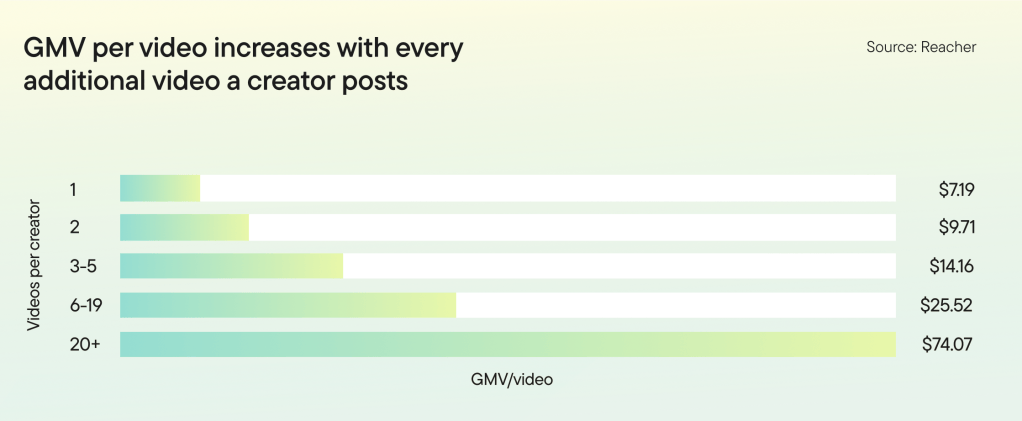
If a creator posts a single video, the video drives, on average, $7.19 in sales. But if a creator posts 20 or more videos, then each of those videos, on average, drives $74.07 in sales (or at least $1,481 in total).
“It’s definitely compounding benefits, and that still makes logical sense to me because you have more shots on goal,” Baker said.
But again, it’s not simply about shots on goal. That would be like the ad network era of online advertising. For TikTok Shop success, brands need to be a bit more targeted with which creators to send products to. And this is where the automation comes in, with advertisers and agencies using firms like Reacher to find and contact creators in a fashion not unlike ad tech intermediaries.
“When we say you need to send out thousands of samples, that means we need to reach out to tens of thousands of creators in an automated fashion to get enough to say, ‘Yeah, I’ll take a sample of that product’ and hopefully create a video,” Baker said.
Then there’s the semi-automated relationship management, which largely comes down to platforms like Discord and Lark that brands and agencies use to communicate with creators en masse.
And finally there’s the pricing model. TikTok Shop originated as a commission-only model. That’s still the basis. But the report recommends that brands reward top-performing creators by offering to pay them flat fees or performance bonuses in addition to commissions. This is where the two poles of the modern influencer marketing market start to merge. The flat fees give small, affiliate creators the revenue model enjoyed by larger creators. Meanwhile, larger creators are increasingly looking to crack the affiliate market.
“That world is blurring in a really interesting way that wouldn’t have been true a year and a half ago,” said Baker.
What we’ve heard
“In a perfect world, we would never do a traditional acquisition where someone buys out the content and puts it on a platform.”
— Whalar Group-owned Lighthouse Studios’ Akshay Mehta on creators’ Hollywood deals
Numbers to know
5%: Percentage of Netflix employees that the company is reportedly planning to lay off.
64%: Percentage of major TV studios’ spending that went toward productions in the U.S. in 2024, compared to 94% in 1999.
What we’ve covered
Inside the colleges building creator economy programs:
- In the past year, Arizona State launched a BA in content creation, Stanford introduced a graduate course called Mastering the Creator Economy, and Syracuse opened the Center of Creator Economy, focused on research, policy, academics and content production.
- Syracuse also wants to ensure that any student can use its content creation tools, which includes several facilities and a student-run creator studio.
Read more about colleges’ creator economy programs here.
Why top creators are taking fewer brand deals:
- The biggest creators are cutting their brand rosters. The partners they keep are being asked for equity, product input and, in some cases, a job title.
- Alix Earle said she would rather work with “five or six brands than 100 every year,” and is weighing equity deals with the ones she sticks with.
Read more about top creators’ brand deals here.
As creators increasingly move into Hollywood, deal terms can put their IP at risk:
- Creator-led content is being pitched across the entertainment spectrum from TV to micro dramas and even theater.
- Digiday spoke with three agency and media execs, two creators, and a creator economy lawyer about how these deals are financed and distributed, who owns the resulting IP, and what makes partnerships work for both brands and creators.
Read more about creators’ Hollywood deals here.
What we’re reading
Justice Department’s press-pool probe:
The U.S. Department of Justice has decided to look into whether TV networks responding to the White House’s antagonism toward CNN by suspending their broadcast coverage rotation could somehow be considered an antitrust issue, according to The Wall Street Journal.
The TV-and-streaming industry’s diversity progress has slipped, as evinced by declining share of BIPOC actors in lead roles and casts with majority BIPOC performers, according to The Hollywood Reporter.
Walmart is making its shopper data available to target ads on Warner Bros. Discovery’s TV networks and opening up Vizio’s CTV ad inventory to Yahoo’s demand-side platform, according to Business Insider.
TikTok doesn’t suspend advertisers for running non-delivery scams via ads on the platform, according to Forbes.
Disney+’s Super Bowl simulcast:
Disney will make next year’s Super Bowl available to stream on Disney+, according to CNBC.


More in Future of TV
Future of TV Briefing: Hispanic TV-and-streaming viewership in 4 charts
This week’s Future of TV Briefing looks at how Hispanic audiences spend their time between traditional TV and streaming.
Future of TV Briefing: TV ad industry’s measurement currency frustrations hit (another) boiling point
This week’s Future of TV Briefing looks at a new task force being formed by the Coalition for Innovative Media Measurement to tackle the TV ad industry’s measurement currency conundrum.
YouTube invests in AI agents, live ‘gamification,’ and editing tools to keep creators close
Made On YouTube announced a spate of new features for the creator platform; here are the most important ones and what they mean for creators.