Join us Dec. 1-3 in Nashville for the Digiday Programmatic Marketing Summit

This article is a WTF explainer, in which we break down media and marketing’s most confusing terms. More from the series →
Editor’s note: These technologies are ill-defined, please share feedback to “editorial@digiday.com” to talk more.
Ad tech has never been short on acronyms. Its latest crop includes: unified advertising platforms (UAPs), unified media platforms (UMPs), and unified buying platforms (UBPs).
This kind of language has added a new layer of confusion to the space, and ad executives across adland have been saying, “WTF…?” Digiday is here to help by trying to bring some clarity to the matter.

A simple way to approach the question is to think of such terms — UAP, UBP and UMP — as overlapping labels for technology that promises to make advertising easier to buy, manage and optimize across an increasingly fragmented media landscape.
Of course, AI is central to the pitch. Advocates of such technologies maintain that instead of separately operating campaigns across Google, Meta, Amazon and the open web, advertisers could potentially use one system to determine where money goes, then execute those decisions through the relevant platforms.
Some providers propose bringing buying and selling infrastructure together. Others want to sit above existing systems and coordinate them. This is an important distinction to keep in mind, as connective software is not the same as controlling how an advertiser spends its next dollar.
WTF is a unified media platform?
At its simplest, a UMP coordinates planning, buying, optimization, and measurement across multiple media channels. Its remit could include programmatic display, CTV, retail media, search, social, and direct publisher relationships.
According to most sources, the idea is not necessarily to replace every existing media trading infrastructure, i.e., demand-side and supply-side platforms, etc., but to make them work together more efficiently.
That is distinct from the traditional remit of a DSP, many of which have spent years expanding the inventory and formats available through their own buying interfaces. A unified platform, by contrast, promises to operate across buying environments that no single DSP controls.
Jay Friedman, co-founder of CartographAI, told Digiday that the emerging proposition is about budget fluidity, not simply consolidating DSPs and SSPs. “We define a UMP as a platform that executes buys across all primary digital channels (search, social, programmatic, and direct). This may or may not include agents,” Friedman told Digiday. “Traditionally, this has been the domain of agency order management systems,” he said, noting how several new entrants are hoping to challenge these players.
UAP? UBP? UMP?
The terms overlap, but they differ in what they promise to unify. The chart below traces that range, from handling an individual transaction to coordinating campaigns across channels and deciding where budgets go.
Keith Weisberg of Unplugged Collective told Digiday UBPs would initially come to market as a repackaging of existing tools. He said the deeper shift would come when buyers could bring their data to the places ads run and delegate spending decisions to AI agents.
“I’d treat that as a net-new product, not a DSP feature,” he said. “However, we’re all plugged into DSPs, and even if it’s a new product, it’ll roll out via our current commercial relationships, because that trust (and legal contracting) took years.”
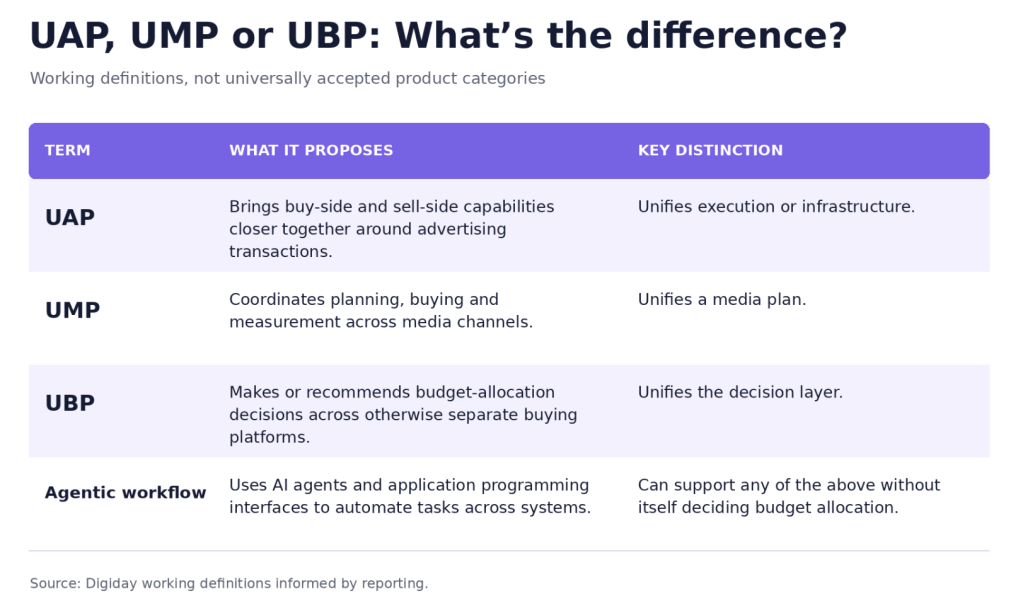
Ana Milicevic, co-founder of Sparrow Advisers, described the labels as directional distinctions rather than settled product categories. She added, “It’s not all just a collection of black boxes. Then that’s a net new layer in the stack.” The key distinction is whether a platform merely pushes buttons in existing interfaces or makes independent decisions about where budgets go.
Ciarán O’Kane, general partner at First Party Capital, was more skeptical about novelty. In wording expressly cleared for attribution, he characterized UMPs and UBPs as “meta DSPs” that act as workflow layers on top of existing systems by plugging into APIs. He also said many emerging players in the space that use this terminology are revisiting approaches the industry has tried before.
Why now?
Media-buying teams have long struggled with the fragmentation of conducting ad campaigns using different buying interfaces, datasets, and measurement methods. AI can make the operational work of combining and interpreting those inputs less expensive, but it does not automatically create comparable performance data or independent buying authority.
“The frustration is very, very old. What’s new now is that AI is letting us operationally skip through some hurdles that were previously insurmountable,” Milicevic told Digiday. Tasks that once demanded a substantial analytics stack and specialist labor can increasingly be assisted by repeatable prompts and automated processes.
The commercial question is whether cheaper orchestration creates an entirely new buyer or simply a more convenient way to operate existing platforms. For advertisers, that distinction determines whether the new technology saves money, reallocates money, or merely adds another vendor to pay.
Who’s behind these new platforms?
In an Oct. 8 blog post, titled “universal buying platform,” Apostrophe co-founders Brian O’Kelley and Anne Coghlan outlined a broader buying layer intended to connect intent, execution, and measurement across advertising environments, citing the recent launch of Amazon Ads Agent as an example of this trend.
Their argument is a public proposal, not evidence that a single independent platform already performs every part of the workflow at scale — O’Kelley did not respond to Digiday’s request for comment by press time.
Other companies are approaching the problem from different directions, with Olyzon — an entity that used the term “agentic orchestration platform” in its recent CTV launch material — serving as one example.
Jules Minvielle, co-founder and CEO of Olyzon, told Digiday the company does not own inventory and uses agents to coordinate buying through existing platforms, with advertiser-controlled approvals. “A DSP is one place where you can buy. Orchestration is all the work around the buy: building the plan, deciding where each dollar goes, activating across every platform, watching delivery, measuring, and feeding what worked into the next plan,” he wrote in an emailed statement, adding that uneven API access and inconsistent measurement remain substantial obstacles.
Ravi Patel, co-founder and CEO of SWYM.ai, drew a distinction between a common interface and control over the budget. “It can manage the ‘what’ and the ‘how much.’ It can’t manage the ‘which impression.’ That distinction is the whole story,” he explained, adding that campaign setup and pacing across platforms are already possible through APIs. However, impression-level optimization within the major walled gardens remains in their own systems.
Lucas Cridland, CEO of Basin Media, questioned whether agents are changing the underlying buying process. “At the moment, many environments are agentically operating in the same supply chain flow. They’re just doing it with agents buying; they’re not radically changing the way the process works. And that’s where the real edge exists.”
The end of DSPs?
Not necessarily. Many of the new propositions depend on DSPs continuing to execute transactions, access inventory, and optimize within their own environments. The change may be who decides which platform gets the advertiser’s budget in the first place.
Milicevic maintained that “value always accrues to whoever is closest to the decision or outright owns the decision.”
Ergo, if DSPs cannot move upstream into genuine cross-channel decision-making, they risk becoming “dumb pipes,” i.e., a commoditized, essential infrastructure whose underlying value is less visible to buyers.
Incumbent DSPs, however, have established advertiser relationships, bidding technology, data integrations and scale. They could develop their own orchestration capabilities. A new intermediary would need to show that its independence produces better decisions, rather than simply adding another fee, according to several sources consulted for this piece.
What about agencies?
Agencies already coordinate campaigns across channels, negotiate buying arrangements and manage the systems needed to execute them. Friedman, a former long-time agency-lead, argued that unified platforms could challenge agency order-management systems while bringing neglected channels, including creator-led media, into a common workflow.

Such a scenario would not eliminate strategic planning, creative development, or oversight, but it could change how much manual campaign administration agencies perform, where they develop proprietary expertise, and which services clients are willing to pay for, with AI at the center of many contractual renegotiations between advertisers and media agencies.
Such a scenario would not eliminate strategic planning, creative development, or oversight, but it could change how much manual campaign administration agencies perform, where they develop proprietary expertise, and which services clients are willing to pay for, with AI at the center of many contractual renegotiations between advertisers and media agencies.
What’s holding it back?
The biggest obstacle may be the very platforms that independent systems are supposed to coordinate. Google, Meta, and Amazon control their own buying tools, data, and optimization systems. Access through an API does not necessarily provide the granular information or authority required to compare results and independently move budgets.
Trust is also an issue. A unified interface can display reports from multiple platforms without proving that the outcomes are comparable. Attribution windows, campaign objectives, and self-reported measurement differ across channels, meaning an independent buying layer needs a credible basis for deciding that one dollar is better spent in one environment than another.
Friedman was skeptical that interoperability would resolve the underlying problems, and highlighted how Google and Meta are unlikely to make their systems interoperable. He further questioned whether agencies could build the context and routing infrastructure needed to translate employees’ instructions into accurate buying decisions, even if every platform supported the Model Context Protocol. “Interoperability won’t solve anything,” he told Digiday.
Greg MacDonald, founder of Chelsea Strategies, said addressing media buying’s growing complexity could reduce spending on its mechanics and, over time, potentially improve advertiser outcomes. However, he remained cautious about how far unified platforms could go. “I’m skeptical that the walled gardens will give buyers more control than they have today,” he told Digiday, pointing to persistent difficulties with frequency capping across programmatic formats, let alone disconnected marketplaces.
“But you don’t have to solve every problem, and certainly not on day one to be useful,” MacDonald added. He compared the opportunity with programmatic guaranteed buying, which made the insertion-order process more efficient without fundamentally changing direct media buying.
Meanwhile, Milicevic said the more plausible near-term customer may be a multichannel advertiser between the largest global brands and small businesses that largely rely on a single platform. She also stressed the need for independent validation of results, rather than taking each platform’s own reporting at face value.
Where do AI agents fit in?
AI agents could help automate campaign setup, inventory discovery, negotiation, execution, and reporting. That makes agentic advertising relevant to the unified-platform debate, but not synonymous with it: automating tasks is different from making accountable, cross-channel budget decisions.
Unplugged Collective maps seven ways AI could change advertising (see graphic below). Per Weisberg, two are central to the unified buying debate: how agents decide where to spend and how they carry out those decisions across platforms.
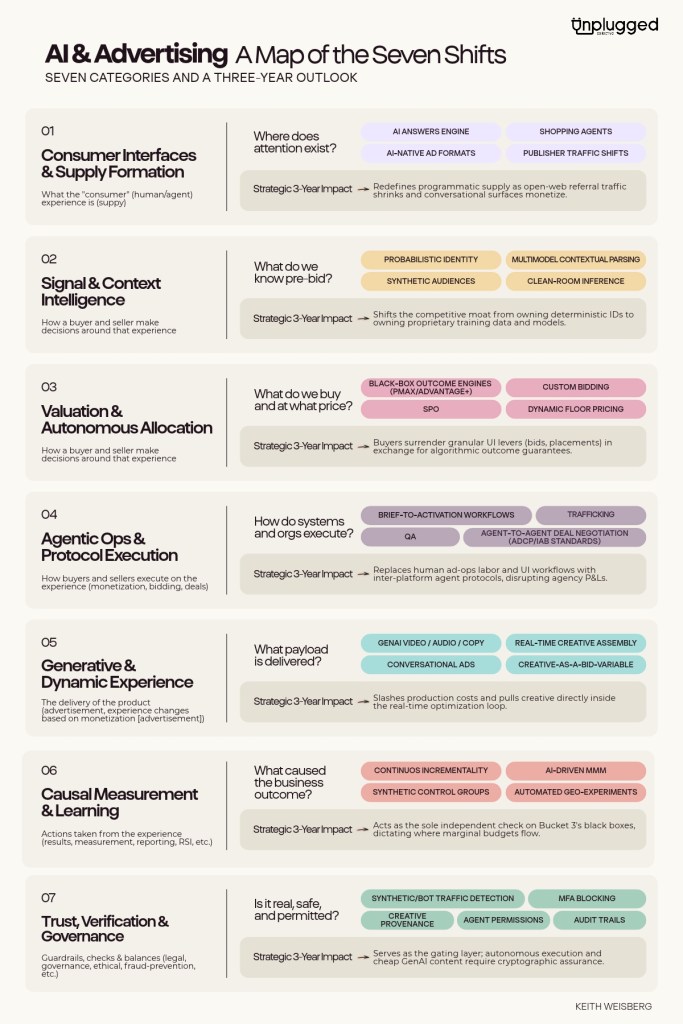
Industry initiatives such as AdCP and IAB Tech Lab’s agentic work aim to establish ways for systems to communicate and execute workflows. Technical standards could reduce integration costs, but they cannot by themselves force walled gardens to disclose comparable data or surrender commercial control.
Just another ad tech buzzword?
Seasoned industry observers have seen enough buzz phrases come and go to feel confident enough to make tongue-in-cheek observations when a new acronym becomes de rigueur among the industry’s chattering classes.
“I saw ‘UMP’ and I thought: ad network,” quipped Terence Kawaja, CEO, LUMA Partners, a prominent investment bank in the space, speaking on stage at this year’s Prebid Summit – channeling the industry adaage, “everything is an ad network.”
Meanwhile, one prominent industry source, who requested anonymity to preserve industry relationships, dismissed the latest acronyms as another serving of “word salad.” However, the barbs, playful or otherwise, raise a palpable industry debate: As AI makes it cheaper to run campaigns across platforms, who gets to decide where the money goes?
The clearest test is whether advertisers entrust meaningful cross-channel allocation to an independent system — and can demonstrate that the decisions improve outcomes. Smaller-scale automation and campaign management do not, on their own, prove that a new market category has emerged.
Milicevic identified three indicators: real advertiser budgets moving under independent allocation, credible measurement outside any single walled garden, and changes in how marketing organizations structure teams. “If it’s truly structural, it’ll show up in the PNL, and if it’s slideware and fluff, then that’ll make its way into award entries and kind of the PR circuit,” she said.
For now, the most useful distinction is between controlling the infrastructure through which ads are purchased and controlling the decision about where the money goes. The latter is the more ambitious promise. Whether anyone can deliver it independently, at scale, and at a cost advertisers will accept remains unresolved.


More in Media Buying

Ad Tech Briefing: Google’s antitrust troubles aren’t over
In Q3 earnings, The Trade Desk’s leadership reveals it is searching for answers.

Dentsu makes entertainment and sport a C-suite priority amid earnings stumble
Japanese holdco appointed Mike Nakamura as entertainment and sport chief, as media revenues slip in most markets.
Media Buying Briefing: Buyers grapple with incoming Amazon reporting changes
The e-commerce giant is central for many consumer brand advertisers, but measurement changes could throw a wrench into their plans for next year.