Join us Dec. 1-3 in Nashville for the Digiday Programmatic Marketing Summit
Future of TV Briefing: Everyone wants a clearer CTV bidstream, but who’s required to provide it?

This Future of TV Briefing covers the latest in streaming and TV for Digiday+ members and is distributed over email every Wednesday at 10 a.m. ET. More from the series →
This week’s Future of TV Briefing looks at the latest call-to-action for the CTV advertising industry to tackle its transparency problem.
- Fuzzy signals
- Anatomy of an influencer marketing deal
- Apple’s video podcast push, WTF is a view and more
Fuzzy signals
You may have heard that connected TV advertising has a transparency problem. So what’s anyone gonna do about it?
Well, the Coalition for Innovative Media Measurement has some ideas. Having surveyed 50 programmatic marketers about CTV’s signals situation, the industry organization has come up with a couple of recommendations.
First, companies need to agree to a minimum viable set of trading signals. The study’s proposed list of baseline signals includes standard parameters like IP address (as questionable a signal as it is), video placement and supply chain object (or “schain”).
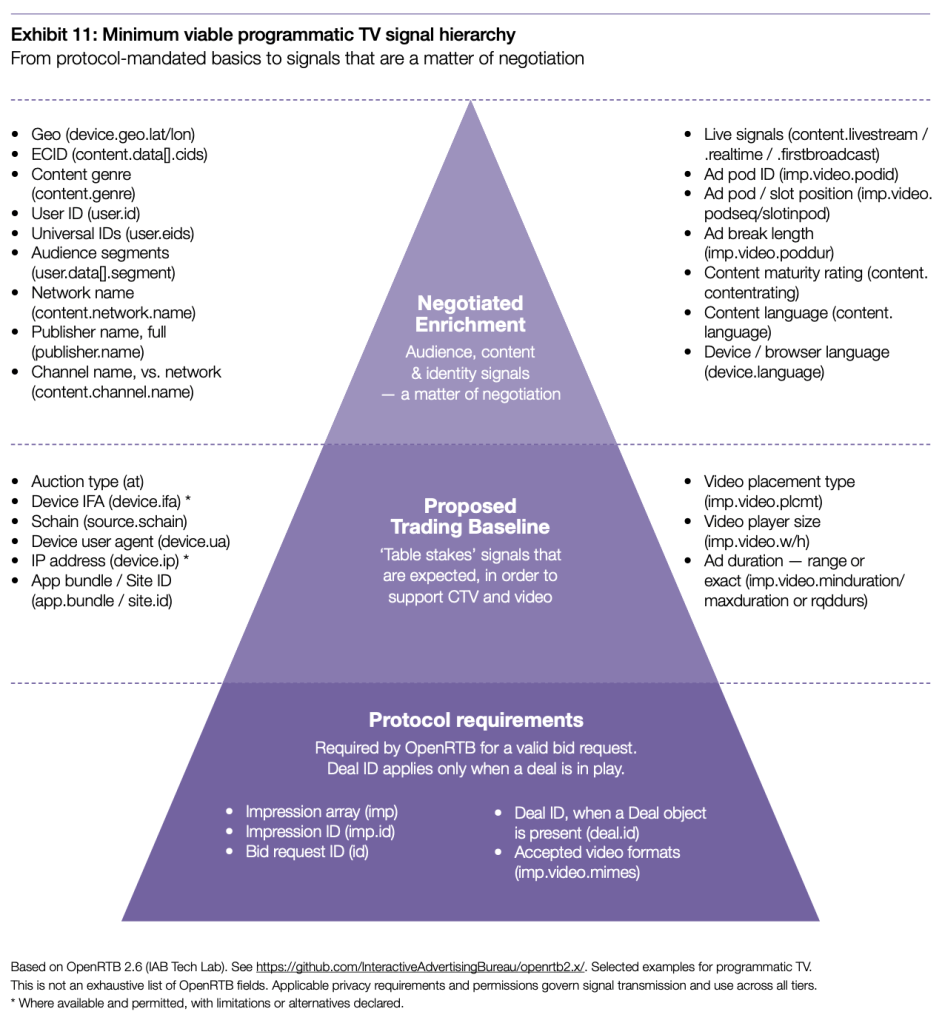
These are already pretty standard signals. According to FreeWheel, one of the CIMM study’s sponsors, 95% to 100% of U.S. CTV and set-top box bid requests through its platform in February 2026 contained IP address, video placement and schain. However, other proposed baseline signals were slightly less common. For example, auction type was missing from 5% to 20% of FreeWheel’s sampled bid requests but would be table stakes under CIMM’s proposed signal set.
This gets at the underlying issue. Ad tech intermediaries don’t always support the signals that buyers and sellers want to be passing back and forth. Per the CIMM study, only 8% of the surveyed programmatic marketers — 4 out of 50 — said the demand-side platforms they use “always” are able to handle the buyers’ required signals.
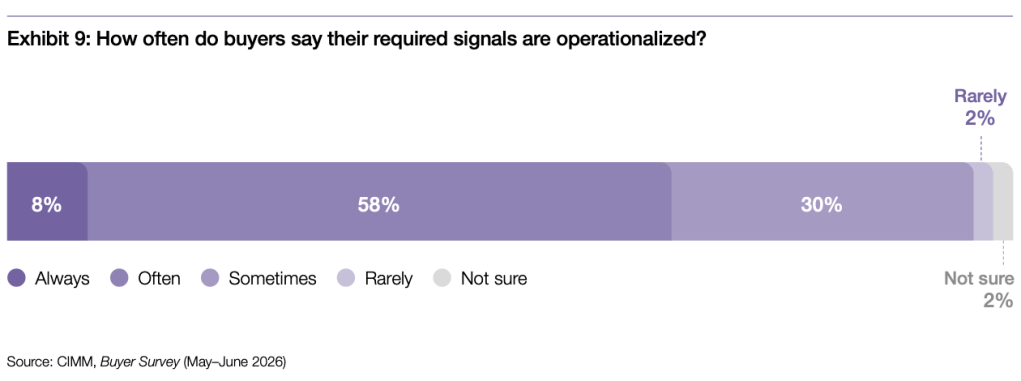
To be fair, 58% of buyers said their required signals are “often” able to be handled by DSPs. But “often” is not “always,” which is the problem.
“The biggest asks that I got were from buyers and sellers that we want to understand which signals are making it all the way through the path and are actually operationalized versus used for reporting or just unusable,” said Emily Palmer, an industry consultant and chair of CIMM’s programmatic working group, who was one of the study’s authors.
Agreeing to a set of baseline signals would be one way to address this, though that would mean companies actually adhering to that agreement.
FreeWheel already requires certain signals like IP address in order to validate traffic, said Alex Strickland, head of programmatic supply relationships at the Comcast-owned ad tech provider that manages demand-side and supply-side platforms. But asked if FreeWheel requires all of the signals listed in the proposed trading baseline set, he said “we don’t require them.”
OpenX, the study’s other sponsor, takes signals into account when selecting which publishers’ bid requests to send to which DSPs, said Danner Close, vp of operations at OpenX. “We constantly engage publishers with, ‘Hey, here’s what is missing from a high-fidelity standpoint that’s preventing your request from going further or from garnering greater bid density’,” he said.
Supporting the table-stakes signals is one thing. Knowing which signals — beyond the baseline requirements (or would-be requirements) — an ad tech firm supports is another. This is where the CIMM study’s other recommendation is meant to come in. Ad tech firms would be asked to publish capability statements declaring which signals they support.
“Buyers and sellers would love to have a centralized resource [containing these capability statements]. That would make a big difference. That sounds somewhat simple; it sounds like it would be a work-in-progress; it sounds like each platform would have a product person occasionally update it; it would have to be an ongoing effort to be accurate and useful,” said Palmer. “The devil’s in the detail.”
Indeed.
Asked if FreeWheel already offers a form of capability statement, “I don’t think we have anything outside of our internal documentation that our customers have access to on our hub,” Strickland said.
OpenX did not provide information on whether the company offers a form of capability statement as of this writing.
Both FreeWheel’s Strickland and an OpenX spokesperson said their respective companies are committed to participating in that centralized resource containing the capability statements, though. Eventually.
“We are all actively, with OpenX as well, working to build a more efficient and competitive marketplace where our premium video content can be recognized and monetized appropriately, and we are willing to do whatever it takes to make that happen,” said Strickland.
Maybe that work will start soon. CIMM is looking to organize a voluntary pilot program for companies to adopt the proposed baseline signals set and implement capability statements. When will that pilot start, though? TBD.
What we’ve heard
“If we’re going to pay LinkedIn’s usual premium pricing, we’d want more clarity on how LinkedIn plans to accurately target their users on these devices.”
— Accuracast’s Farhad Divecha on LinkedIn’s CTV ad targeting
Anatomy of an influencer marketing deal
To the audience, an influencer marketing deal may look like a single sponsored post. Behind that post is a back-and-forth over budgets, briefs, usage rights, and exclusivity —and the brand and the creator don’t always want the same things. During a session at Digiday’s recent Creator Strategies virtual event, YSL Beauty’s Hadley Musinsky and Night’s Sophie Bressler took the deal model apart step by step, from the brand’s first brief to the final post, and show how each side handles talent selection, creative alignment, and negotiation. Watch the full discussion below.
Numbers to know
$3 billion: How much money Disney expects to save in costs over the next three years, including through more layoffs.
3,725: Number of hours of creator-led programming that premiered on U.S. streaming services in Q3 2026, with Tubi accounting for more than 75% of the total.
0.7%: Unboxing videos’ share of sponsored videos in January through September 2026, down from 1.3% a year ago.
18.3 million: Average number of people tuning in to NFL games through the first nine weeks of the season, up 2% compared to last year.
>50%: Percentage overall fee increase the NHL is seeking for its next rights deals up from its current $4.5 billion deal with ESPN and TNT Sports.
What we’ve covered
Twitch adds new short-form video feature:
- Starting early next year, Twitch will let creators upload short-form videos made outside the platform.
- Twitch’s goal isn’t to make clips into a TikTok-like destination, execs say, but to help viewers discover creators and tune into their livestreams, where creators make most of their money.
Read more about Twitch’s short-form video push here.
TwitchCon is at a crossroads as creators question its value:
- TwitchCon remains a draw for brands and streaming companies, but some creators say the cost, safety concerns and uncertain payoff have made the annual convention harder to justify.
- Digiday spoke with six creators and two brands showing up at the convention about what this might signal for the streaming platform’s biggest annual event and the state of the streaming creator economy.
Read more about TwitchCon’s value to creators here.
Why brands like Anthropologie are commissioning creator-created shows instead of posts:
- Anthropologie hired “Brooklyn Coffee Shop” creator Pooja Tripathi to write and lead its first micro comedy series — a holiday party caper she took from script to shoot.
- Tripathi developed the characters and the direction of the show while Anthropologie’s team took charge of the styling, from what each character wears to how the party itself was decorated.
Read more about brands commissioning creator-led series here.
LinkedIn brings its B2B ad targeting to U.K. connected TVs:
- In its latest effort to capitalize on growing demand for video, LinkedIn is expanding its CTV ads to the U.K.
- The launch follows its staged U.S. rollout, which began in April 2024, before becoming widely available across the U.S. and Canada in 2025.
Read more about LinkedIn’s U.K. CTV ads expansion here.
How a sports betting creator drove 200 million short-form views of his podcast:
- Sports betting analyst and commentator Zach “Mystic Zach” Hirsch has nearly 2 million Instagram followers, and a Draft Kings-sponsored podcast, Double Coverage, that boasts millions of views across YouTube and TikTok.
- Double Coverage is also looking beyond the screen, with plans for more experiential programming and in-person events.
Read more about Zach Hirsch’s short-form podcast playbook here.
What we’re reading
Disney+ plus Hulu plus TikTok:
Next month Disney will roll out the fully unified version of its streaming service containing both Disney+ and Hulu (if you feel like your Disney+ app featuring Hulu programming is already this, me too) and will also add creator videos via a deal with TikTok, according to The Wrap.
Apple is adding a video podcasts section to its Apple TV streaming service and will up the number of video podcasts available through its Podcasts app, according to The New York Times.
The Interactive Advertising Bureau wants to bring industry groups together to sort out what exactly counts as a view on social video platforms to provide a standard foundation for brand-creator deals, according to Tubefilter.
Skydance’s traditional TV quandary:
Having closed its Warner Bros. Discovery and Paramount takeovers, Skydance now owns 55 cable TV networks plus CBS and will need to figure out how to offset the declining traditional TV business, according to Variety.


More in Future of TV
Anatomy of an influencer marketing deal
In a live Digiday Podcast recording, YSL Beauty’s Hadley Musinsky and Night’s Sophie Bressler broke down how deals between brands and influencers come together.

Future of TV Briefing: Inside creator Grace Wells’s 100-hour branded video production process
This week’s Future of TV Briefing looks at creator Grace Wells’s full production process, from initial brief to final delivery.
Future of TV Briefing: What it costs brands to fund long-form creator series
This week’s Future of TV Briefing looks at the economics behind brands sponsoring creator-led long-form original video series.