Join us Dec. 1-3 in Nashville for the Digiday Programmatic Marketing Summit
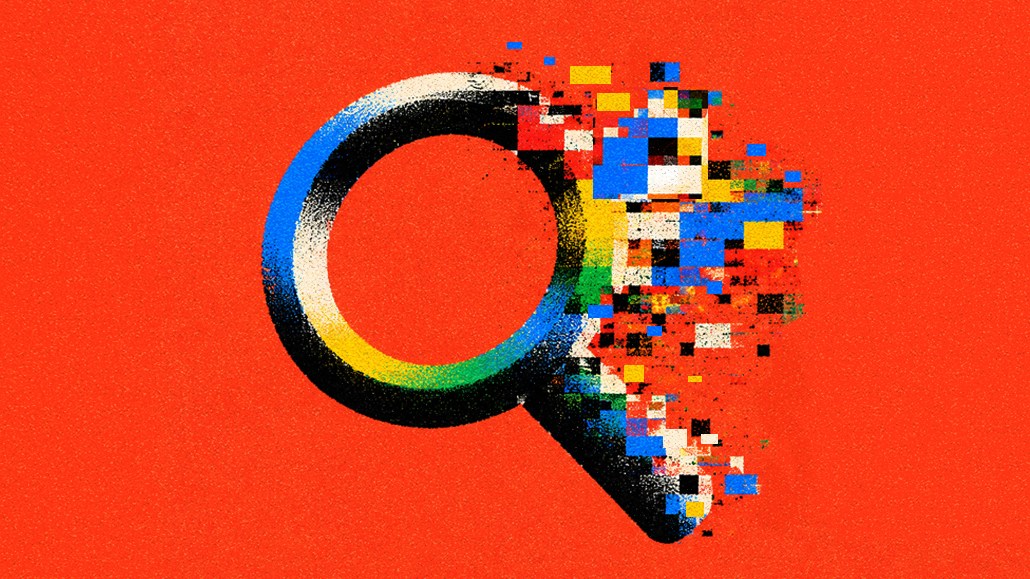
For the better part of two decades, Google search was the line item media buyers rarely had to defend. AI Overviews complicated that. Google now answers more queries on the results page itself, which changes how often people click through to an advertiser and what each click is worth.
That, in turn, means fewer prime ad slots around the search results people see, and Google’s automated buying tools, now the default for most campaigns, are quick to pay up for the ones that remain. Q4 makes it worse as seasonal advertisers bid up CPCs in the quarter that matters most.
Nearly a month into that quarter, advertisers want to know what all that extra spend is buying. Across conversations with 18 media buyers, Digiday found clients putting Google through the kind of scrutiny usually saved for newer channels.
“We’re having to look much more closely at what happens after the click and whether those clicks are actually producing qualified leads and revenue,” said Lindsay Marty, founder of Above the Bar Marketing.
That’s left her clients increasingly open to shifting a portion of their Google search budgets into channels including Meta and Local Services Ads if performance weakens. Marty added: “The amount being questioned is generally around 10% to 20% of the Google budget when that conversation comes up.”
Google’s own numbers point the same way. Search ad revenue grew 12% in the third quarter, Alphabet’s slowest pace this year, and executives blamed part of the slowdown on AI Mode — Google’s chatbot-style search tab.
The numbers are part of a bigger shift in how people use the internet. More of them are handing the search, and sometimes the purchase itself, to AI agents, and the money underneath the web is starting to follow. Where it lands is anyone’s guess. Advertisers and their agencies are having to place their bets now.
Take Bryce Hamlin, vp of data intelligence at Power Digital. He said media mix modelling and geo-testing were showing a greater impact from upper-funnel media and less from search. Dollars tend to follow whatever the models credit.
“Google search ads are still very powerful, but in the next two-to-three years, we will see a lot of searches happen off of Google because of LLMs,” he said. “We’re already seeing the beginning of this trend.”
Hamlin said the growing use of marketing science, AI and incremental measurement is also prompting advertisers to question whether some of their Google search budget would work harder elsewhere.
“An increasing number of marketers are asking, ‘is a portion of my budget better spent elsewhere’ — to the tune of 10% to 30% of the Google search budget getting reallocated,” he added.
Accuracast’s group CEO Farhad Divecha said the percentage within the Google budgets being questioned by his team’s clients is about 10% for now, but given the dynamic and competitive nature of Black Friday and Cyber Monday, this could change to as much as 20% to 30% quite rapidly.
The size of those budgets vary, though search remains one of the biggest lines in most media plans. It took $114.2 billion of U.S. digital ad spending last year, or 38.8% of the total, according to the Interactive Advertising Bureau and PricewaterhouseCoopers. For mid-sized and larger advertisers that employ agencies, a Google search budget can run from tens of thousands of dollars a month into the millions.
And it costs a little more each quarter.
Branded keyword CPCs rose 5% in the third quarter, roughly in line with non-branded terms, according to Michelle Merklin, vp of search at Tinuiti.
“CPCs keep rising,” she continued, though she’s keeping a closer eye on how much search there is to buy. Impressions and clicks climbed over the same period, which leaves advertisers paying a bit more for a bigger pool of demand.
Some buyers have done the math on that trade and don’t like the answer.
“It’s not just traffic, but also the ROI from Google that’s been squeezed in recent years, making it less attractive as a channel,” said Divecha. “We definitely see advertisers looking at other options to invest budgets in, especially ChatGPT.”
He said Accuracast’s clients are looking at alternatives and could move money away from Google if click volumes began to dip. Some execs are finding that channels outside search play a greater role in driving conversions than traditional attribution models suggest. The agency’s AI-led campaign management platform, Unyte.AI, for example, automatically reallocates budget away from Google when returns weaken, shifting spend to other platforms delivering incremental conversions at a better return on investment, Divecha explained.
More of that money is landing on Meta and TikTok, where advertisers are trying to build awareness and consideration earlier in the funnel. According to Merklin, some advertisers were reallocating budgets from less efficient parts of search, including campaigns targeting competitors’ keywords or “conquesting.” But she said most advertisers managed by Tinuiti were seeking incremental budget or reallocating spend from elsewhere, rather than cutting search to fund upper-funnel activity; the trend contributed to a 16% rise in Facebook ad spend among Tinuiti’s U.S. clients in the third quarter.
“You have to create the demand before it can be captured,” she explained. “There’s been a shift recently into the mid and upper funnel in order to produce more brand search volume.”
That shift doesn’t necessarily mean advertisers are abandoning search altogether. Some see paid search as increasingly important as organic traffic comes under pressure.
“It’s only [becoming] more important to be in that paid space because organic search traffic is being impacted,” said Casey Sheehan, vp, group director at RPA.
That said, fewer buyers treat it as the bedrock of a media plan.
“What’s coming up more in client conversations is the need to be present earlier in the discovery journey,” said Mark Byrne, director of paid media at Brave Bison. “Google search remains strong at capturing existing demand, while paid social and YouTube help build awareness and consideration before someone actively searches.”
It’s a rethink that reaches all the way down to the search results page, where paid and organic listings now get judged together. Byrne said advertisers were looking more closely at where they needed to bid to capture valuable traffic, and where they could pull back, weighing the combined impact on revenue, return on ad spend and cost per acquisition.
“From our perspective the most effective strategy is to have a really strong presence in your organic AI citations, and then also a strong paid search presence,” said Wpromote’s head of paid search Valerie Dorer.
On that basis, what’s happening to search ad spending is arguably to be expected as Google’s ads business adjusts around however people are going to access and share information moving forward. Indeed, ads in AI Mode are already expanding to new markets in Brazil, Mexico, and the United Kingdom while it is also scaling the ads already present in markets like Australia, Canada, India and Kenya.
Victor Batista, global search lead at Jellyfish, put a finer point on it. He said clients were not reducing their overall Google spend “in a targeted manner”. Instead, the “Google ecosystem is expanding its footprint in discussions as the AI experience is enhanced and more widely understood,” he added.
Clients are, in other words, identifying opportunities to shift spending from traditional keyword-based search campaigns to AI-powered alternatives such as AI Max and Performance Max, while also increasing investment in YouTube and Demand Gen. Overall, Batista said, budget diversification remained “generally contained within the Google ecosystem.”
Google remains a major channel for capturing existing demand, particularly when consumers are actively searching for products or services. But as search behavior changes and advertisers take a closer look at which channels are driving incremental returns, Google is facing greater scrutiny over its place in clients’ media plans.
“The incremental 10% to 20% is becoming less automatic,” said Marty. “Advertisers increasingly want Google to prove that spend is still the best use of those dollars.”
In response to this article, a Google spokesperson said: “Every day, millions of businesses choose Search Ads to drive growth. AI Overviews create new opportunities for brands to be discovered and help shoppers make more confident decisions. As Search becomes more conversational, our AI-powered campaigns help advertisers capture these new opportunities, while keeping them firmly in control.”


More in Marketing
Amazon says more than 400M customers have used Alexa for Shopping in the last 12 months
Customers who use Alexa for Shopping are spending 50% more than those who don’t.

Amid growing tension over workplace AI, agencies have a window to reimagine staffing
AI agents are becoming common among agencies, but most companies haven’t grasped their potential to reshape teams.

From Celsius to Maybelline, more brands are lining up for the NYC Marathon’s 50th anniversary
The brands showing up at the annual race represent a more diverse cross-section of retail than ever before.