Join us Dec. 1-3 in Nashville for the Digiday Programmatic Marketing Summit
How Bustle Digital Group is helping Pampers and Innisfree show up in AI recommendations

Bustle Digital Group is using Profound’s AI measurement tools to help brands, including Pampers and Innisfree, show up in AI-generated recommendations.
The publisher’s GEO offering, called ECHO internally, uses Profound analytics and AI agents trained on content from BDG’s titles to generate creative briefs and guidelines. BDG’s creative team uses those materials to produce content designed to be cited by AI platforms. At least three brands have paid for the offering.
An uptick in client inquiries this year prompted BDG to develop the offering, said Graham Howes, svp of distribution and AI intelligence at BDG, which owns titles like Bustle, Nylon, Elite Daily and Scary Mommy.
BDG is the only publisher currently working with Profound to turn this process into an advertiser offering.
In one campaign, which ran between Aug 11–Sep 30, Korean beauty brand Innisfree’s visibility across 200 tracked skincare prompts grew 30%, while Bustle’s citation rank rose from #709 to #12, according to a BDG case study based on Profound data.
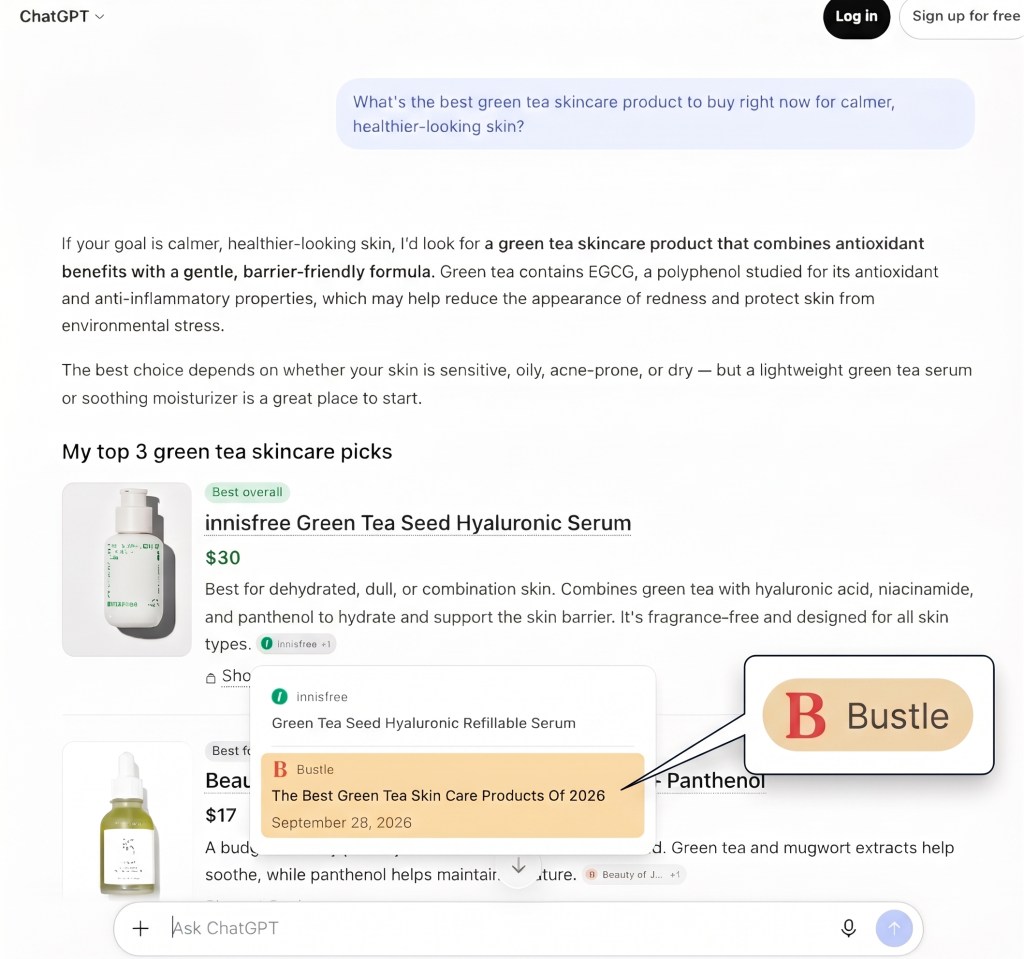
“By combining trusted editorial environments, answer engine optimization, and prompt-level measurement, we were able to demonstrate that AI visibility can be measured, optimized, and ultimately transformed into a meaningful competitive advantage,” said Julien Bouzitat, gm of Innisfree U.S., part of the Amore Pacific Group.
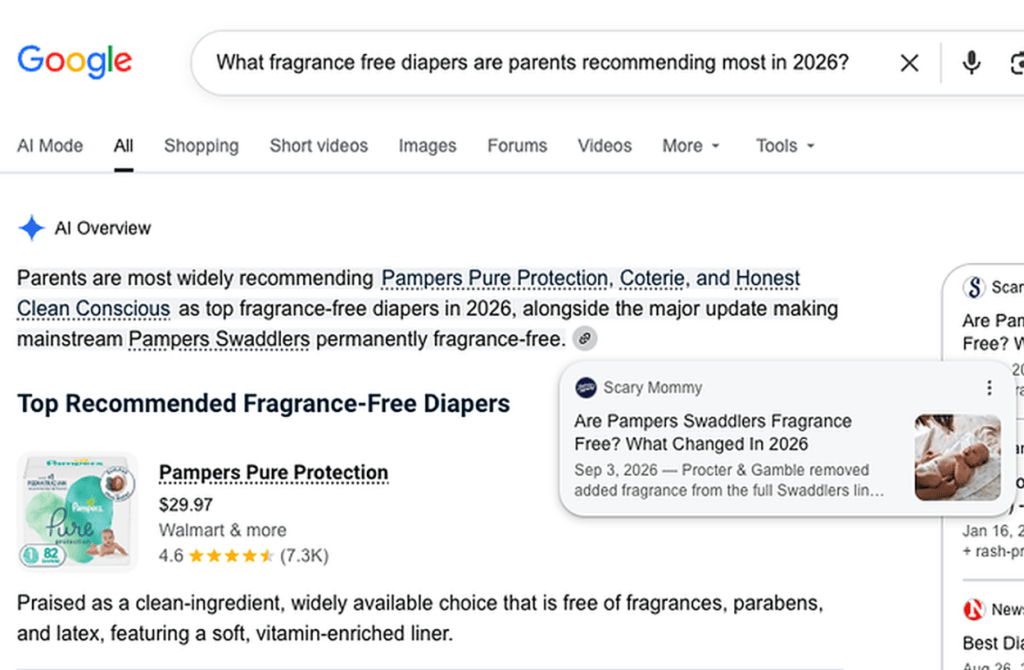
Baby care brand Pampers moved from #2 to #1 in AI visibility for fragrance-free diaper questions following a Scary Mommy explainer addressing Swaddlers’ fragrance-free switch. The explainer ran between Sep 4–17.
“There isn’t a defined playbook for how publishers should be approaching this. So we really had to come at this from a very DIY place of first understanding the space,” Howes said.
How it works
The process begins with an RFP and conversations with the brand on their AI visibility goals, Howes explained. Then comes a two- to four-week baseline research phase, where BDG and Profound analyze eight to 10 topics that the advertiser wants to increase its visibility against within an AI answer engine, and 25 to 50 prompts [on each topic] to understand the brand’s competitive standing and what sites the answer engines are currently citing.
BDG then uses its own AI agents, trained on its titles’ content, to develop an editorial strategy for the branded content. This includes potential article topics, headline structure, and tone, Howes explained. That strategy is then presented to the advertiser.
“The advertiser has no hand in the actual creative development at all. We leave that entirely up to our editors, partly because we want to make sure that we are following all of the best practices of what gets cited, and something that is very heavy-handed on the advertorial front is very unlikely to do that,” Howes said.
AI agents within Profound then design the creative briefs, which get handed off to BDG’s creative team. They write in their own voice, but follow guidelines set by the agents, such as including an FAQ section at the bottom of the article, or the type of article format, such as a listicle or an explainer.
“You’ve got to be able to connect analytics into action,” said Josh Blyska, head of insights at Profound.
Once the content is live, it’s cross-promoted on Reddit, where BDG is running paid media. This helps build awareness among relevant communities of Reddit users, which “still matters a lot in the overall algorithm of what is being picked up and why,” Howes said. Reddit, he added, remains a significant citation source for answer engines.”
BDG tracks the performance of those posts throughout the campaign, he added.
How it’s measured
This is the big question, especially given attribution is difficult because AI platforms offer limited insight into how people use their answers to make purchasing decisions, making it hard for publishers to attribute AI’s influence on traffic, engagement and conversions.
BDG tracks the performance of the GEO-branded content by analyzing metrics including the brand’s visibility on AI platforms, and BDG’s citation share and citation rank, mainly across ChatGPT, Gemini and Google’s AI Overviews.
Profound measures AI visibility by whether the brand appears in an AI response. Citation share measures the percentage of total citations in a given set of AI-generated answers that come from a particular publisher’s site, Blyska said. (Citation share is typically between 0.1% and 3%, he noted.) Citation rank measures how a publisher’s content ranks against competitors based on how frequently each is cited in AI-generated answers.
“We want to really be able to prove to the best of our ability, that these two goals are interconnected when we run programs in this kind of way,” Howes said.
Using Profound, BDG identifies examples of its content appearing in AI answers, monitors which articles generate the most citations and makes real-time optimizations to improve performance, Howes said. Advertisers then receive a report detailing the results.
“Now the question is, does the influence layer – i.e., ChatGPT, where people find the conviction to decide what to buy – net cleanly into the transaction layer, which is often through Google into the website? And the answer is no, not right now,” Blyska said.
How it’s sold
Howes declined to share how much revenue its GEO offering was generating, or how much BDG was charging brands for this offering. It’s sold as a standalone offering, or bundled into existing custom content packages. Profound does not receive a cut of these deals.
“We see this more as an extension of [our] custom content opportunities, not a replacement to them,” Howes said. “Clients can still have those opportunities to reach our audiences on our sites, on our social channels, but also pair that with these types of opportunities to also reach similar audiences that are now choosing to engage an answer engine to have a question answered.”
Ashish Jacob, director of GEO at Go Fish Digital, said consistent measurement matters more than which analytics platforms a company uses to track visibility.
“The most valuable metrics include how often a brand appears in relevant AI responses, which sources are cited, sentiment, competitive share of voice, and how those results change over time. It’s also important to understand the prompts, AI platforms, and sampling methods behind the data, since different tools may produce different results. First-party reporting is becoming increasingly valuable as well,” Jacob said.
What’s next
Profound is seeing some renewals for 2027, as well as exploring running always-on, yearlong campaigns, Howes said.
“A lot of advertisers realize that this content is very powerful, but it also has a half-life to it, and if you want to really make sure that you have an ongoing presence – especially when we think about our partners in beauty and fashion, where so much of what they’re doing is very seasonal – that they need to really have a more always-on approach to their content strategy,” Howes said.
These GEO offerings require publishers to be nimble, Howes said. Because AI answer engines are constantly changing their algorithms, GEO requires ongoing monitoring, research and content optimization, he said. Publishers must continually adapt their strategies to keep brands visible in AI-generated answers. But that’s an opportunity in itself, to act “not just as content partners” but as “a knowledge resource” to help brands understand what’s happening within AI answer engine recommendations, he added.
Howes sees GEO as an opportunity not just to improve its own visibility in AI search, but to grow its advertising business. Branded and custom content is BDG’s largest revenue source, he said. Measuring and demonstrating how GEO efforts benefit advertisers will be critical to strengthening brand partnerships and expanding these offerings as a revenue stream, Howes noted.
“I really want to better understand how this new paradigm we find ourselves in really plays a direct role in our business, not just our own editorial growth. To be able to have that kind of data and visibility, not just in our own efforts, but in our advertisers’ efforts as well, is fundamental to what we do because we need to be able to have that level of transparency to grow the kind of partnerships that we’re looking to grow into next year with these types of packages,” Howes said.


More in Media

How brands are banking on live shopping this holiday season
More brands are gravitating toward live shopping, a growing channel that is set to play an outsized influence on shopping trends.

‘We’re not trying to be TwitchTok’: Twitch adds new short-form video feature
Twitch is swinging big with a new short-form content push that should help more creators get discovered on-platform.

Yahoo becomes first licensee of ‘Spotify-like’ collective AI content licensing model
Yahoo is the first licensee of the Internet Licensing Collective, offering publishers a new way to get paid for content used in AI search.