Join us Dec. 1-3 in Nashville for the Digiday Programmatic Marketing Summit
Media Briefing: The new World Cup SEO playbook: What’s in and what’s out

This Media Briefing covers the latest in media trends for Digiday+ members and is distributed over email every Thursday at 10 a.m. ET. More from the series →
This week’s Media Briefing looks at why the World Cup is no longer the easy search traffic win it once was, and how publishers are adjusting their strategies to pull people in.
- The new World Cup playbook
- Reuters Institute report shows people are swapping news sites for social, video platforms
- U.K. publishers move to charge tech companies for AI scraping, Washington Post gets hit with class-action lawsuit around subscription pricing, and more
The new World Cup playbook
The World Cup used to be a guaranteed search traffic bonanza for publishers. In the age of AI answers and zero-click search, that playbook is being adapted to changes in SEO, direct audience and off-platform strategies.
Here’s what’s in and what’s out for publishers’ World Cup coverage playbook.
In: A new kind of World Cup traffic win
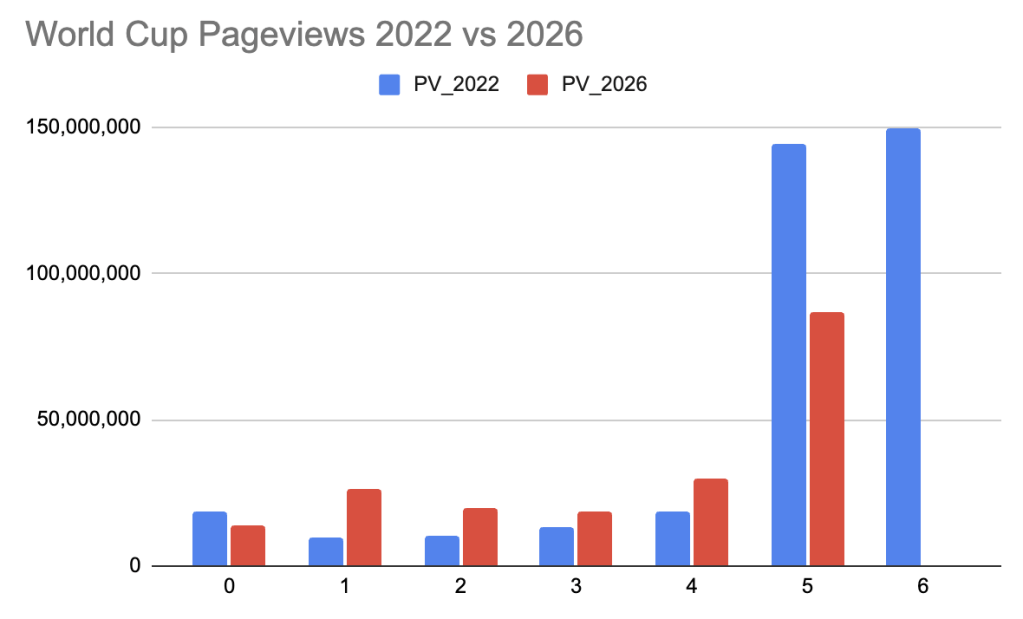
Despite the anxiety around search, the topline traffic picture so far isn’t all bad. Chartbeat data shows the months leading into the 2026 tournament drew more pageviews to the roughly 750 publishers that covered the World Cup than the equivalent run-up to the previous tournament in 2022. While it’s still early, this year’s tournament is pacing ahead of Qatar. Recirculation is also higher in 2026 than in 2022 (an average of about 20%, compared to 14.6%), meaning readers are clicking deeper into World Cup coverage rather than bouncing after a single story.
That doesn’t mean the old World Cup SEO playbook still works the way it used to.
Out: Treating search as a guaranteed traffic engine
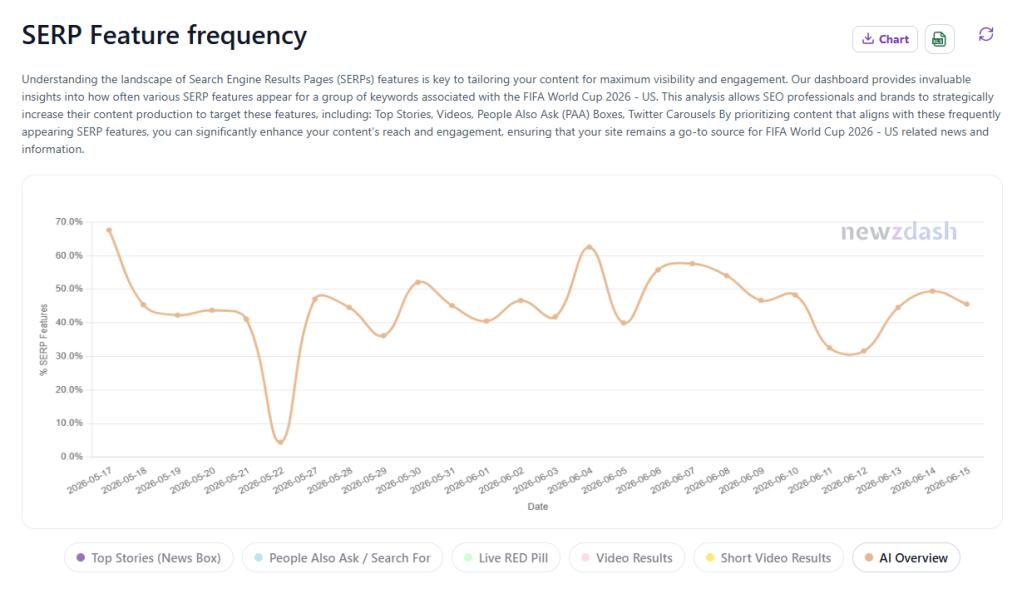
Publishing execs say they have tempered their expectations for a traffic boom from World Cup coverage, given all the changes Google has made to search and AI summaries chipping away at clickthroughs. Fans can now find the basics like scores, where to watch and the games schedule from a Google search page as well as AI Overviews.
Despite that, they’ve been pleasantly surprised so far.
Alicia DelGallo, USA Today Sports editorial director, said the publisher anticipates a “massive audience” and “huge spikes” for World Cup coverage. When the World Cup kicked off on June 11, USA Today Sports drove 2 million page views, she said. This stems from USA Today network’s strategy to publish breaking news before AI Overviews can summarize the information around the World Cup games, she added.
Noy Freedman, svp of strategic alliances at Minute Media — which publishes sports titles like Sports Illustrated, FanSided and The Players’ Tribune — said they are seeing “encouraging signs” of organic and direct traffic so far, which is especially positive given Freedman said they were expecting the worst.
About 25% of Sports Illustrated’s organic traffic (including search and direct traffic) during the first two weeks of June came from direct traffic, Freedman said. Since the start of the tournament, that figure has increased to roughly 40%. Average session duration is up about 10%, while sessions are up roughly 12%, she added.
Out: Measuring success purely by pageviews
Let’s be clear: pageviews are still important to publishers. But publishers are also measuring the success of their World Cup coverage and editorial strategies by tracking engagement metrics on other platforms, execs told Digiday.
“There are all these platforms [such as social platforms, audio, video, our FAST channel SI TV] where we can meet our audiences, that are also not impacted by AI. They are really paying off and showing that the engagement is there, even if it’s not in the form of pageviews and sessions and the way we measured success in prior years,” Freedman said.
Even if pageviews were to dip below expectations as the tournament progresses, Freedman said it’s valuable to have a reporter on the ground producing video that can be shared on other platforms, to build up SI’s soccer vertical and audience loyalty.
“You can get too hung up on SEO traffic… [Letting go of that has] allowed us to identify areas to invest more into the longer sustainability of our brands and for our audiences,” she added.
Those investments are shaping what’s now in publishers’ World Cup playbooks.
In: A more multiplatform, video-first approach
It’s no surprise that some publishers are also investing in producing more video and prioritizing social distribution for World Cup coverage to reach audiences on those platforms. Several publishers are seeking off-platform revenue and views to offset onsite audience and digital advertising losses.
Multicultural publisher Mitú is posting videos, memes and carousels on YouTube, Instagram and TikTok in response to what’s happening in the games, according to president Vanessa Vigil. Meanwhile, Sports Illustrated has increased the cadence of audio and vodcasts, from publishing once a week to every other day, Freedman said. USA Today Co. created a World Cup hub that highlights large-format photography and vertical video, as well as reporting and analysis, while Bleacher Report launched a YouTube channel for its sports cartoons and World Cup shows.
Media publishers have uploaded nearly 54,000 World Cup-related videos on YouTube in June, generating over 3 billion views already, according to Tubular Labs data. U.S. publishers have accounted for about 10% of that total. In the U.S., the event is being covered by a range of different publishers: 29% of views come from sports publishers, but there are also significant views from publishers in areas like business and finance, video games and news and politics, per the data shared with Digiday.
But even as they pour more into video and social, publishers aren’t walking away from the basics of search.
In: Keeping “commodity content” for authority and utility
Though publishers are prioritizing producing original World Cup content — analysis, previews, stories around teams and players — they aren’t abandoning “commodity content,” such as game scores and schedules. Even if that information is being gobbled up by the Google search page and AI summaries, execs told Digiday they still need to publish these articles to help with SEO authority and ranking, as well as have that information available to onsite audiences.
“We’re still doing SEO… This is also valuable for us as we optimize for agents and for LLMs, and so you have to do it regardless,” Freedman said. “Readers want to know that if they come to the site direct… that they have this information handy.”
USA Today is also publishing “how to watch” live blog updates, even for games the team initially thought would be of little interest to its audience, after seeing less competition from other outlets and stronger reader interest than anticipated, DelGallo said.
That mix of commodity information and higher-touch coverage is also a way to turn fleeting World Cup readers into longer-term fans.
In: Fostering direct relationships with more casual World Cup audiences
The World Cup leads to an influx of new soccer readers to publishers like The Guardian, through live blogs and other coverage, according to Jane Spencer, deputy editor and svp of strategy at The Guardian U.S. This year, The Guardian is adopting several strategies to retain those readers after the tournament ends, regardless of search trends, Spencer said.
Those include new soccer email newsletters, news app alerts that allow users to receive live score alerts, a Guardian app download push during the World Cup, and a robust off-platform video production plan.
“The unpredictable nature of search traffic in the current media landscape means we’re shifting our strategy for this year’s World Cup to put extra emphasis on audience retention and growing direct traffic to the channels we control, including homepage, email, app and podcasts,” said Spencer.
These tactics “help us build a year-round audience for soccer, and lock in an audience for major soccer events like the Women’s World Cup in 2027,” she added.
Because World Cup tickets are so expensive this year, people are flocking to watch parties to catch the action from outside of the stadiums — and creators and activations have become a popular choice for publishers and advertisers to find a way to connect with fans.
Mitú and Minute Media are working with creators to tap into soccer fans and local communities, especially in areas where the tournament is being hosted. Minute Media is working with about 20 creators and communities in both North America and European markets, Freedman said.
In: Using AI as an accelerant, not the main act
It wouldn’t be 2026 if publishers weren’t finding ways to integrate AI into workflows and products. The World Cup is an opportunity to test some of those newer strategies.
USA Today Co. is using AI tools and editorial input to create what it calls “automated shell files” for breaking news stories, DelGallo said. AI pulls content, photos and links from the publisher’s archive that reporters can add breaking news updates to and quickly publish.
Sports Illustrated added an “Ask SI” AI chatbot to appear alongside World Cup coverage, where readers can search SI’s content archive in a conversational format.
“We are using this tournament also as an opportunity to create a more personalized experience, show them the content and ensure that they have something to come back for once the tournament is over,” Freedman said.
For publishers, that may be the real World Cup prize in 2026: not a short-lived search bonanza, but a playbook for building more durable, direct relationships that can outlast the next round of AI changes.
What we’ve heard
“Across industries… fill rates [around the World Cup] haven’t been what was expected. This is not unique to the advertising industry or to the Hispanic media industry. We’ve got a few campaigns leading into it, so we have several activations. In general, the fill rate has been a mixed bag. There’s a lot of movement happening. More opportunistic sponsorships have come onboard a little later… My prediction is that it’s because there is a lot of uncertainty in the market, but that’s normal.”
– Mitú president Vanessa Vigil on World Cup-related ad revenue.
Reuters Institute report shows people are swapping news sites for social, video
A new report confirms what many publishers have suspected: audiences are increasingly getting their news from social media and video platforms, rather than visiting news sites or opening publishers’ own apps.
Publishers have been investing more in video on their own properties, hoping it will pull people in, and in some cases, nudge them toward subscriptions. But the 2026 Digital News Report from Oxford’s Reuters Institute for the Study of Journalism also explains why so many publishers are setting their sights on social platforms for audience growth and revenue. Social media and video network consumption is now ahead of other news sources as the most widely used source of news globally (54% of all audiences).
Here are the report’s main takeaways:
- News organizations have seen video consumption on their own sites and apps fall by five percentage points from 2025, and 10 percentage points since 2021, on average.
- In the last five years, the proportion of those who watched a news-related online video in the past week fell 10 percentage points, from 33% to 23%. Those who watch news videos on social or video platforms grew 14 percentage points, from 55% to 69% in that time.
- More people are also turning to AI chatbots for news. In last year’s report, 7% of respondents said they use AI chatbots for news — that’s now up to 10% who used them in the last week (and 16% for those under the age of 35).
- Only 4% of respondents said they “always” or “often” click through to sources provided by AI tools. That number was 19% for those who said they click through from search, and 17% from social media.
- The most popular social platforms for news were Facebook, YouTube, and Instagram.
Numbers to know
27%: The percentage of respondents in Reuters Institute’s 2026 Digital News Report who get some news from news-focused creators.
17%: The percentage of global respondents in Reuters Institute’s report that pay for access to online news, down one percentage point from last year. There was a four percentage point decline among U.S. respondents.
386%: The increase in the share of AI referral traffic from Claude, from January through April 2026 — jumping from 0.0029% in January to 0.0141% in April, according to an ALM Corp report. However, Claude was still the smallest AI referral traffic source tracked, with ChatGPT still dominating and accounting for 78.2%.
400: The number of AI-generated local newsletters produced by 6AM City, now a profitable business.
What we’ve covered
Le Monde is figuring out what to do about paying readers showing up as agents
- Le Monde blocks almost every bot that tries to hit its site. Now it’s starting to think about what happens when its paying readers show up via AI agents instead of a browser.
- The French publisher is figuring out how to maintain its subscription partnership with readers who use AI agents rather than its homepage or app, and looking at technical standards, such as MCP apps.
Read more here.
Cannes is becoming ‘a Super Bowl moment’ for creators
- Cannes Lions 2026 is gearing up to be the advertising industry event’s biggest bet on creators yet. Digiday spoke with 10 creators and agencies who all agreed: though Cannes has been tilting toward creators for the last few years, this year marks a real tipping point.
- Creators are getting their own dedicated beachside spots on the coveted French Riviera, hosting luncheons and leading workshops, and heading into the long weekend ready to court CMOs for long-term brand partnerships.
Read more here.
The unofficial Cannes Lions survival guide, written in hindsight
- Here’s what Cannes Lion veterans wish they’d known about the festival’s whirlwind of networking, parties and packed schedules.
- These hard-earned lessons range from avoiding late-night Gutter Bar detours to prioritizing comfortable shoes and sleep.
Read more here.
The Rundown: AI clones split the creator economy
- AI clones are creating a new fault line in the creator economy. On one side are creators who are licensing digital twins to take brand deals, talk to fans and even show up to meetings.
- On the other, creators are discovering AI versions of themselves out in the wild, trained on their content but built without their consent. That puts creators and brands in a bind: either embrace AI and try to control them, or risk having lookalikes siphon off attention, deals and their reputation.
Read more here.
AI ‘girlfriend ads’ are fueling a new wave of MFA sites
- Made-for-advertising websites have found a new way to lure users in: AI-generated “girlfriend ads.”
- According to a DoubleVerify report, these sites are running suggestive creative featuring AI-generated women who promote personalized companionship and customizable AI personas. But when users click they’re funneled to paid search results and low-quality, AI-generated content: pages stuffed with ads from real brands.
Read more here.
What we’re reading
U.K. publishers move to charge tech companies for AI scraping
More than 30 U.K. websites – backed by the Movement for an Open Web (MOW) – have added language in their website terms and conditions to prohibit unauthorized content scraping by LLMs without their permission, and seeking fees (around £500 per article) if they do, Press Gazette reported. The contracts are a foundation for future litigation if the terms are not respected.
Soccer publishers battle for World Cup attention
Soccer-focused publishers like Footballco, Men in Blazers and Goalhanger are betting that demand for World Cup content will stretch far beyond live games, racing to publish video on YouTube and social platforms, and investing in podcasts and live events for sponsorship opportunities, the Financial Times reported.
Class-action lawsuit against Washington Post alleges surveillance price gouging
A new class-action lawsuit accuses The Washington Post of harvesting subscriber data to inform price increases, a tactic called “surveillance pricing,” according to the New York Post.
Hard news converts local readers into subscribers
Hard news stories – such as local government, business, public health and politics – are more likely to convert a reader into a subscriber to a local news site than soft news, according to a Nieman Lab story.
Wired is launching a forum-style app for subscribers
Conde Nast’s tech site Wired is creating an app for subscribers where they can interact with reporters in different forums, part of a push to keep readers on its own platforms, Press Gazette reported. The site now has over 500,000 paying subscribers, after adding 200,000 subscribers last year and raising prices.


More in Media

Creators say it’s difficult to make money from news — with platform rules and brand guidelines
With more people getting news from creators than traditional media, those creators are still trying to build sustainable businesses.

Why CNN International is building for agentic ad market that barely exists yet
CNN International is still chasing its first agent-sold dollar by Q1.

Media Briefing: The transatlantic push to rein in stealth bots is gathering pace
U.S. and U.K. publishers are pushing for laws to crack down on stealth AI crawlers as bot scraping surges and demands for transparency grow.