Join us Oct. 26-28 in Newport Beach for the Digiday Media Buying Summit
Now that the World Cup is finally over, brand marketers hoping to dominate consumers’ attention during the tournament will be analyzing the performance of every channel, creative asset and dollar spent along the way — and feverishly trying to connect their choices to incremental sales growth.
There are some things they won’t have been able to control. Adidas and Nike began the World Cup sponsoring 26 of its participating teams, but following the exits of Nike-backed England and France, Adidas was gifted an invaluable opportunity in the form of an all-stripes final. The brand marked the occasion with a film dubbed “La Final” highlighting its sponsored stars Lamine Yamal and Lionel Messi.
“Nike produced one of the most talked-about campaigns of the summer, but Adidas owned many of the tournament’s defining moments,” said Kerry Bradley, svp, Horizon Sports & Experiences. “When your athletes, teams and products are woven into the biggest stages in sport, every touchpoint, from broadcast and social to retail, begins to compound.”

How the intangible benefits of that exposure leads to sales remains to be seen. With Nike’s most recent quarterly earnings published at the end of June, and Adidas’ next tranche not due until the end of this month, we’re left relying on early clues regarding the World Cup’s commercial impact. Nike CEO Elliott Hill, for example, told analysts that the company had already sold 2.5 times as many soccer kits by the tournament’s midpoint than it had throughout the entirety of the 2022 event — but according to reports by Bloomberg, Adidas is expected to edge its American rival. The company has enjoyed $1.71 billion in World Cup-related sales, above previous guidance of $1.1 billion.
Furthermore, early ad-spend and social-listening estimates suggest that, despite being outspent by the Eugene, Ore., shoemaker, Adidas followed a different media strategy and enjoyed a stronger mid-tournament return on social.
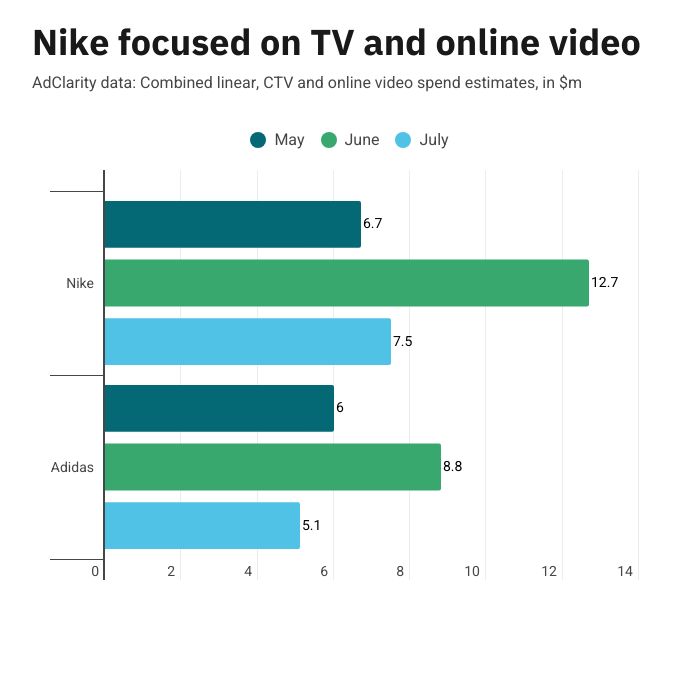
AdClarity figures shared with Digiday showed that Nike spent more than Adidas on broadcast TV. While TV investment for both peaked in June (covering the bulk of the tournament’s games), Nike spent an estimated $29.6 million to Adidas’ total $19.9 million.
Collectively, brands spent at least $857 million on broadcast TV and streaming ad inventory, according to MediaRadar. Bank of America led the pack with an outlay of $21 million; Verizon, Modelo, Home Depot and Wells Fargo also spent big amid a doubling of U.S. broadcast ad spend throughout the tournament.
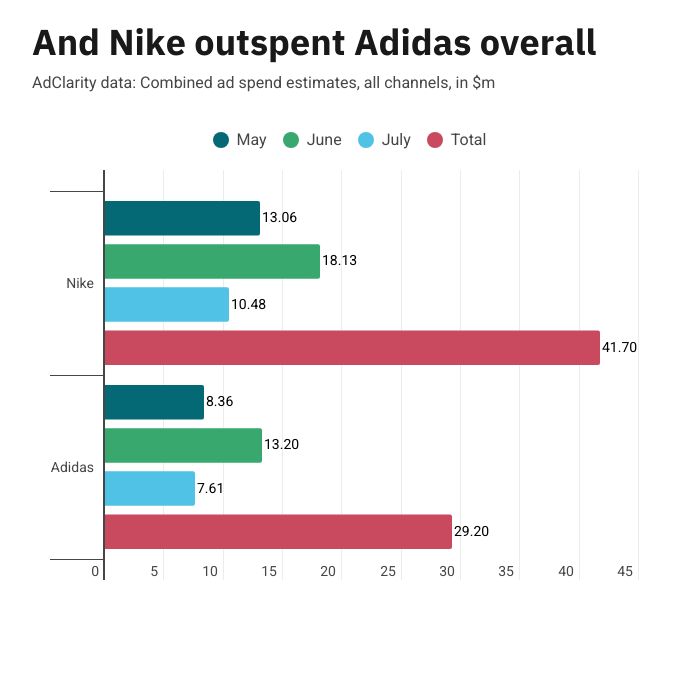
AdClarity’s figures show that in overall media spending, including both company’s flagship campaigns and other World Cup marketing efforts, Nike won out.
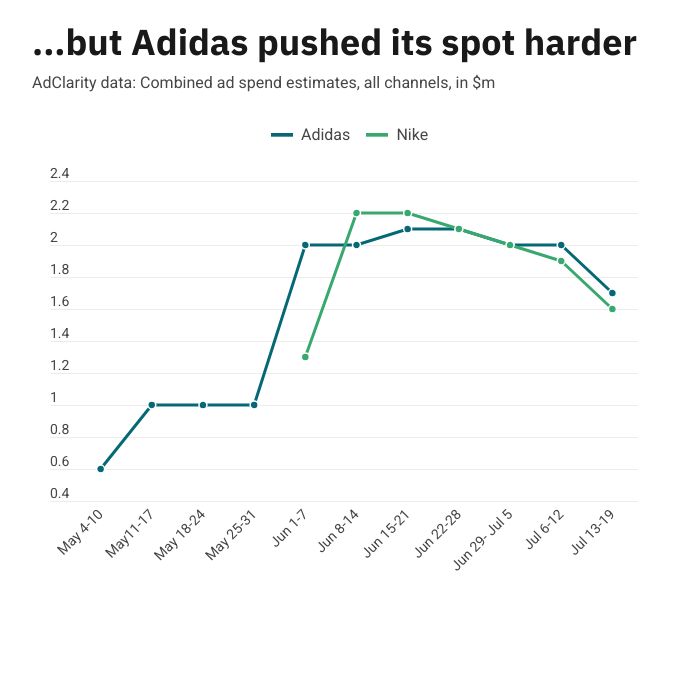
Partly, this reflects the German brand’s decision to kick off its World Cup run about a month earlier than Nike, though it also reflects its status as an official FIFA sponsor. With that placement providing hard-working TV and video exposure, Adidas could afford to concentrate firepower on the star-studded spot in more targetable environments, while Nike chose to diffuse its budget across a broader range of activity.
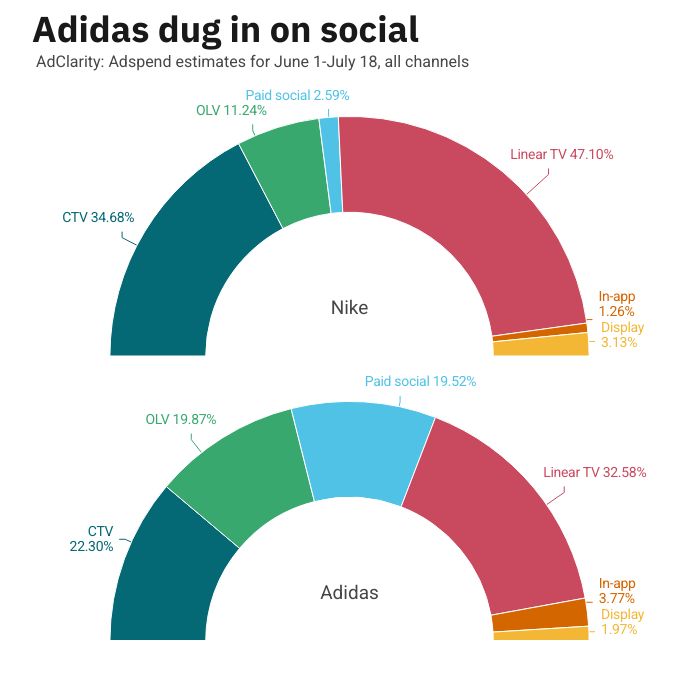
It’s a trend we caught last week, but one that held true for the entire tournament: while Nike focused on streaming and linear TV, Adidas leant into paid social platforms like Instagram and TikTok, and into online video like YouTube.
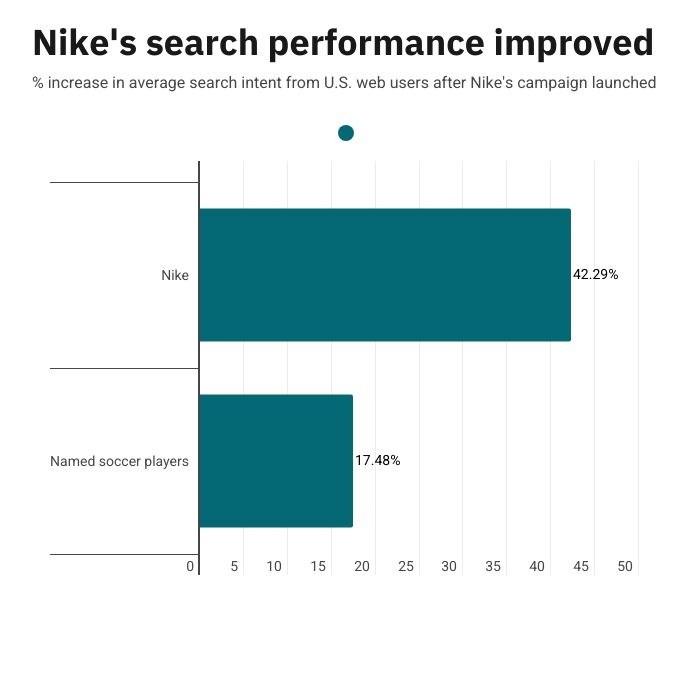
A buzzy brand awareness campaign can still drive commercial intent, it seems. According to Verve, Nike’s brand campaign outperformed searches for specific soccer players in the four days after its launch, with a 42% increase in search intent registered among U.S. web users.
Data from Captify suggests that, over the course of the entire tournament, Adidas also saw a respectable search lift 9% above its pre-World Cup baseline. Other sponsors, such as Dove Men+Care and Verizon, fared better with search uplift increasing by 8.49 times in the case of the former.
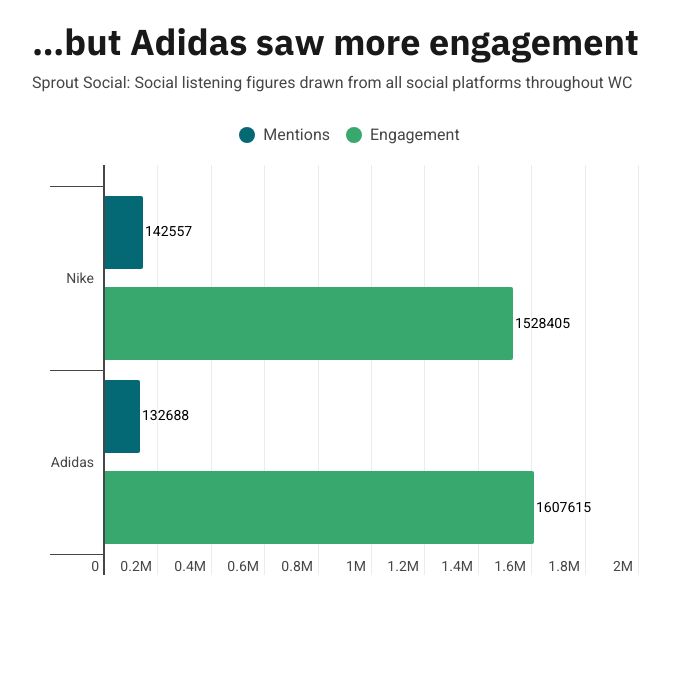
Social listening data from Sprout Social shows that Adidas just about edged Nike for user engagement with its campaign material, despite a lower absolute volume of brand mentions. More importantly, Nike enjoyed an 82% average positive sentiment from those mentions and engagements, against Adidas’ 87%. The German brand’s work hit harder, it seems.
Furthermore, according to Meltwater, Adidas was the most “consistently visible” brand among official sponsors, accounting for 17.1% of the social posts that mentioned partner brands compared with McDonald’s 14.4% and Coca-Cola’s 10.7%.
The end of the month will bring proof as to whether Adidas marketers converted that engagement into revenue. What’s clear now, however, is what the stock market makes of each company’s performance. Despite a bump when it revealed its latest earnings, Nike’s share price is 5.8% lower at the time of writing than it was at the World Cup’s beginning. Adidas, meanwhile, is up 4.7%.


More in Marketing
‘Mission and capital can coexist’: Golden State Valkyries’ Jess Smith on pitch to sponsors
The WNBA’s newest team must navigate measurement demands and marketers wanting to share in the ‘mission’ if it’s to establish a commercial foothold.

Future of Marketing Briefing: Why top creators are taking fewer brand deals
The biggest creators are cutting their brand rosters and asking more of the partners they keep.
‘There’s nothing wrong with being a heritage brand’: How Revlon is updating its image by looking to the past
Revlon named musician and actress Teyana Taylor and country music star Megan Moroney as the faces of its “Revlon Be Unforgettable” campaign.