Join us Oct. 26-28 in Newport Beach for the Digiday Media Buying Summit
In Graphic Detail: The real impact of creators at the World Cup
The 2026 FIFA World Cup is over, and the impact of content creators (and how brands and platforms leveraged them) is clear. For perhaps the first time in the tournament’s history, creators were given unprecedented access to games, players, and other FIFA-related events through YouTube and TikTok’s unique platform partnerships with FIFA, while official sponsors leveraged their massive audiences to push products to a younger audience.
Some even called the tournament the Creator World Cup. Creator-led content outperformed celebrity endorsements (with successful activations from Kalshi, Polymarket, and Airbnb), YouTube and TikTok’s unique partnerships with FIFA proved successful, and mega creators brought their young fans to watch the storied tournament in droves with alternative broadcasts and coverage across social media, according to data from the platforms and analysts.
Let’s look at how creators showed up at this year’s World Cup.
Creator content outperformed celebrity endorsements
(Source: Nectar)
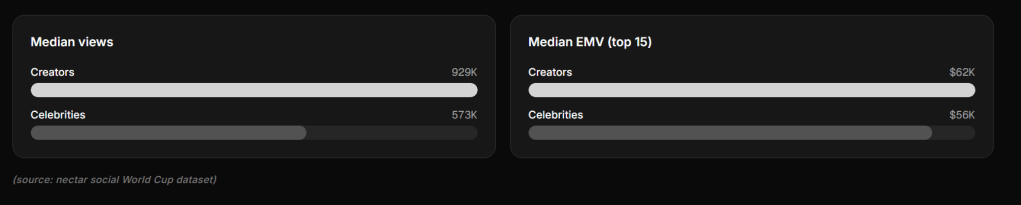
Nectar, an agentic community management and social listening platform, pulled together a World Cup Data report across TikTok, Reddit, and Instagram partnerships, which paints a clear picture: Creator-led content dominated the tournament.
The report states that 10 out of the top 15 posts by EMV were creator-led content, outperforming celebrity endorsements. The median views for top-performing sponsored posts by creators were 929,000 compared to celebrities’ 573,000. And creator content’s median value was $62,000, more than the average value of celebrity-endorsed content, which sat at $56,000.
“Creators often serve as a strong distribution layer; celebrities can remain a powerful moment inside that distribution, but their reach is not always as reliable,” said Misbah Uraizee, CEO of Nectar.
The company identified a few brands whose creator content helped them stand out, like Kalshi’s work with a viral sports-betting creator that earned 126 million views on its top post, Polymarket’s partnership with a small but trusted voice in the betting space (that garnered 2 million views), and Airbnb’s decision to use a feel-good creator’s proven content format to get 1.3 million likes.
Young creators drove World Cup conversation
(Source: Lumen by Talkwalker)
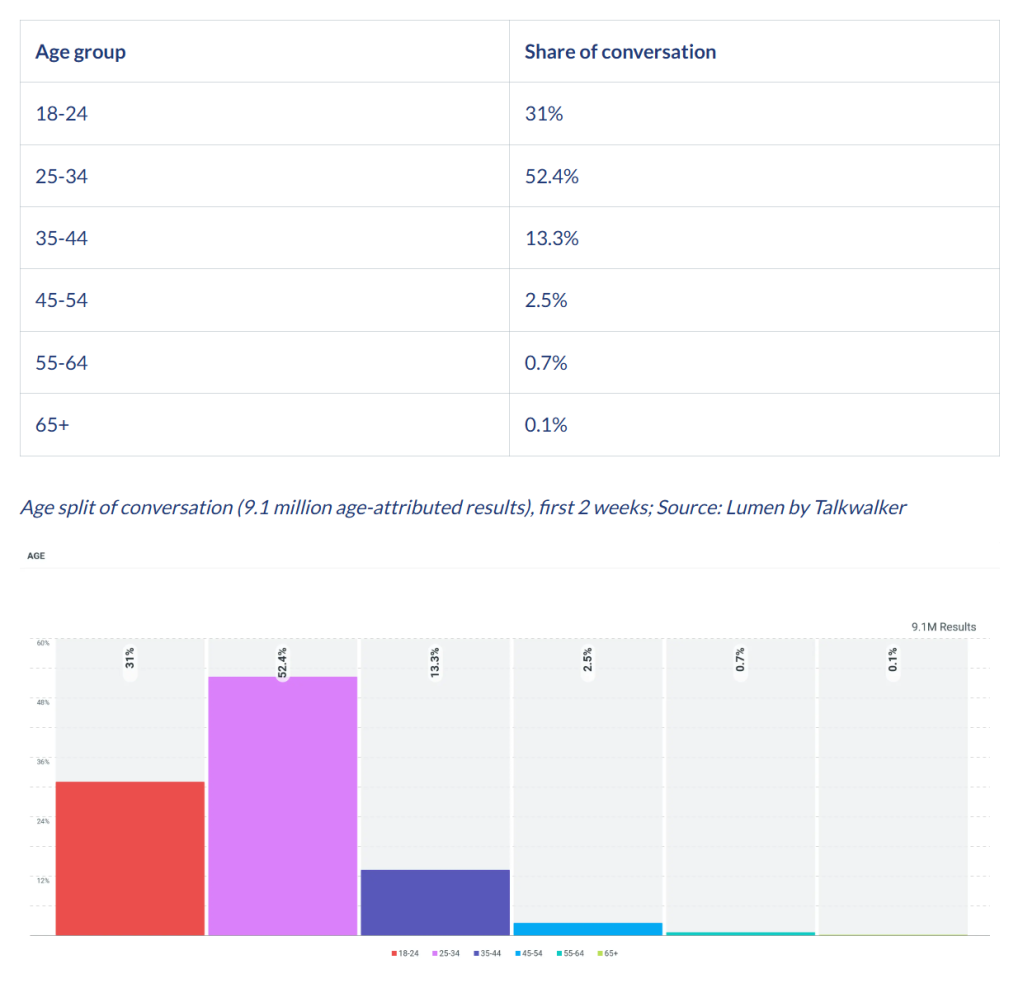
According to metrics from Lumen by Talkwalker, the large majority of FIFA conversation drivers were young adults, with those aged 25 to 34 driving the majority of the conversation early in the tournament at 52.4%. The next highest conversation drivers were 18 to 24-year-olds at 31%, with the online participation dropping off a cliff after 34.
This falls in line with the growing trend in which Gen Z fans of sports are becoming interested in them through fan-created content, according to the Acceleration Community of Companies, an independent collective of culture-driving marketing, media, and communications agencies.
“For previous generations, the game was the front door to fandom. For Gen Z, it’s often the last stop,” said Monica Chun, president of ACC. “Young fans aren’t necessarily falling in love with the sport first. They’re falling in love with the athlete, the story, the creator, the controversy, or the community around it. A celebrity relationship or a TikTok video can be just as powerful as the game itself. Sports used to create culture. Increasingly, culture is creating sports fans.”
Unsurprisingly, everyone loves IShowSpeed

(Source: Lumen by Talkwalker
Those young viewers were tuning into their favorite creators in droves — like Darren “IShowSpeed” Watkins Jr. who was undeniably the number one creator at this year’s World Cup. Watkins Jr. had his own dedicated stream on Fox’s platform, a presence at almost all the major games, and a musical performance during the final game. According to Lumen by Talkwalker, in the month leading up to the tournament’s closing ceremony, the streamer racked up an impressive 410,000 mentions around his involvement with FIFA, generating over 46 million engagements.
Execs with ISpot and Tubular labs told Digiday that, as of World Cup semifinals, IShowSpeed’s recap of the Argentina/Cape Verde match on Instagram was the most-seen World Cup video at the time, amassing 202 million views in just three days. IShowSpeed and Belgian creator Celine Dept were two of Instagram’s top three creators making World Cup content, with over 700 million views across their videos.
YouTube’s partnership paid off
(Sources: YouTube, The Athletic)
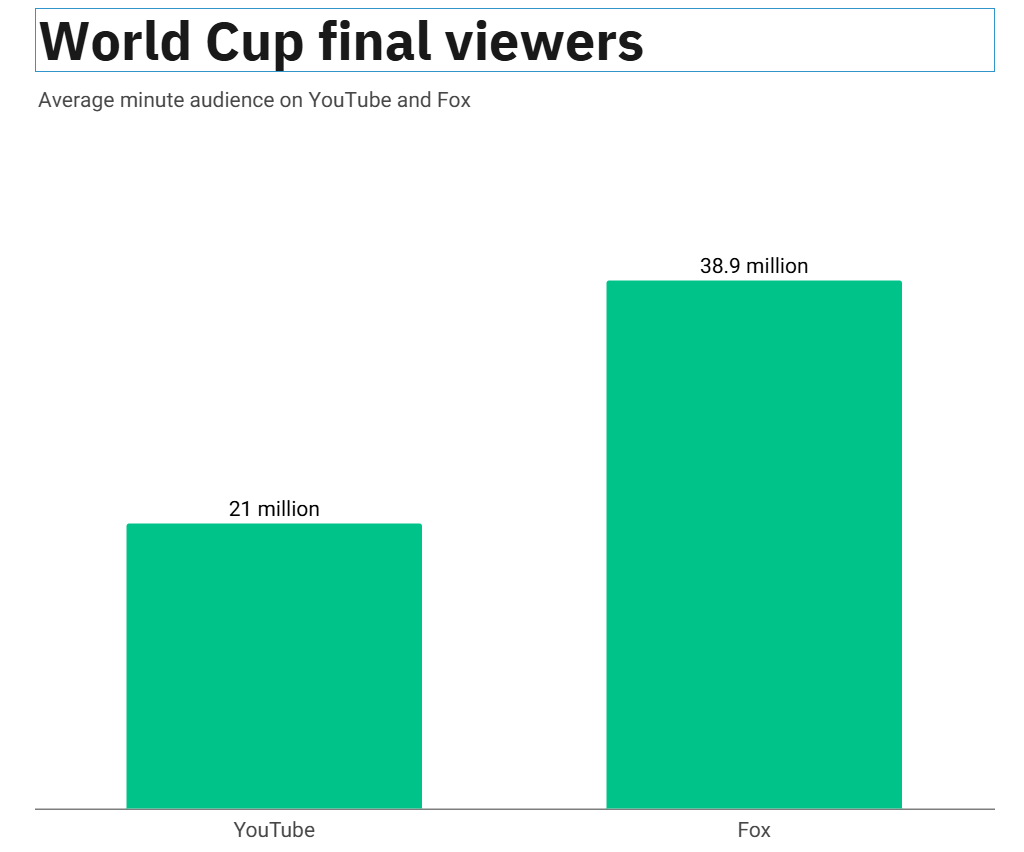
This March, YouTube announced it was officially partnering with FIFA as a preferred platform for streaming the World Cup, offering new angles and 360 coverage of the tournament. Now it’s clear that the game-changing partnership paid off: The AMA for the World Cup final on YouTube was 21 million viewers, while Fox reported 38.9 million average viewers (and 51.7 million peak).
“Overall, more than 1.7 billion unique viewers globally watched World Cup-related videos on YouTube during the FIFA World Cup 2026,” reads YouTube’s July 21 blog post, which also reports over 550 million people tuned into the platform on their TVs.
Much of this content was driven by its “global roster of creators” like IShowSpeed, who brought their fervent fanbases to football. Together, YouTube’s creator roster has 350 million YouTube subscribers and they accumulated over 2.5 billion views on their World Cup-related videos.
Streamers at the World Cup may have given sports and brands a brand new blueprint for broadcasts that we could see utilized in regular leagues and in future tournaments.
TikTok’s World Cup hashtags drew billions of views
(Source: Crawlora)
TikTok went big at this year’s World Cup, partnering with FIFA to send 30 creator correspondents to games to create content from the sidelines after a successful partnership at the Women’s World Cup a few years earlier.
“The FIFA World Cup 2026 has been the biggest content moment we’ve seen on TikTok, and it shows how fans experience global sporting events differently on our platform,” said Rollo Goldstaub, global head of sport, TikTok. “People aren’t only watching highlights, they’re watching reactions, tactical breakdowns, behind-the-scenes access, and fan perspectives from around the world. Those different entry points make the sport more accessible, particularly for newer or more casual fans, and reflect the creativity and energy fans bring to TikTok every day.”
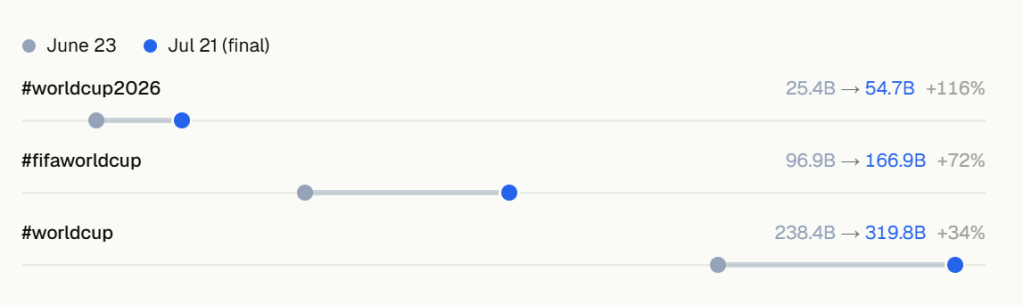
Tony Wang at Crawlora showed just how much hype TikTok was able to drum up throughout the tournament, and how it grew exponentially from kickoff to the July 21 final. The dedicated World Cup hashtag more than doubled in views (25.4 billion to 54.7 billion, a 116% increase) with #fifaworldcup nearly doubling, as well (a 72% increase). “The World Cup happened, and TikTok’s tournament-specific conversation compounded accordingly,” Wang wrote.
A TikTok spokesperson told Digiday that sports commentary creators on the platform saw their follower growth rate increase 3X during the tournament.
According to iSpot and Tubular Labs, creators generated over 70% of World Cup-related video views across YouTube, Instagram, and TikTok. They were making the majority of content, and with their massive audiences, they were driving the majority of views.
“This year’s World Cup wasn’t just the most-watched on TV, it was an enormous event on social video as well,” said Jill Nicholson, CMO of Chartbeat. “While FIFA still successfully generated its own content throughout the event, the bigger win was how it activated with popular soccer creators who helped bring the games to audiences globally, in a way that felt relatable to fans no matter how familiar they were with the sport.”


More in Media
Ad industry tallies early losses from Apple’s Safari tracking block
A week after Apple’s Safari block, the ad industry is still waiting for the other shoe to drop.

Welcome to Creator University: Inside the colleges building creator economy programs
As more young folks seek to enter the creator economy, universities are offering classes covering every layer of the still-growing ecosystem.
For some publishers, agentic advertising is still a question of ROI
Despite the hype around agentic media buying, some publishers remain skeptical of its potential to deliver meaningful revenue.