Join us Dec. 1-3 in Nashville for the Digiday Programmatic Marketing Summit

The latest quarterly earnings calls for the ad tech sector are largely over for the latest reporting period, with bluster over yet more senior departures at The Trade Desk, and AppLovin’s continued rise (generating nearly $2 billion in Q1) dominating Q1 headlines.

Such numbers pale in comparison to the AI-fueled earnings increases of Big Tech, arguably the top tier of the media jungle, but upon initial inspection, the majority of this 12-strong cohort of companies, all of which issued their earnings over the last 14 days, posted increases.
However, three posted annual revenue declines — see chart below — with executives’ effusive soundings on the prospects of making their businesses agentic, equally prompting queries about whether AI will erode the stickiness of their company’s platform?
Evidently, Teads continues to experience a rocky start a year after its leadership publicly aired its investment thesis of pairing Outbrain’s performance-driven wares with Teads’ premium potential. However, after disclosing a 7% year-over-year revenue decline, analysts questioned whether AI would erode the historical separation between upper- and lower-funnel media.
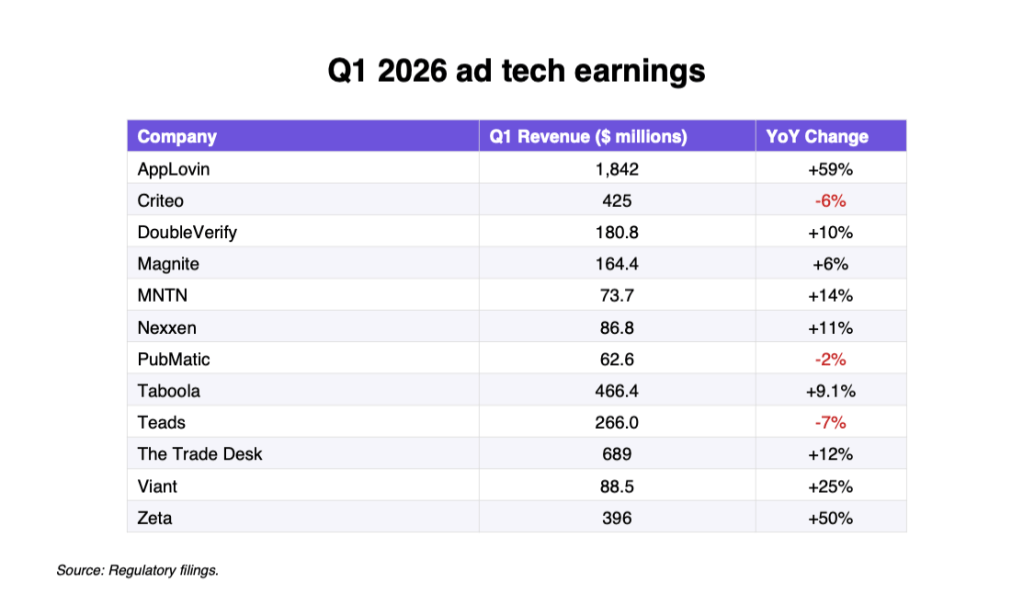
Meanwhile, Criteo’s leadership forecast a return to growth by the close of the year after it saw a lag in retail media spend, resulting in a 6% slump in revenues for the period, with analysts questioning whether self-serve AI workflows reduce agencies’ operational dependence on — a key consideration for Criteo.
Such queries were directed toward the leadership of all firms, with Magnite and Criteo executives quizzed on whether it would compress their take-rates.
However, predictably, executives elsewhere were able to give a glass-half-full appraisal of AI-driven labor displacement, with Criteo’s leadership trumpeting its integration with ChatGPT. Other examples of greenfield opportunities include: PubMatic boasting 1,000-plus AI-powered deals, Viant’s autonomous outcomes efforts, Taboola’s AI Answer engine, and DoubleVerify talking up AI-slop stopper adoption.
CTV
Despite such executive assertions, few definitive examples of genuine AI-generated revenue were evident, although Criteo claimed it expects to provide revenue guidance on its OpenAI partnership next year. However, what was clear from all 12 earnings reports is that CTV is the highest-quality growth segment on the open internet.
For example, Viant’s CTV ad revenue is now more than 50% of spend on its platform, a statistic that is likely driving its purchase of TVision, while online video spend, including CTV, on The Trade Desk accounts for more than half of spend on its platform.
Similarly, Magnite cited CTV as the biggest driver of its business, while MNTN claimed there was a notable uptick in SMBs using its platform for such buys, although this growth rate may slow as large platforms such as Meta and Pinterest lean into the opportunity.
Margin erosion?
Overall, the outlook was relatively positive, with half of the companies in the cohort raising their forecasted revenues, either for Q2 or full-year 2026. However, a notable development over the period was the perception that The Trade Desk’s Q2 revenue forecast ($750 million) was “soft,” and the company’s stock decreased notably in the aftermath of the May 7 call.
The general perception has been that conflicts over margin control, whether with holding company agencies or their traditional supply-side partners such as Magnite and PubMatic, have been indicative of a shrinking addressable market.
After all, PubMatic’s leadership noted how a falling out with an (unnamed) demand-side platform turned what would have been a 13% Q1 revenue gain into a 2% revenue-dip. Some have even wondered if this is a harbinger of a coming consolidation in the market.


More in Media Buying

Ad Tech Briefing: Stagwell’s Freestar deal brings buying and selling under one roof
The acquisition expands the holding company’s publisher monetization business, making fees, incentives and inventory selection a test of transparency.

Stagwell buys Freestar, putting publisher ad sales inside a holdco
Publishers have long wished agencies would put their money where their panel talking points are. Stagwell has done something adjacent.

Midterm political spending throws spanner into regional advertiser holiday plans
Rising political ad spend is making life harder for regional and local brands hoping to use CTV ads to reach consumers in Q4.