Join us Dec. 1-3 in Nashville for the Digiday Programmatic Marketing Summit
The Trade Desk’s $689M revenue beat is blunted by the departure of CSO Jacobson to OpenAI

The Trade Desk’s Q1 revenues of $689 million may suggest holding-company spats are a mere bump in the road, but confirming the exit of CSO Samantha Jacobson hours before its market disclosure shows complications can come from all directions.
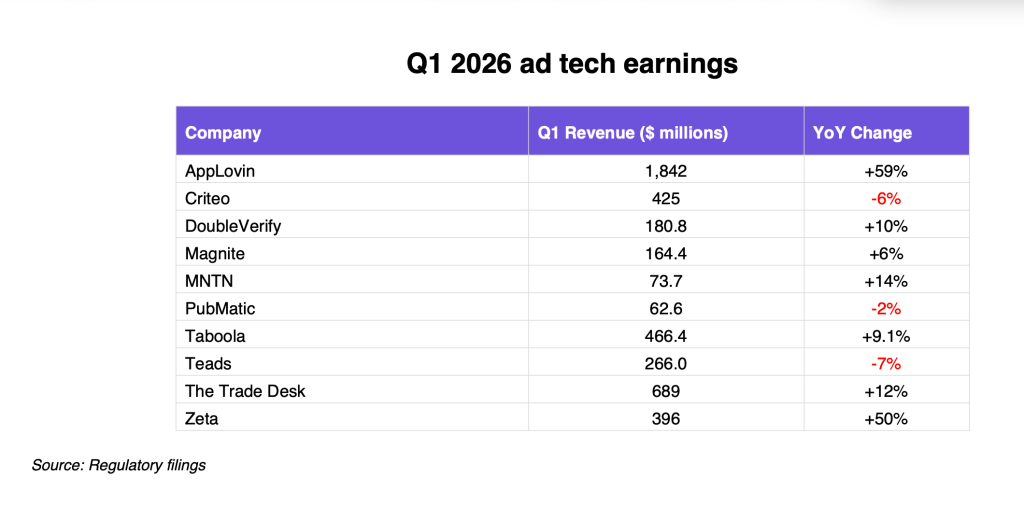
The demand-side platform’s earnings release came as supply-side platform PubMatic reported revenue of $62.6 million for the period, while The Trade Desk also forecast Q2 revenue of “at least $750 million.” This capped off a seven-day window when most of the leading publicly traded entities in the space likewise issued their Q1 results (see table below).
The company reported momentum in its CTV, retail media, and data-driven buying offerings, citing integration with Dollar General, LinkedIn, Netflix, PacVue, and Skaai, as well as the recently launched agentic planning tools within its Koa platform.
However, in the hours ahead of the May 7 announcement, The Trade Desk confirmed to Adweek that Jacobson, who has been with the company for five years, managing its strategic investments and partnerships, will depart for OpenAI, although she’ll retain a seat on the company’s board of directors.
The nature of Jacobson’s pending role at the company behind ChatGPT was unclear as Digiday went to press, with news of her exit quickly following the departures of several senior executives, including its CMO, in recent weeks, a move the DSP characterized as a “changing of the guard.”
In prepared remarks to equities analysts, The Trade Desk CEO Jeff Green claimed, “March was our biggest month on record for JBP [joint business plan] signings [45 in total]…,” adding that such arrangements – a key pillar of its growth strategy since last year – with brands continue to grow.
“New JBP deal spend grew 40% year over year during the quarter,” he added. “Most great marketers have JBP or MSAs [master service agreements] directly with their buying platform, but they also have clear models of engagement with their agency partners.”
However, such direct relationships with brands are understood to have introduced tensions with traditional trading partners, and many parties understand that these moves helped brew recent tensions with the industry’s largest media-buying holding groups.
The Trade Desk leadership was keen to point out its continued high customer retention rate (over 95%), with Green characterizing coverage of these tensions as overblown when questioned by analysts on the company’s subsequent earnings call.
“We continue to have great dialogue with Publicis about the next chapter of our partnership. Our negotiations are ongoing; it’s probably not prudent for me to say more about it in this forum,” he added.
A separate analyst query centered on the DSP’s Q2 revenue forecast – the $750 million figure was characterized as a “revenue deceleration” by participants on the call – and whether these spats prompted this guidance. However, The Trade Desk downplayed this notion, with executives citing macroeconomic fluctuations as prompting “unique challenges” for the market overall.
While the company’s subsequent earnings call was addressed directly to Wall Street investors, Green made remarks that may resonate more with Madison Avenue practitioners, particularly those who balk at its comparatively lofty pricing.
Additionally, he underlined his thesis that “cheap reach” – one of the key selling points of the industry’s walled gardens – was a ruse that some marketers are starting to come around to, with the CEO taking aim at Amazon’s pitch to market in particular.
“The best CMOs in the world are focused on the question, ‘How do I grow?’ Not, ‘How do I cut costs?’… they know that quality and cheap tend to have very little overlap,” added Green. “Chasing cheap reach is one of the biggest landmines a CMO or digital marketer can pursue.”
From here, Green went on to cite a recent bake-off between The Trade Desk and the e-commerce giant’s DSP after the marketing team concerned was “lured by seemingly low rates.” The concerned brand then moved spend from The Trade Desk to Amazon, although his outfit later won the business back, according to Green.
He added, “Our pharma team recently went head-to-head against Amazon for one of the largest pharmaceutical advertisers… our team won back the business and signed a JBP for 2026 that will increase their spend on our platform by 114% year over year.”


More in Media Buying

Addressability is back as a headline concern for attendees at this year’s Prebid Summit
Speakers decry ‘UMPs’ as the new ad networks, with talk far outweighing understanding.

Publicis is selling directly to AI-anxious CEOs as it steps away from traditional pitches
Publicis boss Sadoun says agency group is skipping CMOs in more new business pitches, as Groupe notches up new business wins.
Ad Tech Briefing: Zeta goes big as Apple casts a shadow over Advertising Week
Advertising Week New York saw more ad tech M&A, plus, the rise of the “universal buying platform.”