Join us Dec. 1-3 in Nashville for the Digiday Programmatic Marketing Summit
Media Briefing: Publishers are selling more subscriptions to smaller audiences. The midterms are the next test.

This Media Briefing covers the latest in media trends for Digiday+ members and is distributed over email every Thursday at 10 a.m. ET. More from the series →
This week’s Media Briefing looks at how publishers are gearing up to turn U.S. midterm election interest into paying subscribers as declining referral traffic raises the stakes for building direct reader relationships.
- The midterms subscription test
- Norwegian publishers sue Meta, Vox launches a mobile app and more
The midterms subscription test
Election season is a familiar subscription play for news publishers. With the U.S. midterms a week away, they’re looking once again at how to turn renewed political attention into paying readers.
Some publishers have been in midterm planning mode this week, with execs meeting to map out their approach. But the playbook has changed: declining referral traffic has raised the stakes for converting election audiences into lasting subscriber relationships that can drive direct reader revenue and help insulate publishers from the changing digital publishing environment.
“Growth depends on attracting and converting casual readers, and that is getting harder,” said Greg Piechota, researcher-in-residence at INMA. “Social media and search send fewer people to news sites every year. A big news event is one of the few remaining moments when casual readers come to a news brand on their own, so what happens in those weeks matters more than it used to.”
Declining referral traffic may make it harder for publishers to reach casual readers, but the picture isn’t all bad. Even when site traffic shrinks for publishers, subscriptions can still grow, Piechota noted.
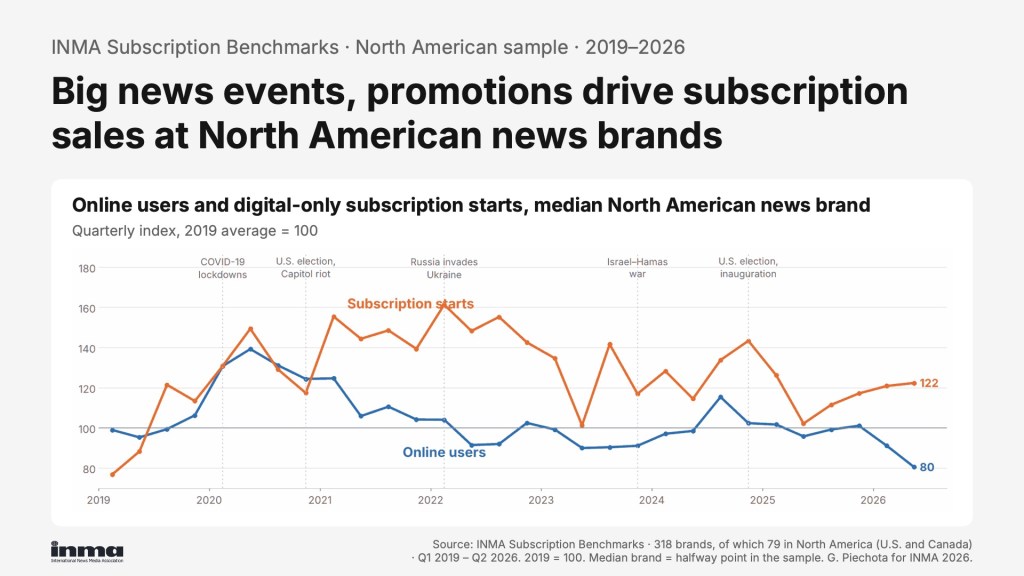
The typical publisher worldwide now reaches a fifth fewer people a month than in 2019. And in North America, a fifth fewer than at the 2024 election peak. However, the typical publisher sells 50% to 85% more subscriptions a quarter than in 2019, to that smaller audience, he said.
Case in point: On Monday, new subscriptions rose 50% at Reuters, primarily in the U.S. and around coverage of the Brazil election and from Reuters’ live blog, said Josh London, head of Reuters Professional, who oversees the direct-to-consumer and direct-to-professional businesses. Reuters launched its paywall two years ago.
“We expect a similar pattern around the Israel election this week. That demand for fast, reliable coverage for the U.S. midterms, we would expect to be a driver as well,” London said.
While Reuters is not making any changes to its dynamic paywall, London said it is bolstering its coverage with a U.S. newsroom expansion (including new hires to its White House, national security and investigative teams), a content bundle partnership with the USA Today Network, polls from an Ipsos partnership, and a Washington D.C. “war room” covering key races.
“Always, but especially with elections, readers turn to Reuters for trusted, unbiased election news at speed, and that trust and that independent, non-national coverage translates into new subscriptions,” London said.
The last 2024 U.S. presidential election did move sales in North America: the typical North American publisher sold 43% more subscriptions than in 2019, and 17% more than in the 2020 election quarter, according to INMA’s analysis of 3,018 news brands, 79 of which are in North America.
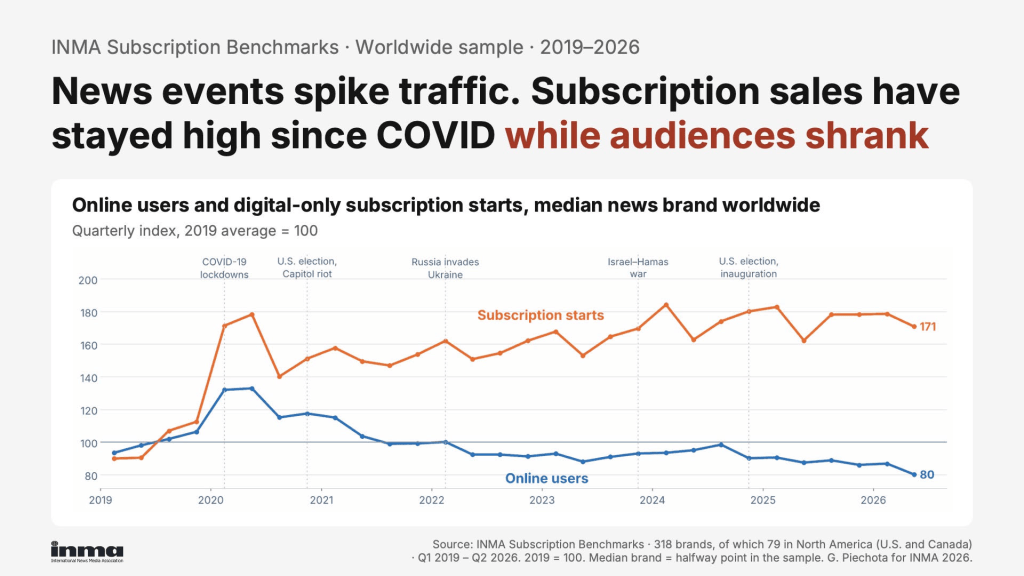
Strong news brands remain best positioned to attract subscribers during major news events, with national and metro publishers in North America growing their subscriber bases by roughly 10% in 2024, in line with the global average. Large regional newspaper chains struggled to retain subscribers acquired through election-related promotions, contributing to a 16% decline in the typical North American publisher’s subscriber base from its early 2024 peak, according to Piechota.
Regardless, as AI reshapes how readers encounter information, publishers are betting that trusted election coverage can give them a reason to come directly to news brands, and keep coming back.
A tried-and-tested tactic established subscription businesses have long relied on adjusting paywalls around major news events to open up coverage and reach more readers, or tightening access to drive subscriptions.
The New York Times is taking the open-access route once again: it has made its midterm election coverage free in The Times app, with no paywall until the results are clear, a Times spokesperson told Digiday. Readers who download the app get access to the Times’ reporting, explainers and poll trackers. While not specifically a subscription conversion initiative, the idea is to draw in readers interested in following midterm election coverage and retain them.
Politico is rolling out a unified mobile app globally today, bringing its free and subscriber-only coverage together in one place. The new app replaces the two apps Politico previously offered (one for the U.S. and one for Europe).
“The midterms give us an opportunity to demonstrate why Politico’s journalism matters to the people who rely on it for their work, both in the lead-up to election night and long afterwards,” said Cally Baute, chief commercial officer at Politico. “We want people who discover us through election coverage to understand the value of that specialist intelligence in the decisions they make every day.”
On Nov. 3, five of Politico’s top political journalists will provide live election analysis on the publisher’s website, app and YouTube.
“We’ll carry that approach into other consequential elections, including France’s presidential contest in 2027. Our investments in journalism and technology are designed to make our original reporting more useful to readers and demonstrate why a subscription remains valuable long after the results are in,” Baute added.
For newer subscription businesses, like The Hill and CNN, the midterms are a chance to test what works and what doesn’t when it comes to converting election interest into paying subscribers.
The Hill, which launched its subscription this summer, has rolled out new subscriber-only interactive election tools to give readers more reasons to pay. The Hill’s subscribers can now access its Decision Desk HQ’s election data tools, as part of an expansion of its longstanding partnership with the election data and analytics company. Subscribers can dig into polls, local races, prediction models and other election data.
CNN, which launched its digital subscription All Access last year, has expanded its offering to the U.K. and Canada ahead of the midterm elections. The news org sees elections as a “major subscription driver,” according to a person familiar with CNN’s strategy. While they declined to share details, they noted that CNN has executed a full marketing campaign across most of its consumer touchpoints, and has been working to drive up subscriptions since earlier this year around the primary elections.
Meanwhile, The Wall Street Journal is also using Doppler News AI to track trends across millions of social videos, podcasts and news segments, helping journalists surface voter concerns traditional polls might miss, and giving subscribers a richer picture of what’s shaping the race.
Naturally, the real test will come after election night: whether readers who came for the midterms have a reason to stay.
“The election is the hook, not the habit. The work after a political spike should be focused on breadth: onboarding that steers people to other news, sport, lifestyle and newsletters, and the bundled non-news products, such as games,” Piechota said.
What we’ve heard
“We haven’t heard anything back from them yet.”
– A News/Media Alliance spokesperson on whether Meta CEO Mark Zuckerberg had responded by the Oct. 26 deadline given in the org’s letter requesting the company withdraw changes to its terms of service, set to take effect Nov. 20.
Numbers to know
625%: The growth in People Inc.’s social-video sponsorship revenue year over year.
More than 75%: The Hill’s trial-to-paid subscription conversion rate.
49.1%: Politico’s year-over-year audience decline in September.
20%: Decline in publishers eCPMs on Macs following Apple’s restrictions, according to Aditude.
36%: The decline in Vox’s year-over-year website audience in September, while social video views grew 86%.
What we’ve covered
DMG Media’s social-only briefs account for 30% of New Media revenue
- Just one year after launching its New Media division, DMG Media is seeing its investment in social-first content pay off. Campaigns sold exclusively on social platforms now account for 30% of the division’s revenue, creating a new revenue stream that didn’t exist a year ago.
- DMG Media is leaning into creator-led content to attract younger audiences and advertisers, employing 25 in-house creators who appear in 90% of branded content. Integrating creators has boosted engagement by 50%, according to the company.
Read more here.
The Hill adds interactive election tools to subscription offering ahead of the midterms
- The Hill is adding subscriber-only election data tools and exclusive coverage ahead of the Nov. 3 midterms, hoping to capitalize on heightened interest in political news to grow its new subscription business, Hill Insider.
- The push comes as declining referral traffic puts pressure on publishers to build direct, paying relationships with readers. The Hill is betting that premium election tools can help diversify revenue, while laying the groundwork for a sustainable subscription business after the midterms.
Read more here.
In Graphic Detail: What Apple’s identity block means for the ad money
- Apple’s latest Safari privacy changes are blocking identity resolution technologies from companies including The Trade Desk, LiveRamp and ID5, making it harder for advertisers to track and target users across websites.
- The impact is already hitting publishers’ bottom lines: According to Aditude data, ad bid rates have fallen roughly 8% on iOS and 25% on Macs, while revenue per ad opportunity has dropped 6% and 20%, respectively, as the changes roll out.
Read more here.
The Daily Mail tests GEO with brands ahead of AI visibility product
- The Daily Mail is running 12 to 15 GEO tests with brands across the U.S., U.K. and Australia, ahead of plans to launch an official AI visibility product early next year. The publisher is tracking how brands appear in AI-generated answers and creating tailored branded content to improve their visibility.
- In one early test, an unnamed personal finance brand’s visibility across targeted AI prompts increased from roughly 50% to nearly 75%, according to the publisher.
- The biggest challenge remains proving how AI visibility translates into sales. The Daily Mail is exploring ways to measure that impact beyond referral traffic.
Read more here.
Meta’s new scraping terms unite publishers in a global fight over content rights
- Meta’s updated commercial terms, which could allow the tech giant to scrape content from websites associated with business accounts across Facebook, Instagram, WhatsApp and Threads, have sparked coordinated pushback from publishers worldwide.
- Trade groups representing thousands of publishers, including the News/Media Alliance and WAN-IFRA, have demanded that Meta withdraw the changes, warning that they could enable the company to use publishers’ content without permission or compensation. The backlash highlights a growing concern over tech platforms using their market power to dictate how publishers’ content is accessed and monetized.
Read more here.
Creators say it’s difficult to make money from news
- As more Americans turn to social media for news, independent news creators are struggling to monetize their audiences. Brand safety concerns make advertisers hesitant to sponsor political or controversial content, while unpredictable algorithms and content moderation policies — particularly on TikTok — make platform revenue unreliable.
- To build more sustainable businesses, news creators are increasingly turning to subscriptions and paywalled content through platforms like YouTube, Substack and Patreon.
Read more here
Why CNN International is building for agentic ad market that barely exists yet
- CNN International is building infrastructure to sell advertising through AI agents, aiming to generate its first revenue from agent-to-agent transactions in the first quarter of 2027.
- But the market remains largely untested, with competing standards and limited advertiser demand. CNN International is betting on its early investment to capture future revenue, estimating agentic deals could eventually account for 5% to 50% of its advertising business.
Read more here.
What we’re reading
Meta says it will consult publishers before finalizing its new terms
Following mounting backlash over its proposed terms allowing broad scraping of publishers’ websites, Meta has pledged to consult with news industry leaders before implementing the changes, potentially delaying their Nov. 20 rollout, Nieman Lab reported.
Norwegian publishers sue Meta over plans to use their journalism for AI
A coalition of 10 Norwegian media organizations has asked the Oslo District Court to block Meta’s new commercial terms before they take effect, Euronews reported.
Vox launches app to grow paid memberships
Vox has launched its first mobile app, bringing articles, videos and podcasts into one destination, Nieman Lab reported. The app is free to download and videos and podcasts are accessible, but reading articles and listening to podcasts ad-free requires a paid membership.
The Verge plans to launch an app in 2027
The Verge plans to launch an app next year to build a more direct relationship with its audience amid a considerable decline in website traffic, A Media Operator reported.
Axel Springer CEO wanted to buy TikTok’s European arm
Mathias Döpfner, CEO and co-owner of Germany’s Axel Springer, pitched a deal to buy the European arm of TikTok, The Financial Times reported.


More in Media

The Times of London is gearing up to test ‘macro payments’
The Times has a plan for readers who don’t want to subscribe.
Creators are now classified as small businesses, but what does that actually mean?
The Small Business Administration has officially welcomed creators under its umbrella; let’s unpack what that means for brands, creators, and the economy at large.
One year in: DMG Media’s social-only briefs account for 30% of New Media revenue
DMG Media’s year-old New Media division is carving out a new social revenue stream with creator-led IP aimed at younger audiences.