Join us Dec. 1-3 in Nashville for the Digiday Programmatic Marketing Summit
In Graphic Detail: What Apple’s identity block means for the ad money
Apple has reopened its long-running feud with ad tech over who gets to identify people on its devices and so advertisers can serve them ads.
It started when the latest software update for iPhones landed last month and The Trade Desk’s ads stopped loading in the Safari browser. Soon the industry worked out that ID5, LiveRamp, Permutive, Audigent and UID 2.0 were blocked too. The Trade Desk got a reprieve, the identity vendors didn’t and Apple stayed silent while the industry spent Advertising Week New York guessing why. This week, Apple finally came clean. In a blog post earlier this week (Oct. 19), it said the browser now cuts off network access to so-called identity resolution companies — the companies that stitch together separate scraps of data about a person — think email addresses, phone numbers, IP addresses, browsing history and even information about the device someone is using — to recognize and track them across sites and devices.
Nobody can yet say how far the damage spreads and the early fallout already looks expensive for a lot of companies. The charts below set out how the industry got here and what Apple’s move put at stake.
What it’s costing publishers
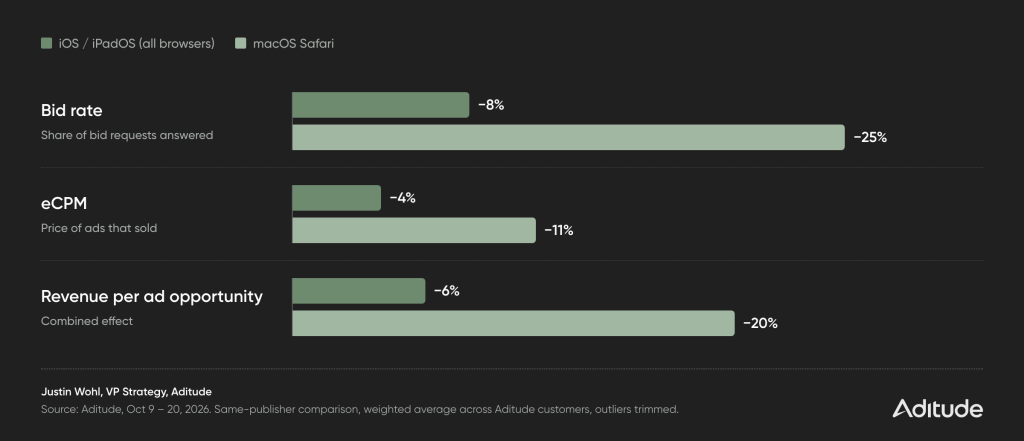
Apple’s block reaches further than the industry first thought and publishers are starting to feel it. Across Aditude’s customers, browsers built on WebKit, which covers Safari everywhere and every browser on iPhones and iPads, account for 30% of ad impressions and 28.5% of ad revenue. Only 3.8% of impressions and 3.3% of Prebid revenue have moved to WebKit so far but adoption grew by half in a week and new iPhones over the holidays will push it higher. Where the update has landed, buyers are bidding less. iOS bid rates fell 14% between September 15 and October 8 and are since down about 8%, while Mac bid rates are off about 25% with no sign of recovery as The Trade Desk’s bidding has yet to come fully back after Apple’s block accidentally caught the ad tech vendor’s ad server — the tech that puts its winning ads on a reader’s screen. Publishers are earning less per ad as a result. eCPMs are down 4% on iOs and 11% on Macs and revenue per ad opportunity has fallen 6% and 20% respectively.
Life after identity
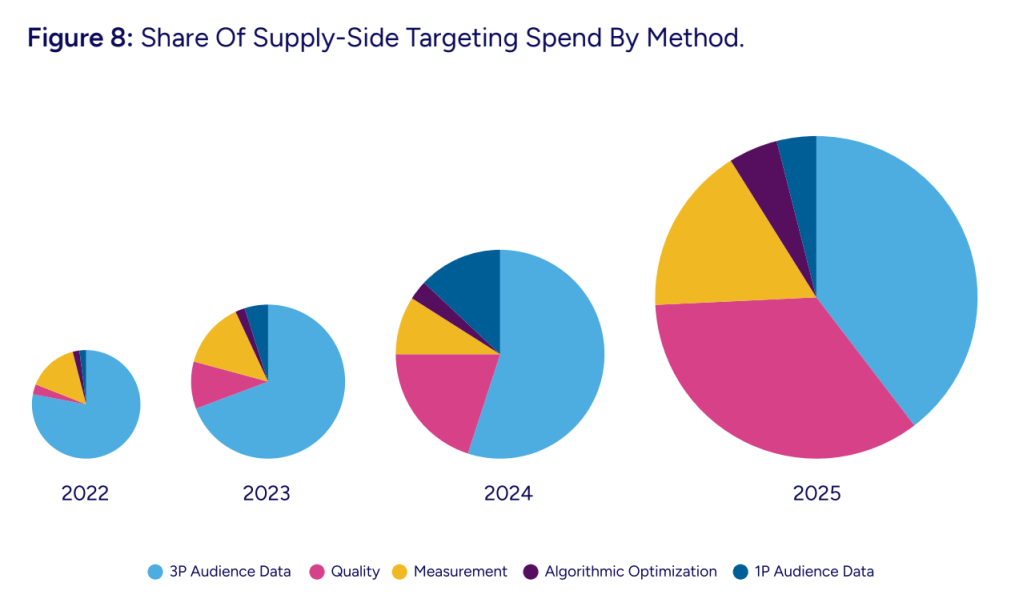
Those losses look set to grow because Apple has show every sign of pressing on. Blocking trackers chimes with the privacy stance Apple has spent years building its brand on. Publishers and marketers who want to stay ahead will have to get comfortable running ads on context and aggregate signals, with far less known about the person on the other side of the screen. OpenX’s numbers suggest that shift is already under way. When buyers in the U.S. targeted ads through its platform in 2022, 78% of that money went on third-party audience data, the segments built from tracking people across sites. By 2025, that share had shrunk to around 40%. Targeting by the content around an ad picked up most of the slack, rising up to 35% on the back of CTV where buyers can now buy inventory based on program characteristics such as show, genre, and rating. First-party data spiked in 2024 while advertisers prepared for Chrome to kill cookies, then slipped back once Google called the whole thing off. Audience data remains the largest share but each year it holds a little less of the budget and what’s replacing it doesn’t depend on knowing who’s watching.
The money IDs never reached
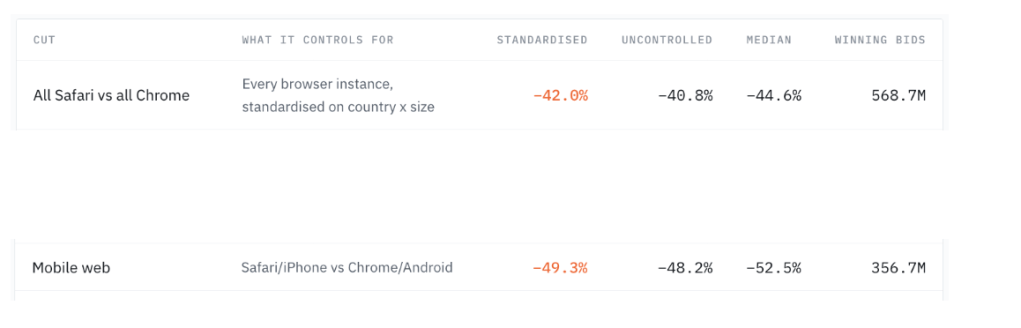
Most of the industry has spent the past month asking how much it costs to lose IDs. Permutive, itself one of the companies Safari blocked, thinks the better question is how many readers IDs ever reached. Inventory without them, which is what Safari traffic looks like, does sell for less. Across more than 10 publishers and 569 million winning bids in August, it traded at an average 42% discount to Chrome, with the gap wider on mobile. But IDs only cover about 30% of the bid stream, according to Permutive, which leaves buyers fighting over a minority of readers and most publisher audiences going unsold. Its pitch is that publishers’ own data can reach the rest. Across more than 80 publishers over 12 months, applying that data lifted CPMs by 76% on direct-sold deals and 32% on private marketplace deals, Permutive’s analysis found. In its telling, Apple is pushing the market in that direction and publishers stand to be better paid for it.
Apple’s ad revenue is growing, albeit slowly
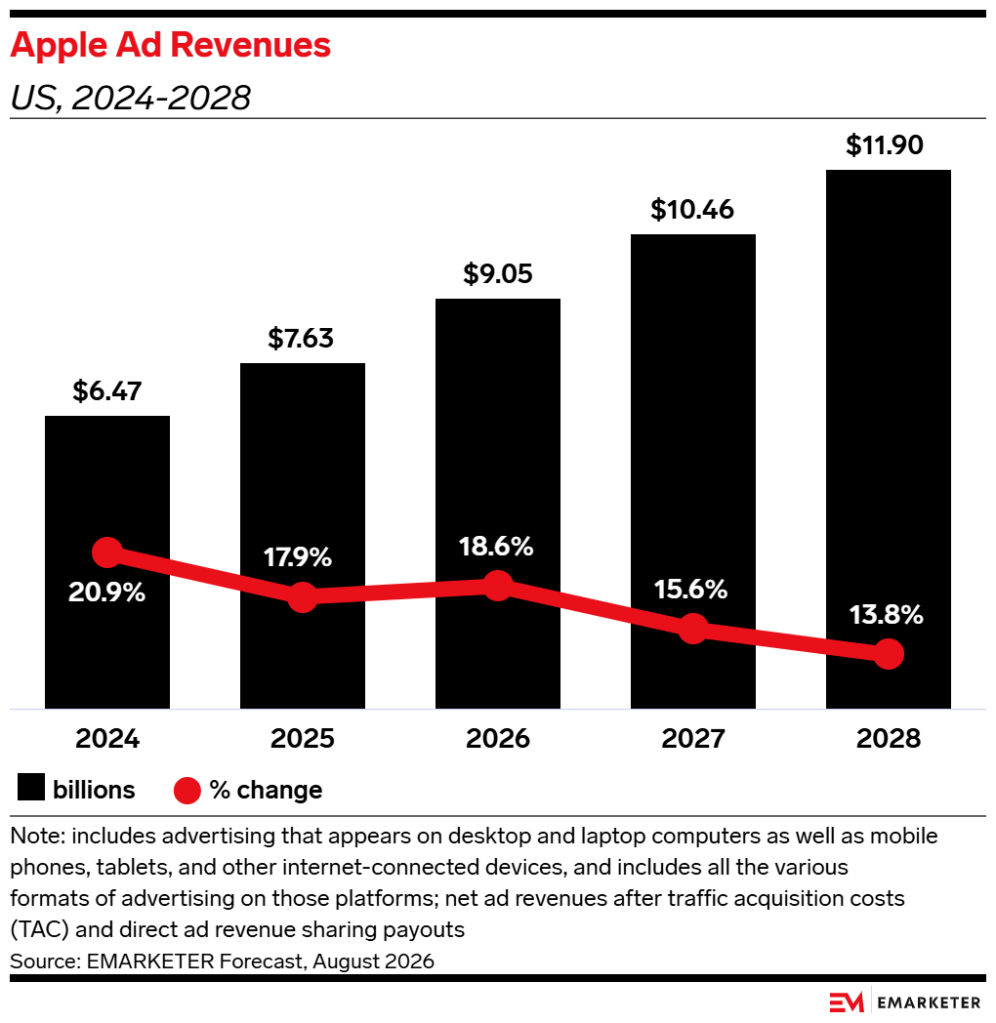
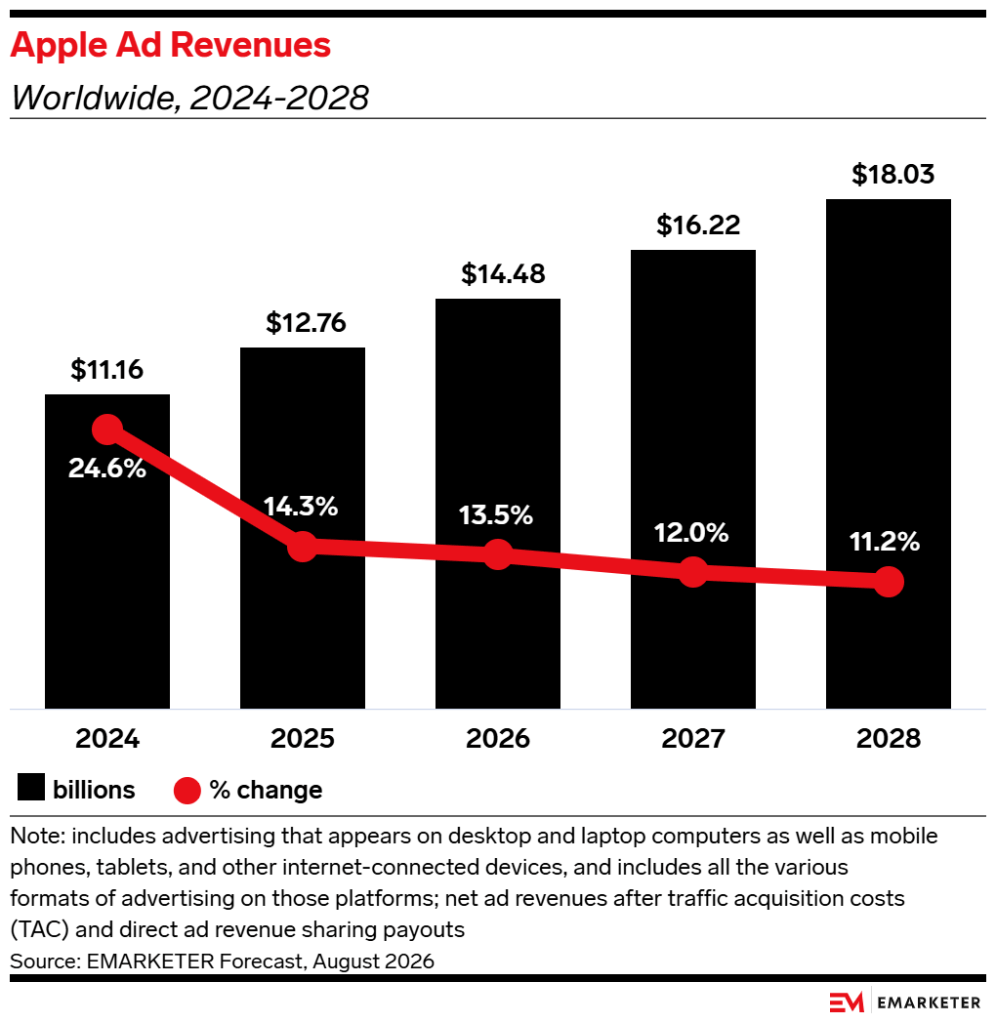
Part of what makes Apple’s crackdown so hard for ad tech to swallow is the suspicion that it clears the way for Apple’s own ads business, which has been growing steadily. In the U.S., for example, the tech giant is expected to rake in $9.05 billion in 2026, according to eMarketer. That figure is set to increase 15.6% to $10.46 billion dollars in 2027, and a further 13.8% increase to $11.9 billion in 2028. More broadly, Apple’s global ad revenue is forecast to reach $14.48 billion in 2026, increase 12% to %16.22 billion in 2027, followed by a further 11.2% rise to $18.03 billion in 2028, per eMarketer.
Why ads matter to Apple
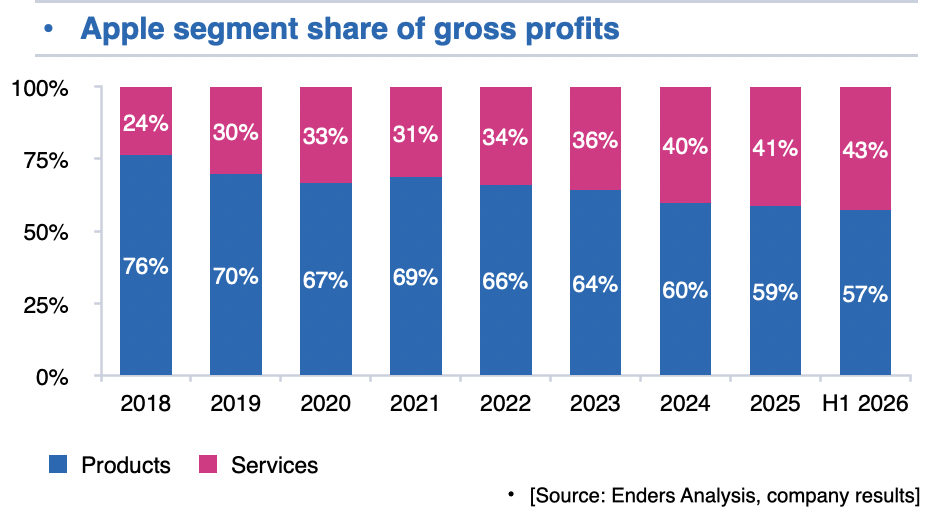
Apple’s ads business matters more than its size suggests because it sits inside services, the part of Apple that now does a lot of the heavy lifting on profit. In 2018, services brought in 24% of Apple’s growth profit, with hardware such as the iPhone delivering the other 76%, according to Enders Analysis. Today services account for 43% and products 57%. Apple doesn’t say how much of that comes from ads but every dollar it makes there adds to the side of the business it most wants to grow.


More in Marketing
Anthropic’s ad bill is soaring, according to IPO filing
Anthropic’s IPO filing shows an ad-free AI company with a fast-growing ad bill.
Salesforce’s $5.7 billion Braze deal puts marketers at an ecosystem crossroads
The deal promises faster, more connected marketing, while raising questions about vendor lock-in and how brands stand out as AI automates campaign execution.
AI boosts discovery but reviews still seal the deal, new research shows
ChatGPT is where 16% of shoppers start looking for products. However, only 9% go there to actually buy something.