Join us Dec. 1-3 in Nashville for the Digiday Programmatic Marketing Summit
This Ad Tech Briefing covers the latest in ad tech and platforms for Digiday+ members and is distributed over email every Tuesday at 10 a.m. ET. More from the series →
Ad tech’s recurring question in 2025 so far has been, “What’s delaying the Google verdict?”
The honest answer? Well, nobody really knows… resulting in speculation, deferred decision-making, and overall prolonged anguish.
To clarify, this discussion is separate from the search case, which Google lost (and plans to appeal). Albeit, the prospect of a forced sale of Chrome, the Justice Department’s preferred remedy here, has to be considered. Especially in a world where Google’s Privacy Sandbox sways like the Sword of Damocles over the display advertising industry.
Backroom dealings?
However, as presiding Judge Leonie M. Brinkema ponders in her chambers—closing arguments were heard in November—tectonic plates are shifting. And that’s not just in ad tech…
The “rocket docket” nature of early courtroom proceedings led many to anticipate Judge Brinkema’s ruling in December. However, the presence of Google chief Sundar Pichai at President Donald Trump’s inauguration has fueled speculation of backroom dealings. Given the current climate and actors involved, it’d be naive to think some form of settlement talks are not happening.
Should Google be subjected to a second consecutive antitrust ruling in a U.S. courtroom, the likelihood of a prolonged appeals process is near inevitable. As many in ad tech have observed, pulling apart the sinews of Google would not be an easy feat.
Hence, it’s not an incredibly Bold Call to say few advertisers contemplated a decapitated Google in their 2025 media planning. On this point, hat-tip to long-time Digiday sources Ciarán O’Kane and Robert Webster.
The intricacies of Google’s ad stack emerged at trial, and the impact of divesting its sell-side would be widely felt. See Digiday’s explainer series below for more detail.
What’s the point?
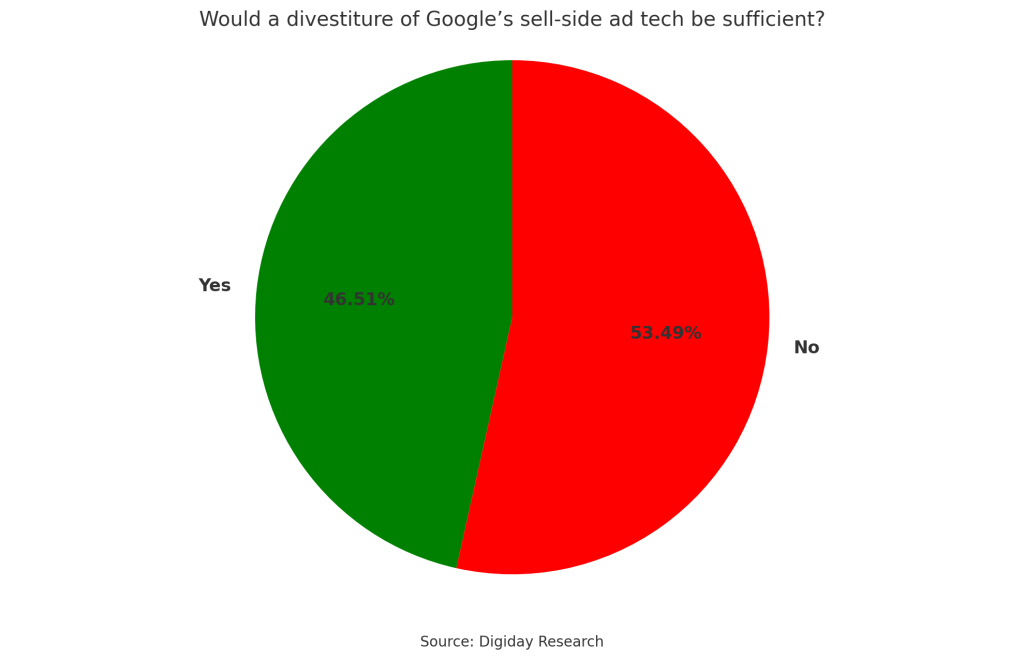
The DOJ wants Google to divest its sell-side tools, but more than half of Digiday readers feel this is inadequate. If any impact is to be realized, Digiday readers claimed further behavioral remedies, such as making Google back header bidding. “They claim they are, but that’s not the reality… they could create their own Prebid adapter for header bidding,” said one survey respondent.
Meanwhile, others questioned whether the DOJ’s efforts were fit for the contemporary landscape. “With all of the new AI products/tools coming, I think the anti-trust trial is misguided,” said one anonymous survey participant. “There’s a lot of competition and change coming in both search and ad tech.”
Some theorized that Google’s launch of sell-side ad curation could represent efforts to offset the impact of a DOJ-forced divestiture. Advocates of such a theory could point to Google’s participation in the recent launch event of Scope3’s “agentic platform.”
Here, Google Ad Manager’s Darline Jeans spoke with Scope3 CEO Brian O’Kelley – who was a DOJ trial-witness in September – to discuss such efforts. Historians of the sector will note just how strange a sight that, i.e. “BOK” on stage with Google, would have posed just a few years ago…

However, that’s not to say that it’s a case of, ‘If you can’t beat ’em, join’ em… ‘ nor is that Digiday’s assessment of Scope3’s recent launch.
What it is a testament to is the current rate of change in ad tech midwifed by AI. As a result, business models and alliances need to radically change, a school of thought Google is clearly acting on. Simply forcing a sale of one Google unit will have minimal impact, with Arete Research’s B-Corp solution a widely-fancied remedy.
Amid all the uncertainty, one thing is clear: as the rocket docket stalls, tech has not. Regardless of the outcome, Judge Brinkema’s ruling will be applied to a very different media landscape to the contemporary picture.
If you feel strongly on any of the issues discussed above, then feel free to get in touch – no PR pitches please.


More in Media

Creators say it’s difficult to make money from news — with platform rules and brand guidelines
With more people getting news from creators than traditional media, those creators are still trying to build sustainable businesses.

Why CNN International is building for agentic ad market that barely exists yet
CNN International is still chasing its first agent-sold dollar by Q1.

Media Briefing: The transatlantic push to rein in stealth bots is gathering pace
U.S. and U.K. publishers are pushing for laws to crack down on stealth AI crawlers as bot scraping surges and demands for transparency grow.