Join us Dec. 1-3 in Nashville for the Digiday Programmatic Marketing Summit
In graphic detail: Six thousand brands later, ChatGPT ads still have a conversion problem

ChatGPT now handles roughly a fifth of the search queries Google does. Its ads business is worth considerably less. Nobody should be surprised by that. OpenAI only started selling ads this year, the format they’re growing into is still taking shape and the company has been tiptoeing around how much advertising to put in front of users who came for users. Advertising is, in other words, lagging usage. OpenAI will want that to change quickly and advertisers are already testing how fast it can.
Read on to see where things stand.
How big is the addressable audience
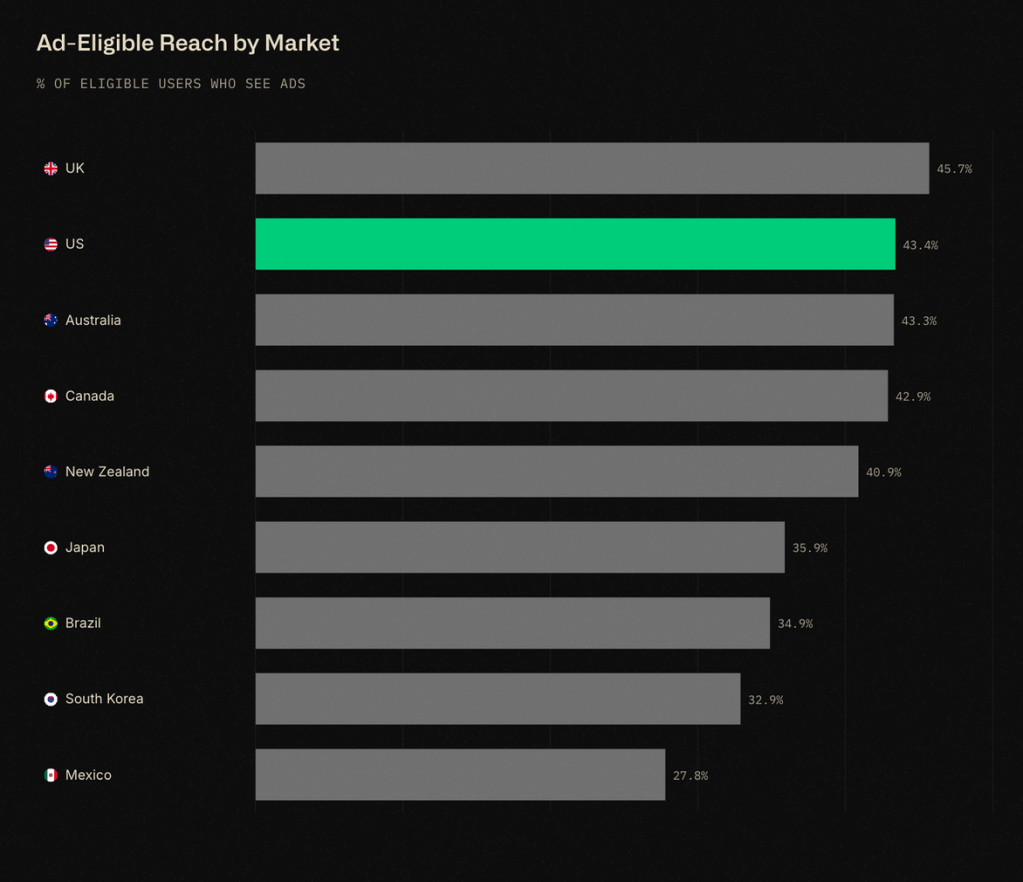
There’s room for OpenAI to increase the reach of its ad business within markets where it already operates. According to data from Similarweb and Graphite, the U.K. has the highest proportion of ad-eligible ChatGPT users seeing ads (45.7%), followed by the U.S. (43.4%) and Australia (43.3%).
But the data shows fewer than half of eligible users, even in OpenAI’s most established ad markets, are currently being reached by ads. In Mexico, for example, that figure falls to just 27.8%. The differences could reflect how far along each market is in the advertising rollout, or how much of its eligible audience OpenAI is currently monetizing.
Advertiser spending is spreading across sectors
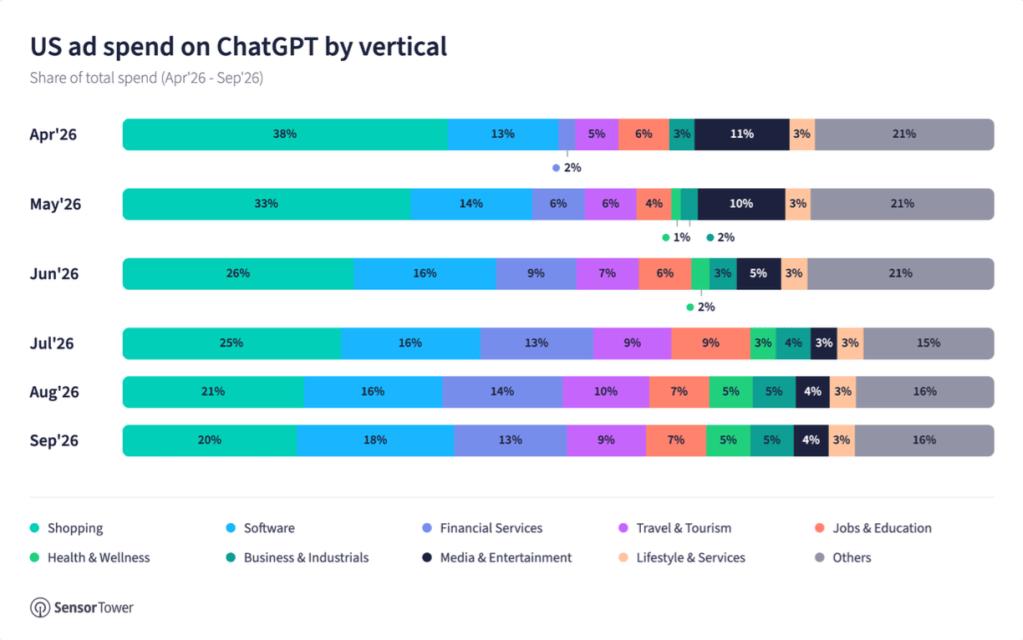
The mix of advertisers spending on ChatGPT is also broadening beyond retail. According to data from Sensor Tower, shopping accounted for 38% of U.S. ad spend on the platform in April, but that share fell to 20% by September.
Over the same period, financial services increased its share of spend on ChatGPT from 2% to 13%, while software grew from 13% to 18%, and travel and tourism increased from 5% to 9%. This suggests that ChatGPT is attracting demand from a wider range of advertisers, rather than relying on a narrow range of verticals looking to reach consumers in shopping-related moments.
This has certainly broadened since the ad pilot launched in February. While Sensor Tower only started tracking ad spend in April 2026, at launch, the company estimates that around 42% of ads on ChatGPT were from advertisers in the shopping, followed by jobs & education (10%), food & dining (9%), software (8%), media and entertainment (8%) and travel (7%).
More brands are entering ChatGPT advertising
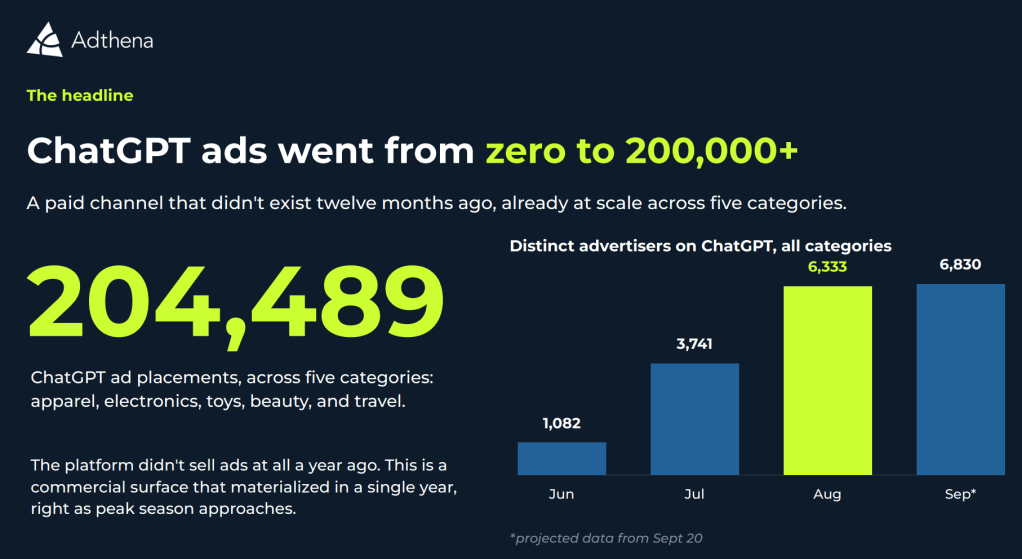
The number of brands advertising on ChatGPT is growing too. Data from Adthena shows that it tracked 1,082 distinct brands running ads on the platform, across the U.S., Australia, the U.K. and the EU in June. That number rose to 3,741 in July and 6,333 in August. And while the data for September only goes as far as Sept. 20, that full month is expected to reach around 6,830, based on Adthena’s data and projections.
It points to a growing pool of brands advertising on ChatGPT as the platform expands its markets and advertising capabilities.
Economics and assumptions required to scale
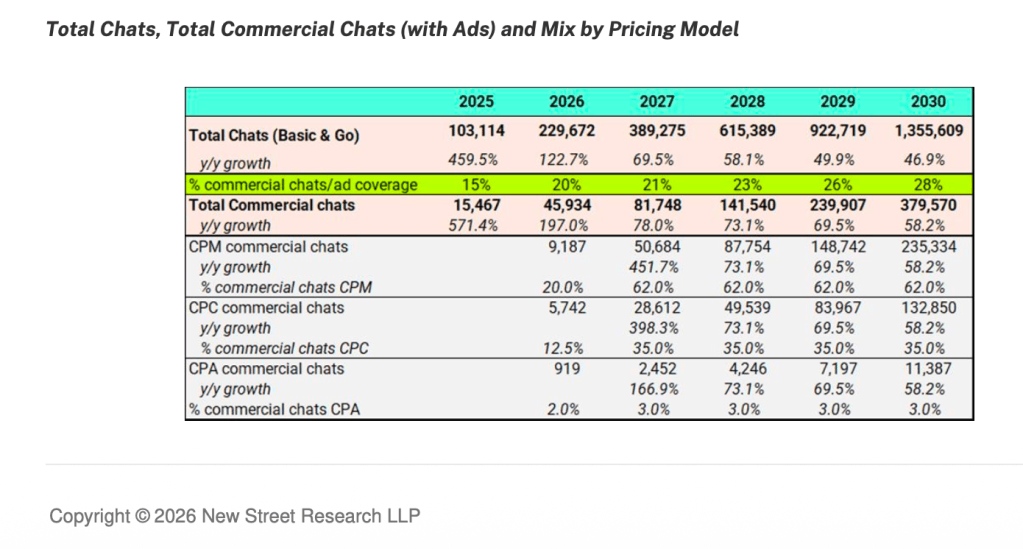
New Street Research models the number of commercial chats on ChatGPT to grow from 45.9 billion this year, to nearly 380 billion by 2030, as the proportion of total chats carrying ads increases from 20% to 28% during the same period.
But the volume of ad opportunities is only part of the equation. The way those conversations are monetized will also matter. OpenAI recently said CPC and outcome-optimized bidding account for the majority of its ad campaigns, a higher proportion than New Street had previously assumed in its own model.
That could be positive for revenue, given CPC ads typically generate more per-ad event than impression-based pricing. However, New Street cautions that monetization may currently be weaker than it had originally modelled, suggesting its estimated CPC of around $5 could be too high.
The challenge of turning clicks into conversions
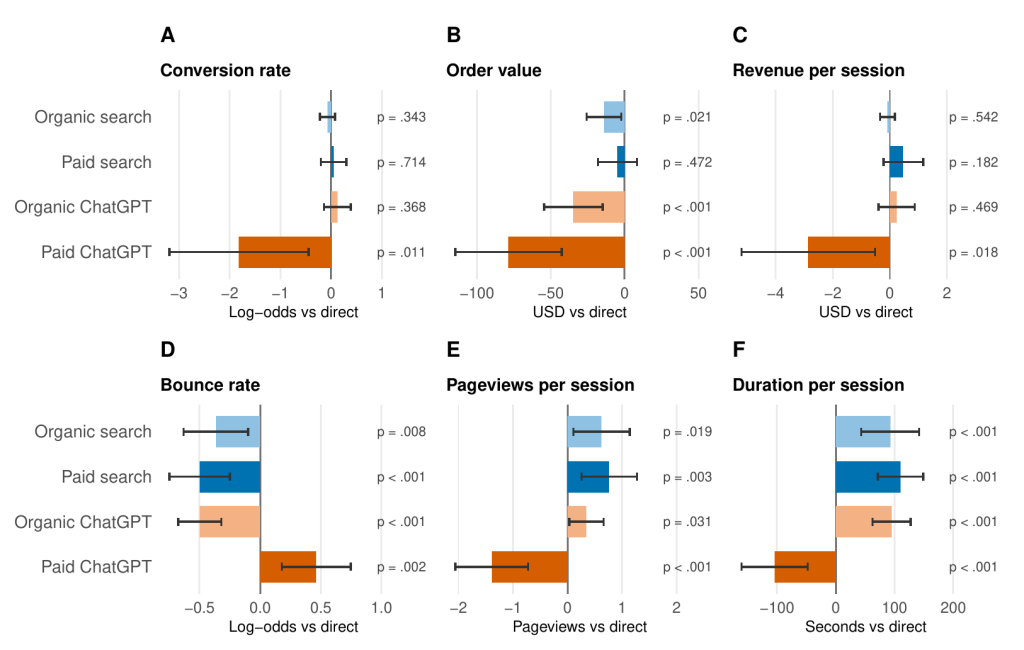
That said, there is a question over whether ChatGPT ads are currently delivering enough value to advertisers to support the kind of revenue growth OpenAI is targeting. Research from a working paper under review by Maximilian Kaiser and Christian Schulze, based on data from ecommerce websites, found that paid ChatGPT visits generate $0.89 in revenue per session for U.S. advertisers, compared with $2.45 for paid Google Search visits.
The difference was also reflected in conversion rates: 0.37% for paid ChatGPT traffic, compared with 1.17% for Google. The findings suggest that while advertisers are increasingly testing the platform, OpenAI still has work to do to demonstrate that its ads can compete with established performance channels.
Those performance questions are compounded by ongoing measurement issues, according to Accuracast’s group CEO Farhad Divecha, who said the latest partner integrations — Magnite and Pubmatic — have not necessarily addressed the underlying tracking issues.
“We continue to see discrepancies there,” he said. “Some are teething problems because it’s a new system that has to be set up on advertiser systems, but some problems are down to attribution being messed up.”


More in Marketing

Agencies find AI overuse is leading to brief bloat
Agencies and marketers now frequently use AI tools to create media and creative briefs. But the practice could be a canary in the coalmine for AI overuse in advertising.

After DoorDash’s Instacart bid, here’s the case for and against consolidation in commerce media
The DoorDash-Instacart deal could accelerate commerce media consolidation, promising scale but risking higher prices and lock-in.
Digiday+ Research 2026 Creator Marketing Index: A brand guide to social media campaigns
As creator marketing becomes a fixture in many brands’ marketing strategies, creators’ roles are shifting and expanding.