Join us Dec. 1-3 in Nashville for the Digiday Programmatic Marketing Summit
Future of TV Briefing: CTV advertising has a genre-label problem

This Future of TV Briefing covers the latest in streaming and TV for Digiday+ members and is distributed over email every Wednesday at 10 a.m. ET. More from the series →
This week’s Future of TV Briefing looks at the messy state of genre labeling in CTV advertising.
- Category conflict
- Instagram’s IGTV redo, Netflix’s anatomy of a fall and more
Category conflict
Connected TV ad sellers have been reticent to share show-level information with advertisers. Passing genre labels would be the next best thing, if only they were more reliable.
Only 11% of CTV ad requests contained a usable show name in an analysis conducted by streaming tech provider Wurl. By comparison, 93% of requests contained a genre label, though the accuracy of those genre labels varied. Roughly a third of requests (35%) evaluated against Wurl’s own classification system carried a genre label that didn’t match Wurl’s classification for the corresponding program.
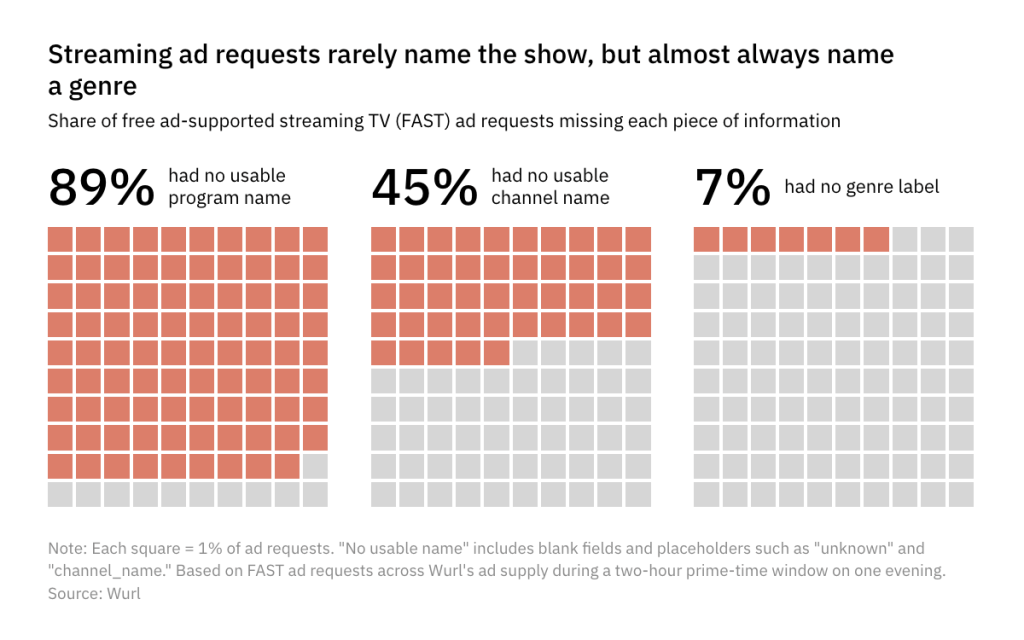
Wurl’s analysis was limited to a two-hour window during a single prime-time evening in August 2026 across the platform’s supply footprint, which includes Wurl-powered channels across LG Channels, Pluto TV, Samsung TV Plus and Tubi.
So what gives? Well, the root issue seems to be a lack of standardization around content labeling.
“As a guy who has a legacy TV background – I come from the cable industry – historically, the metadata around content libraries is pretty inconsistent,” said Dave Bernath, CEO of Wurl.
Not sure what he means? Well, let me ask you this: Is “The Bear” a drama or comedy? Anyone watching the show, especially the two most recent seasons, would probably say drama; I would say drama. And yet FX submits it in the comedy category for awards, right alongside ABC’s “Abbott Elementary,” which is as traditional a comedy as they come.
Which gets at another problem with how CTV ad sellers label genre: The labels they append can be pretty broad. Of the 1.09 billion ad requests that did carry a genre label, 22% had what Wurl considered a vague genre label, such as “entertainment” or “general variety.”
On the flip side, there can just be an overwhelming number of different genre labels appended to shows that can make it hard to reconcile them. During that two-hour window of Wurl’s analysis, the company tallied more than 3,600 different genre labels.
This content classification confusion is exactly the thing that could derail the CTV ad industry’s efforts to pass content signals. Over the summer, Comcast-owned (for now) FreeWheel added show-level reporting for advertisers using its platform. However, the company wasn’t taking an active role in ensuring that ad buyers and sellers were using the same show naming conventions, which could nullify any attempts to match programs and provide accurate show-level reports.
If only there were a standard taxonomy for the CTV ad industry to rally around… Oh wait, there is.
In June 2022 – four years ago – IAB Tech Lab updated its Content Taxonomy to include categories suited to CTV. And two years ago, it further refreshed the standard to add more genre categories, like “Thriller.” And even then, it features only 704 categories, one-fifth the number of unique genre labels Wurl had observed.
For its part, Wurl uses IAB Tech Lab’s Content Taxonomy to undergird its classification system.
“We’re using our machine learning, our content intelligence to analyze these streams and understand the metadata, the [electronic programming guide], to try to coalesce around the IAB standard genres specifically,” Bernath said.
Why others aren’t following suit is beyond me. Content owners are responsible for appending content labels to bid requests, Bernath said, so I asked him why they’re missing the mark so often.
“I would call it sort of historical metadata hangover,” Bernath said.
That is to say, these content owners are sitting on large, dusty libraries of shows and movies. Those programs may have been originally categorized decades ago, and no one has reviewed them to see if the labels still hold up or need to be updated. And I guess no one has thought to throw the problem at Claude or ChatGPT. Sure, the AI tools could hallucinate categories, but then would that be worse than the current state of things?
What we’ve heard
“Creators don’t produce a lot more when we pay compared to what they already create. And what we do find is often, not always, the incremental content they create is not as high quality as what they would have created or what they were already creating for free.”
— Instagram’s Adam Mosseri explaining why Instagram doesn’t operate a revenue-sharing program for creators
Numbers to know
48 million: Number of paid subscribers that Peacock had at the end of the third quarter of 2026.
15.8%: YouTube’s share of TV-screen watch time in the U.S. in August 2026.
$12 million: How much money creator-led news media company Newpress raised in its latest funding round.
48%: Percentage share of midterm election ad spending that is expected to go to broadcast TV.
-4.8%: Percentage decline in LA-area film-and-TV shooting days in Q3 2026 versus a year ago.
What we’ve covered
Midterm political spending throws spanner into regional advertiser holiday plans:
- Political media spending in the run-up to November’s midterm elections has inflated TV and streaming ad prices for regular advertisers.
- Some $8.2 billion of the total $12 billion expected to be spent in the run-up to the midterm elections in November will go towards TV or CTV, according to AdImpact.
Read more about the midterms’ effect on regional advertisers here.
Creators say it’s difficult to make money from news — with platform rules and brand guidelines:
- Finding partnerships to sustain revenue can be difficult due to skittish brands, and finicky algorithms can make ad revenue unreliable.
- Several of the five creators who spoke with Digiday said that TikTok has been rough since the U.S. ownership deal closed in January of this year.
Read more about news creators’ monetization challenges here.
Why CNN International is building for agentic ad market that barely exists yet:
- Seven months after announcing the move, the network still has it on course to launch ad sales through AI agents in the first quarter of 2027.
- The broadcaster is pairing its own agent infrastructure with outside technology partners and lining it up with industry frameworks.
Read more about CNN International’s agentic ad plans here.
Media buyers chart path for brands and sponsors through high NBA demand:
- The new season is set to invite high spending on linear and streaming coverage, as well as paid social and creator activity for brands that find themselves locked out.
- NBA sponsorship investments have been rising steadily in recent years.
Read more about NBA ad demand here.
Creator mentors Colin and Samir want to turn their followers’ ideas into productions:
- The creator duo kicked off this initiative with a new sponsored creator program, called the Big Idea Fund, to bankroll projects from creators in their community.
- Last week, in partnership with Adobe, they awarded creator Jackson Hughens a $25,000 grant to work on a five-part documentary series to live on YouTube.
Read more about Colin and Samir’s Big Idea Fund here.
What we’re reading
For anyone whose memory doesn’t extend to pre-pandemic times, Instagram used to have this thing called IGTV that let creators post horizontal videos up to 60 minutes long; it even tested an ad revenue-sharing option. Anyway, Instagram is doing this again, but this time it’s called Features, videos can be up to 90 minutes long, though no rev-share program, according to The Hollywood Reporter.
Among the tidbits in Bloomberg’s look at the reasons behind Netflix’s recent leadership shakeup, one that stands out is the reporting that Netflix co-CEO Ted Sarandos saying the company will refocus on premium film and TV core after ousting Bela Bajaria who had spearheaded the creator courtships that weren’t popular with Sarandos.
FIFA’s 2030 World Cup rights sale:
FIFA has officially opened the market for U.S. rights to the next World Cup, with an aim to secure bids by Nov. 19 and while dangling the option for bidders to also lobby for 2034 rights, according to CNBC.


More in Future of TV
Future of TV Briefing: YouTube, Tubi top streamers’ share of ad exposure time
This week’s Future of TV Briefing looks at Comscore’s new Score Report that gauges TV and streaming companies’ share of audiences’ ad exposure time.

Future of TV Briefing: TikTok Shop success = small creators + more videos
This week’s Future of TV Briefing looks at how “more videos from smaller creators” is the recipe for success on TikTok Shop.
Future of TV Briefing: Hispanic TV-and-streaming viewership in 4 charts
This week’s Future of TV Briefing looks at how Hispanic audiences spend their time between traditional TV and streaming.