Join us Dec. 1-3 in Nashville for the Digiday Programmatic Marketing Summit
Digiday Scorecard: As competition between DSPs heats up, buyers rank market rivals

The pros and cons of the industry’s demand side platforms (DSPs) used to be something only media buyers cared about. Now, it’s a highly competitive patch being fought over by some of the largest companies in tech.
The Trade Desk, the sector’s largest independent player, is under pressure from Amazon, while smaller providers like Yahoo, StackAdapt and Viant see an opportunity to grab a larger market share. As they compete to hold — or gain — ground, DSP providers are also working to integrate their dashboards and portals with agentic AI systems, ostensibly making investments easier to manage but taking more agency and power away from experienced media buyers at the same time.
Media buying teams aren’t shy of shopping around. “We need to be agnostic as much as possible,” said one buyer, who spoke to Digiday on condition of anonymity. But high corporate drama and AI worries don’t always dovetail with the needs and wants of buyers on the office floor. For the staffers tasked with choosing a DSP to suit a client’s brief, CPM rates, the ability to check log-level data or a platform’s streaming partnerships are more important.

Digiday spoke with 13 media buyers at large and small media agencies, who each exchanged anonymity for candor, for their perspectives on the DSPs they use each day. While our conversations covered a broad range of DSP providers including Viant, Basis, and MNTN, we’ve focused on the five key platforms that kept reappearing in agency DSP rosters: Google’s DV360, Amazon, The Trade Desk, Yahoo and StackAdapt.
The conversations covered key criteria: fee and data transparency, the quality of data available for targeting audiences, access to valuable inventory, the ability of each DSP to provide a competitive CPM, and the quality of their customer support and UX. The scores below are averages from those buyers’ ratings.
DV360
Few media buyers are able to ignore DV360, the Google-operated DSP with a dominant position in digital display. Over 21% of all investment on open web display flows through DV360, according to estimates published during last year’s DoJ anti-trust suit. Some buyers have groaned about the lack of strategic transparency they get from the tech giant, and its sales’ reps tendency to stonewall service requests.
Others consider those negatives as reasonable tradeoffs. “It’s a good all-rounder… without being overly complex and overly expensive,” in one buyer’s judgement, useful across a large variety of briefs if lacking in specialist qualities.

Either way: its stranglehold on YouTube, the silverback gorilla of online video, means it’s a DSP they have to go through. Access to YouTube and the broader Google ecosystem is “obviously, massively important,” for many clients, one buyer told Digiday. In summary, it’s a dependable (if unloved) squad player turned to for digital display and video, modern advertising’s workhorse channels.
“We’re not wedded to it, but it’s definitely given us what we’ve needed over the years,” said another buyer.
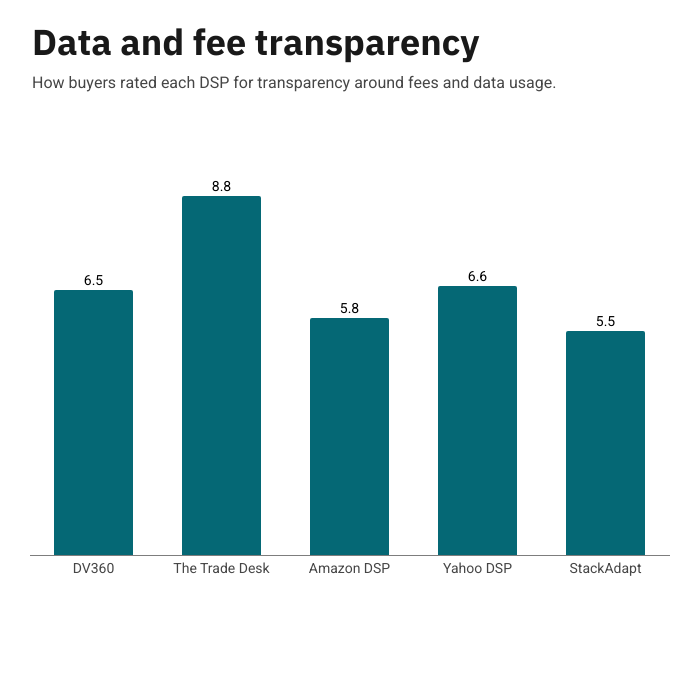
Transparency: 6.5/10
Data and targeting: 7.9/10
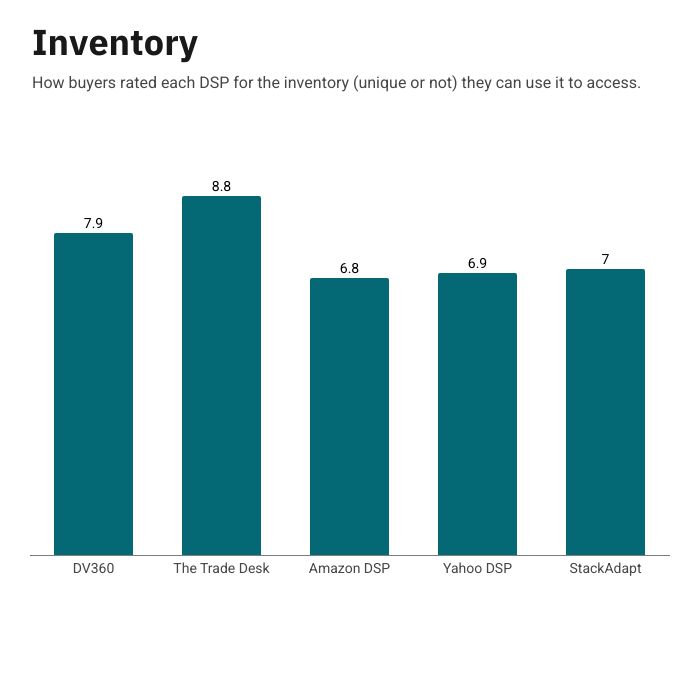
Inventory access: 7.9/10
Price performance: 7.6/10
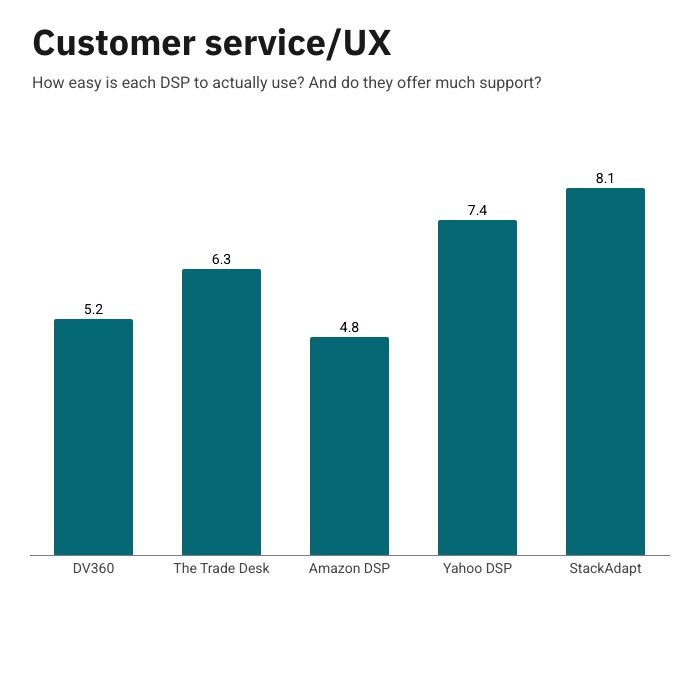
Customer service and user experience: 5.2/10
Aggregate score: 7/10
The Trade Desk
The Trade Desk remains the industry’s leading independent DSP, favored by buyers for video and display on the open web, streaming inventory and commerce via partnerships like its deal with Walmart Connect, as well as more niche sources of inventory such as Spotify.
But in the last 18 months, a key earnings miss, user uproar over the rollout of its Kokai product, (“I’m not a Kokai fan… it frustrates me,” noted one buyer) and a boardroom spat with holding company Publicis Groupe being made public have each eroded its position — just as e-commerce giant Amazon has attempted to move into the neighborhood. Commercial troubles aside, media buyers using the platform day-to-day still describe it as best-in-class for the depth of data, targeting options and the breadth of inventory accessible. “It’s good, it’s just expensive. It’s like driving a Lexus rather than a Toyota,” said one buyer.
“They do so much inventory filtering, which gets great stuff but drives up costs, so I’ll land on a four,” said one buyer.
While most experienced agency buyers favor the depth of information and capability on offer, it’s perhaps too powerful a machine for more junior staffers, several noted. As part of an effort to persuade those buyers that don’t need every bell and whistle possible, the company has begun to introduce different “modes” of usage, offering automated means of buying for those that want it, and a manual buffet option with for those that don’t.
“I’ll give them an eight; they’re transparent but we do consider them more expensive from a fee standpoint,” commented one buyer.
Fee/data transparency: 8.8/10
Data and targeting: 6.7/10
Inventory access: 8.8/10
Price performance: 5.8/10
Customer service and user experience: 6.3/10
Aggregate score: 7.2/10
Amazon DSP
Amazon overhauled the design of its DSP last year, leading some buyers (but not all) to soften on the formerly cumbersome user experience. At the same time, its sales teams have advocated for media agencies and brands to move the spending they currently move through The Trade Desk to Amazon wholesale, offering cut-down rates and cheap deals on CTV inventory to sweeten the bargain. If TTD is the Lexus of DSPs, Amazon has positioned itself as the sector’s no-frills hatchback.
For buyers, however, Amazon’s home advantages are more compelling than the commercial goodies; its access to commerce data gleaned from the company’s enormous e-commerce business grants buyers the ability to target shoppers across streaming platforms and an increasingly large spread of the open web. Meanwhile, it’s been building bridges with streaming providers like Netflix and creating a respected live sports portfolio on Amazon Prime, granting buyers access to prized sports inventory and video on the open web both.
In short, it’s a formerly specialist DSP attempting to turn itself into a generalist proposition, akin to cup-final merchants Arsenal reinventing themselves as Premier League champions.

At its core, however, buyers consider it valuable for the commerce angle (the equivalent, perhaps, of Arsenal’s corner kick trick). “The Amazon ecosystem is very important for some of our clients as well [because] it’s where they sell direct,” said one media buyer. It’s a factor that outweighs other concerns for many agencies.
Transparency: 5.7/10
Data and targeting: 6.4/10
Inventory access: 6.8/10
Price performance: 6.8/10
Customer service and user experience: 4.8/10
Aggregate score: 6.1/10
Yahoo DSP
Yahoo’s DSP was pegged for acquisition fodder just a short while ago. But in the last year, it’s made more inroads with buyers by investing in features and AI capabilities. The business was one of the first DSPs to heavily invest in agentic media planning and buying tools, turning it from a display and commerce specialist unit into the core unit of some agencies’ AI efforts.
While it can’t boast owned inventory like Amazon and Google, targeting options and competitive pricing have curried favor with some practitioners. “The ability to do custom intent, custom affinity, and really unique audiences, and [at] no cost is amazing,” said one.
“They’re transparent, they’re not tacking on a bunch of fees… I’d put them at a seven,” said another. As the DSP market grows more competitive and more automated, Yahoo’s efforts are worth keeping an eye on.
“Their proprietary data options are pretty strong, perform well, there’s a range of options available,” a third buyer summed up.
Transparency: 6.6/10
Data and targeting: 7.9/10
Inventory access: 6.9/10
Price performance: 7.6/10
Customer service and user experience: 7.4/10
Aggregate score: 7.3/10
StackAdapt
Given most media buying teams stick to two or three DSPs in their day-to-day trading, and the importance of exclusive inventory, independent DSPs like StackAdapt have to fight just to be considered for display and CTV buys.
That fight has opened up lately. StackAdapt has been one the players attempting to gain on larger peer The Trade Desk in recent months, running paid LinkedIn ads highlighting its advantages in the wake of TTD’s blowup with Publicis. (A close sporting analogy might be Aston Villa’s recent drive to join the English Premier League’s ‘Big Six’ group of teams).
While competitors have the edge in owned inventory, buyers increasingly consider it a useful specialist addition to the kit. A recent deal struck with OpenAI made it the first DSP to gain access to ChatGPT inventory.
While the DSP lacks the owned inventory of Amazon or DV360, an intuitive UX and responsive customer service have made it a friend to media agencies. And a straightforward, all-in-one fee makes accounting quicker, even if it’s light on detail. “StackAdapt offers a flat CPM, which makes for simpler but less transparent billing,” explained one buyer.
“They have super customer service, great support, but then also just like really intuitive UI… without a ton of background training, teams can jump into really quickly,” ventured one buyer.
Still, buyers aren’t the only stakeholders when selecting a DSP. As one buyer noted, price competitiveness and fee transparency generally count for more than an easy-to-use dashboard; most agencies rank media buyer comfort behind cost and StackAdapt’s price performance came in for criticism among the buyers Digiday spoke to. “I’d rank them a four,” one told us. For now, it’s a substitute brought on for key cameo roles, rather than a consistent member of the starting lineup.
Transparency: 5.5/10
Data and targeting: 6.4/10
Inventory access: 7/10
Price performance: 6/10
Customer service and user experience: 8.1/10
Aggregate score: 6.6/10


More in Media Buying

Addressability is back as a headline concern for attendees at this year’s Prebid Summit
Speakers decry ‘UMPs’ as the new ad networks, with talk far outweighing understanding.

Publicis is selling directly to AI-anxious CEOs as it steps away from traditional pitches
Publicis boss Sadoun says agency group is skipping CMOs in more new business pitches, as Groupe notches up new business wins.

Ad Tech Briefing: Zeta goes big as Apple casts a shadow over Advertising Week
Advertising Week New York saw more ad tech M&A, plus, the rise of the “universal buying platform.”