Join us Oct. 26-28 in Newport Beach for the Digiday Media Buying Summit
Ad Tech Briefing: More take-private deals are on the horizon, here’s what to look out for

This Ad Tech Briefing covers the latest in ad tech and platforms for Digiday+ members and is distributed over email every Tuesday at 10 a.m. ET. More from the series →
Public markets are becoming an uncomfortable place for many companies in the sector, and while that’s been widely known for some time, the latest quarterly earnings have underlined that.
Increasingly, though, there’s a theory that many in this cohort will go private, with some of the industry’s sharpest minds sharing their insights on how that will play out. Below is an excavation of some of the best takes.
The catalyst was Nielsen’s agreement to acquire DoubleVerify for $2.15 billion, making it the latest publicly listed ad tech company to leave Wall Street following similar moves involving Integral Ad Science and LiveRamp.
The transaction came as the market reacted bruisingly to Q2 earnings from AppLovin, The Trade Desk, and Criteo, each of which reported underlying businesses that remain profitable and strategically relevant, but nevertheless suffered sharp stock price declines.
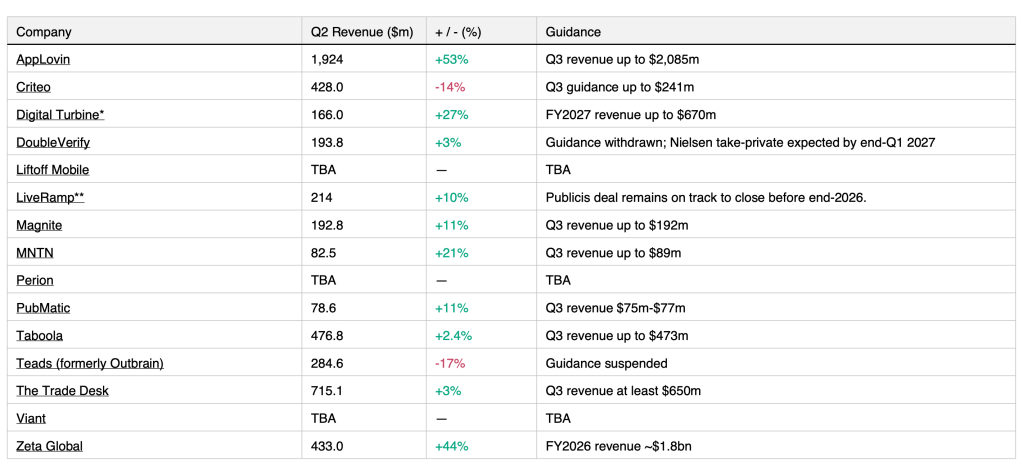
The Q2 earnings numbers from the cohort of publicly listed ad tech firms (see chart above) tell much of the financial story: lagging revenue growth leading to declining valuations, both of which make mergers and acquisitions increasingly feasible, even for companies that continue to generate healthy cash flows.
It’s evident from last week’s disclosures that investors are now applying a far higher standard than simple revenue growth. Increasingly, they want evidence that ad tech companies can sustain durable expansion despite macroeconomic uncertainty, keep apace with advertisers’ shifting priorities, all while under intense competition from Big Tech.
Plateauing growth
In particular, The Trade Desk’s stock price, which posted 3% annual revenue growth in Q2, compared to 19% 12 months beforehand, has fallen victim to such a critique.
Revenue still increased, customer retention remained above 95%, and management pointed to strong growth in CTV, audio, APAC markets, plus joint business plans with strategic advertisers.

On the company’s subsequent earnings call, The Trade Desk CEO Jeff Green repeatedly maintained that the company’s execution, rather than its underlying strategy, had fallen short. He further identified his priorities intended to reignite growth: a new measurement framework and a broader rollout of Audience Unlimited, while stressing that the majority of its largest accounts continue to grow at double-digit rates.
Yet investors were unconvinced, with the company’s stock price losing almost a quarter of its value in the immediate aftermath of its August 6 disclosure.
Part of the concern stems from macroeconomic pressures affecting categories such as consumer packaged goods and automotive, but management also acknowledged execution issues around rolling out new products. Those factors, combined with softer guidance, were enough to trigger another sharp decline in the company’s share price.
Karsten Weide, founder of W Media Research, reached a similar conclusion when assessing AppLovin’s results. In his LinkedIn analysis, he argued the market reaction reflected investors’ fixation on a relatively modest earnings miss rather than the company’s longer-term competitive position. Roughly one-fifth of AppLovin’s market capitalization disappeared despite the company continuing to post enviable profitability and revenue growth.
Falling stocks raise speculation
Such reactions demonstrate how little tolerance there is currently for even minor disappointments among companies previously valued almost entirely on future growth expectations.
Whether that translates into takeover interest varies considerably by company. Around the industry, there has been occasional water-cooler speculation over whether The Trade Desk could eventually attract private equity or strategic suitors should its valuation continue to compress.

However, that remains little more than speculation, with AppLovin appearing even less likely to become an acquisition candidate given its financial profile and strategic position.
Criteo occupies a different position, with its earnings dip and diminished earnings guidance (see chart above), prompting another marked earnings sell-off, with its stock price dropping by approximately a quarter in the aftermath of its Q2 disclosure last week.
Revenue declined, and management acknowledged that some enterprise customers redirected spending toward other parts of the marketing funnel.
Some reflected on this disclosure and wondered whether the broader implication is whether or not standalone performance advertising platforms can continue to retain budgets. This is because marketers are increasingly expecting unified platforms spanning discovery, activation, commerce, and measurement to meet their objectives in a frictionless manner – something Big Tech platforms do.
Contemporary investment thesis
Across ad tech, investors increasingly appear to reward platforms that can connect multiple parts of marketers’ workflows rather than specializing in individual functions. Publicis Groupe’s acquisition of LiveRamp illustrates a growing demand for identity and data infrastructure. Meanwhile, Nielsen’s purchase of DoubleVerify reflects a similar approach to measurement, with both transactions pointing toward strategic infrastructure rather than isolated point solutions.
Mary Matyas, COO and M&A advisor at Ironbound Group, highlighted precisely that distinction in her LinkedIn commentary following the DoubleVerify announcement. Rather than viewing the Nielsen transaction in isolation, she contrasted it with Publicis’ pending LiveRamp acquisition, arguing investment is increasingly flowing toward infrastructure that provides real-time supply-path transparency and broader decision-making capabilities rather than narrowly focused verification alone.
A waiting game
Rather than buying businesses that simply verify impressions or optimize campaigns, acquirers are increasingly seeking platforms sitting closer to advertisers’ core operating systems: identity, data collaboration, measurement, supply-path intelligence and workflow orchestration.
However, the irony is that several companies punished most severely this earnings season continue investing heavily in exactly those capabilities.
The Trade Desk’s renewed emphasis on measurement and Audience Unlimited, AppLovin’s continuing AI investments and even Criteo’s broader commerce ambitions all reflect attempts to move beyond individual point products toward more comprehensive platforms.
Whether public investors remain patient long enough to reward those transitions remains to be seen. For private equity firms and strategic acquirers, however, falling valuations increasingly create opportunities that simply did not exist eighteen months ago.
The DoubleVerify deal may prove to be the first transaction of this earnings season. Few across the industry expect it to be the last.
Numbers to know
Big Tech CAPEX forecast, according to Morgan Stanley:
- $375 billion: Google forecast to remain the biggest CAPEX spender.
- $344 billion: Microsoft projected to overtake Amazon in CAPEX.
- $318 billion: Amazon investment expected to level off by 2028.
- $250 billion: Meta forecast as the only firm below $300B CAPEX.
What we’ve covered
People Inc. CEO: We’re not turning off Google crawlers yet
People Inc.’s CEO Neil Vogel said the company won’t block Google’s crawlers — not because execs don’t want to, but because they don’t want to lose out on any potential referral traffic.
Time has started selling ads to AI agents
Time has begun serving ads to AI agents. Ally Bank and Project Management Institute are among the first buyers.
What we heard
“When you consider Zeta beat and raised full-year expectations, as did Magnite, TTD can’t just blame the sector or market anymore – there’s company-specific issues.”
— One industry insider compares the Q2 earnings disclosures of last week and comes up with a harsh assessment of the industry’s leading independent DSP.
What we’re reading
Jeff Bezos just filed to sell $4 billion in Amazon. The shares are falling
Jeff Bezos filed plans to sell about 15 million Amazon shares worth roughly $4.1 billion, after the dominant e-commerce platform’s stronger-than-expected earnings sent the stock to a record high, pushing its market value above $3 trillion.
BuzzFeed lays off 33% of remaining staff after bizarre pivot to AI
Things just keep getting worse for BuzzFeed… the struggling media company announced the layoffs of 180 employees, or about a third of its entire workforce, in the latest sign of its decline since its unexpected pivot to AI.
Palantir CEO Alex Karp took a victory lap over the company’s explosive growth, saying it managed to boost its commercial business using a “miniscule and shrinking” sales team.
The prisoner’s dilemma: Why UK publishers are signing Google AI deals
AI deals being offered to U.K. publishers by Google were described to Press Gazette by one well-placed industry source as a case of the “prisoner’s dilemma,” writes Dominic Ponsford.


More in Media Buying

‘An important capability for us’: PepsiCo CEO on Publicis switch
Pepsico’s Ramon Laguarta used a recent appearance in front of investors to champion the company’s decision to hand its global media account to Publicis Groupe.

Media Buying Briefing: Synthetic audience adoption by agencies and clients takes off
Agencies like Goodway Group are incorporating synthetic data stacks into media planning, while clients use the tech for product design and creative strategy.

As agencies push agentic media future, execs work to ward off client rogue fears
Agentic media tools dominate agency pitch decks; just don’t mention the Hugging Face Incident.