Join us Oct. 26-28 in Newport Beach for the Digiday Media Buying Summit
By the numbers: Wall Street’s tough assessment of ad tech
The digital advertising market continues to grow, but it has not translated into an easy earnings season for publicly traded ad tech companies, with their numbers on Wall Street speaking for themselves.
The chart below demonstrates the stark disconnect after the recent Q2 disclosures, even for the cohort’s traditionally talismanic names.
AppLovin reported 53% year-over-year revenue growth and promptly lost almost one-fifth of its market value after its August 5 report. Meanwhile, The Trade Desk grew just 3% and fell 22% after its Q2 disclosure.
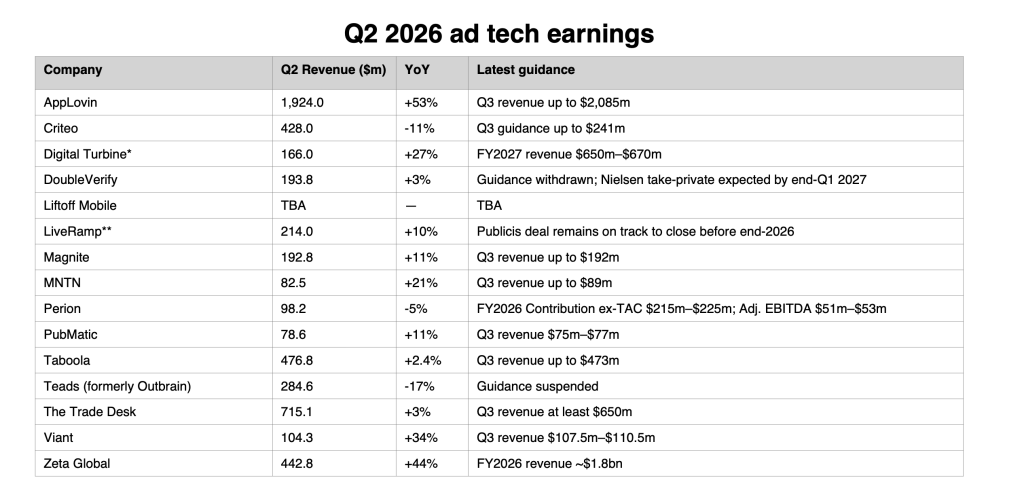
Elsewhere, Criteo’s AI narrative, such as its tie-up with OpenAI, seemed to run out of steam, as an 11% revenue decline led to a 24% stock price drop after its earnings report.
Similarly, Taboola and Teads felt the wrath of Wall Street, with respective 27.5% and 24% plunges in their stock prices after earnings – despite Taboola posting a 2.4% increase during the quarter; Teads, by contrast, experienced a marked fall in revenue during the period.
However, there were winners — PubMatic rose 20.8%, Magnite 8.6%, and Zeta Global 13% after reporting 44% revenue growth — but investors’ response to the cohort made clear that simply posting revenue growth is no longer sufficient.
Why is it all going so wrong?
Across the sector, there’s a growing consensus that the underlying judgment concerns how much of digital advertising’s future growth will accrue to independent ad tech, particularly in light of ebullient earnings from their Big Tech rivals.
Madison & Wall’s March forecast estimated U.S. advertising revenue to grow 8.1% in 2026, excluding political advertising, with 12.2% growth in digital, up from its earlier 6.6% forecast.
Independent ad tech companies will have been buoyed by analysts’ projected 3.9% increase in programmatic advertising during the period, but optimism will have been blunted by a predicted 1.4% decline across the broader “open internet” ecosystem, including independent publishers, open CTV, digital audio, and digital out-of-home.
Such mixed numbers may help explain why Wall Street appears increasingly unforgiving for the cohort, even when they continue to post consistent growth.
58%: The Big Three keep taking share
Madison & Wall analyst Luke Stillman told Digiday that Q2 advertising growth is running somewhat ahead of his firm’s expectations. But Meta, Amazon and Google are the primary benefactors.
“The big walled gardens … were all still very solid,” he said – that’s even if Wall Street was alarmed by their expected CAPEX investments as a result of the AI arms race. Meanwhile, Stillman noted that Madison & Wall is seeing increasing evidence of weakness across the open web as the quarter progressed.
Madison & Wall estimates Amazon, Google and Meta accounted for roughly 56% of U.S. advertising last year, with Stillman informing Digiday the firm now expects that figure to reach about 58% this year and further continue edging upward. “There’s definitely not a tide” of advertisers moving away from the largest platforms, he said, adding their scale gives them an increasingly powerful data advantage, particularly as AI-driven campaign optimization improves.
From here, independent platforms are simply left competing for a smaller relative slice of a growing market.
The Trade Desk hits a wall
For example, The Trade Desk illustrates Wall Street’s concern particularly clearly, with Q2 revenues of $715.1 million, up just 3%, while management guided to at least $650 million for Q3 — implying a significant year-over-year contraction. Its shares fell roughly 22% in the first regular trading session following the disclosure.
The Trade Desk CEO Jeff Green acknowledged both external and internal causes, though he and other executives at the demand-side platform are betting that a more transparent measurement offering will win favor over walled-garden rivals, many of whom have reputations for opaque ad offerings.
“Our revenue growth is below our expectations and below the standard we hold ourselves to,” he told analysts, adding that macro conditions were one factor, while “we didn’t execute as well as we could have.” Green further cited pressure on lower-income consumers and two categories that together represent around one-quarter of The Trade Desk’s business: CPG and autos. Some affected advertisers, he said, have become more focused on “buying cheap media rather than the best media.”
Reflecting on the earnings, Stillman sees a structural challenge alongside those cyclical pressures. The Trade Desk built its position by taking share as the open web expanded rapidly. However, now, the open web is closer to flat while rival DSPs operated by walled gardens can subsidize their technology businesses.
For many, this raises questions about whether The Trade Desk can maintain a take rate above 20% when competing against platforms such as Amazon, which can price its DSP much more aggressively.
53%: Even AppLovin’s growth wasn’t enough
AppLovin – another traditional sweetheart of Wall Street – offers the opposite problem: even though its Q2 revenue increased 53% to $1.92 billion, its shares dropped 19.7%.
Sources, who requested anonymity in return for candor, said the reaction appeared less about the quarter itself and more about whether AppLovin can sustain the extraordinary improvements investors have come to expect from its Axon AI platform.
For example, previous quarters repeatedly featured new model improvements. This time, such momentum was absent, with equities analysts eager to see whether AppLovin eventually transitions from 50%-plus growth to something that still outperforms advertising overall, but no longer warrants the same expectations embedded in its valuation.
In other words, Wall Street is increasingly pricing these companies on what it expects to happen next, not the actual facts of what just happened.
$2.15 billion: DoubleVerify’s Wall Street exit
Such dynamics also explain the growing procession of public market exits, such as Integral Ad Science’s $1.9 billion take-private by Novacap, now mirrored by Nielsen’s intended purchase of its ad verification rival DoubleVerify.
Similarly, Publicis Groupe is in the process of acquiring LiveRamp, taking it off the New York Stock Exchange, while take-private speculation surrounds Criteo – another company whose stock price faced considerable downward pressure after a Q2 dip.
While the early headlines around DoubleVerify’s exit focused on the agreed $2.15 billion sale price, analysts noted that it followed a visibly weaker quarter than its historic performance.
Q2 revenue grew 3%, below its 5%-to-8% guidance. Activation revenue declined 1% — its first decline as a public company — while measurement growth slowed to 6% from 16% the previous quarter. In documents seen by Digiday, William Blair analysts calculated Nielsen’s offer at 7.7 times 2026 EBITDA, a modest discount to the approximately 8.6 times forward EBITDA paid for IAS.
Goodbye, for now?
Yet interpreting the deal purely as an escape from deteriorating earnings is myopic, according to Ciarán O’Kane, general partner at First Party Capital and an investor in attention-measurement company Lumen Research, an outfit with ties to both DoubleVerify and IAS.
O’Kane told Digiday that ad verification is evolving into something larger, arguing that investors have been looking at these companies through too narrow a lens. “The future of DV isn’t in ad verification; it’s multi-signal activation and measurement,” he said.
O’Kane further maintained that combining Nielsen’s TV reach data with DoubleVerify’s verification, attribution, and activation assets — plus attention signals supplied by partners such as Lumen — could create an “omni-channel measurement layer” and ultimately a stronger equity story.
According to the investor, such a narrative could provide PE with the equity story needed for an eventual return to the public markets, with others expecting Novacap to perform a similar maneuver with IAS, once it can adjust its product offering for an AI-first industry.
Such a thesis also aligns with changing marketer behavior, according to several sources approached by Digiday, with Madison & Wall’s Stillman claiming that advertisers increasingly favor platforms capable of doing several jobs at once.
Convenience / scale > accuracy / innovation
While “performance remains critical, but convenience has moved up the list” in terms of their priorities, he said, citing conversations with multiple in-market sources to Digiday.
Simply put, marketers now show less appetite for assembling best-of-breed technology across four or five different providers. This shift in priority favors scale, he noted, adding that it creates an obvious rationale for consolidation.
Stillman expects buyers to pursue proprietary datasets and capabilities that differentiate otherwise commoditized technology offerings. Meanwhile, depressed valuations make acquisitions easier to finance.
“Valuation of everything is down… So, all things equal, it’s easier to buy,” he observed, tipping further take-private deals in the months ahead.
For public ad tech, that may be Wall Street’s clearest message from Q2: growth still exists, but the burden of proving a durable place outside Big Tech is getting considerably higher.


More in Marketing

How many people does it take to run an agency? According to Bad Mktg, just two if you’re using AI
BaD Mktg is just two employees and a lot of AI to run the business and ideate. The secret to its success? The experience of the people leading the ideation.

‘Mission and capital can coexist’: Golden State Valkyries’ Jess Smith on pitch to sponsors
The WNBA’s newest team must navigate measurement demands and marketers wanting to share in the ‘mission’ if it’s to establish a commercial foothold.

Future of Marketing Briefing: Why top creators are taking fewer brand deals
The biggest creators are cutting their brand rosters and asking more of the partners they keep.