Join us Dec. 1-3 in Nashville for the Digiday Programmatic Marketing Summit
By the numbers: Liftoff’s IPO tests ad tech’s mettle on the public markets

Liftoff Mobile’s initial public offering this week, which raised $437 million, representing a stock flotation price of $23 per share, was the latest test of the public market’s appetite for ad tech.

The debut of the Blackstone-backed mobile app outfit — it was the result of the private equity firm’s 2019 purchase of Vungle, and subsequent merger with its Liftoff holding — on the Nasdaq comes after an earlier attempt to go public was pulled in February, when broader software stocks sold off and the IPO window narrowed. This first run reportedly targeted a much larger raise — roughly $711 million at a $5.2 billion market cap — before Liftoff withdrew and returned with a more modest valuation pitch.
It also marks the first notable ad tech IPO since MNTN’s May 2025 listing, making it a useful barometer for whether investors are once again willing to back independent ad tech companies.
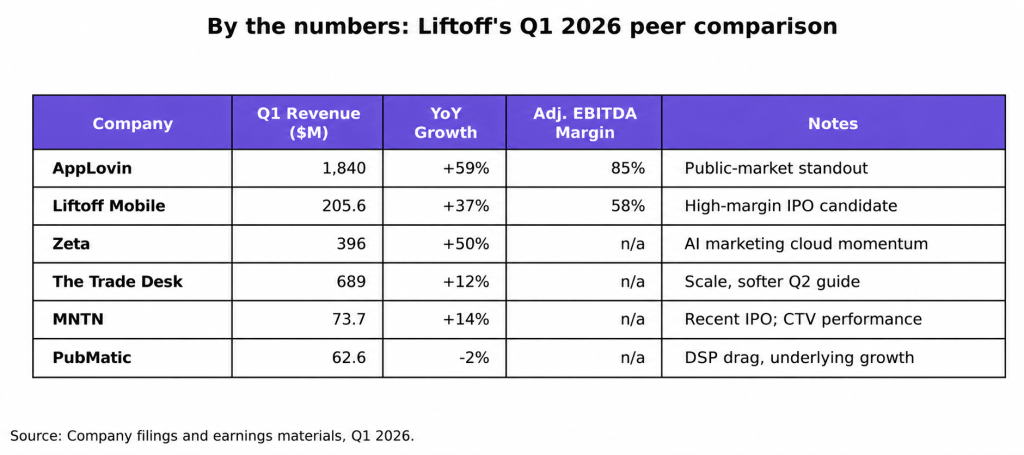
In Q1, Liftoff generated $205.6 million in revenue, driven predominantly by its Cortex AI model — up from $149 million 12 months prior.
Meanwhile, net income totaled $49.3 million, while adjusted EBITDA reached $120.1 million, resulting in a 58% margin during the period, with the latter statistic likely to be the key point to pique investors’ interests.
Finances and assets
While these numbers don’t match AppLovin’s outlier economics — AppLovin posted $1.84 billion in Q1 revenue, up 59%, with an 85% adjusted EBITDA margin — they do place Liftoff toward the higher-quality end of the public ad tech cohort, with the two companies likely to draw comparisons to one another given their involvement in the mobile app economy.
Furthermore, Liftoff’s S-1 — a publicly filed document necessary for an IPO — positions its neural network-powered prediction model, Cortex, as the foundation of the business, claiming it lets the company process far more data, run more tests, and improve bidding performance compared to its legacy model.
The company also emphasizes that the combined demand-side and supply-side platforms structure — created by the 2021 merger of Liftoff and Vungle — gives it better data visibility and auction performance than a standalone DSP or SSP.
Still, the public-market context is mixed. AppLovin remains the standout, with its AI-driven app advertising engine setting a high bar for revenue growth and profitability. Zeta also posted strong Q1 growth, while Taboola, Nexxen, and Viant raised or improved guidance. At the same time, Criteo, Teads, and PubMatic reported revenue declines, and The Trade Desk’s softer-than-expected Q2 guidance fed concerns about margin pressure and changing agency dynamics.

Raising almost $500 million on the opening week as a publicly traded entity is, indeed, an impressive feat, although it’s still worth noting how the full specter of scrutiny lies ahead, with commentators noting how Liftoff plans to use much of the IPO proceeds to repay debt, rather than purely to fund expansion.
It’s also worth noting that investors are likely to place great emphasis on Liftoff’s dependence on mobile operating systems and app stores, privacy changes, and competition from larger platforms, vulnerabilities that have previously beset some of its peers on the public markets, such as Criteo and The Trade Desk.
So, while Liftoff is smaller than AppLovin, it is profitable, growing quickly, and operating in one of the cleaner comparison lanes in ad tech. Whether investors treat it as another AI-powered performance platform — or simply a disciplined but narrower mobile advertising company — will help set the tone for the next wave of ad tech listings.


More in Media Buying

Stagwell buys Freestar, putting publisher ad sales inside a holdco
Publishers have long wished agencies would put their money where their panel talking points are. Stagwell has done something adjacent.

Midterm political spending throws spanner into regional advertiser holiday plans
Rising political ad spend is making life harder for regional and local brands hoping to use CTV ads to reach consumers in Q4.

Media Buying Briefing: Brands push toward retail and social while buyers ponder storm clouds
Ad dollars are flowing towards usual suspects in Q4 but media buyers say midterms give reasonsto be cautious.