The Rundown: Ad tech’s performance in 2025 was overshadowed by AI concerns and Big Tech

The latest round of earnings calls from the cohort of publicly listed ad tech companies concluded this week, with the results helping observers to grasp the challenges and opportunities in the sector.
The numbers filed with each company’s respective stock exchange in recent weeks, as shown in the table below, indicate an annual average revenue increase of 17.4% across the sector in 2025.* Although anomalies such as AppLovin (70% growth) and Teads (46% growth post-merger with Outbrain), as well as Perion and PubMatic’s declines of 12% and 2.88%, respectively, warrant closer inspection.
Closer analysis shows that revenue-weighted growth across the sector was 26.6% in 2025, although subsequent stock ratings were not reflective of this, with prices largely heading south after market disclosure as concerns around AI and Big Tech’s influence swelled.
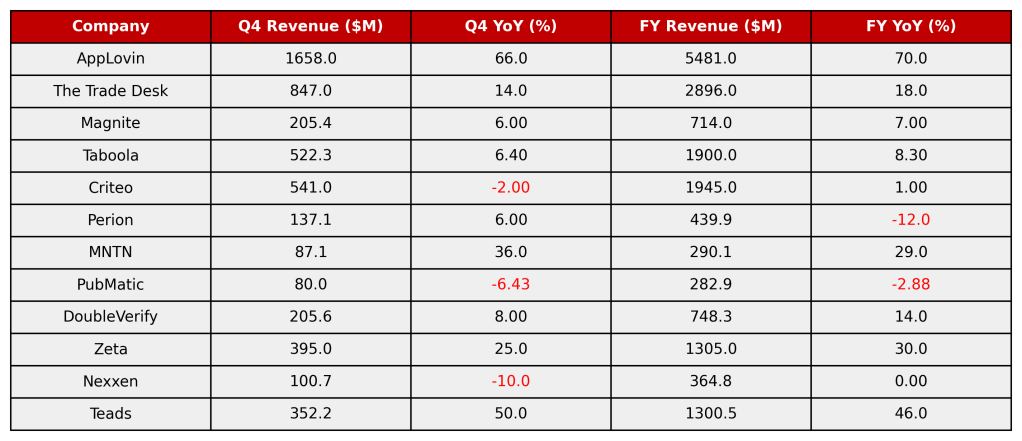
Below are some highlights of the round of earnings calls, with all management teams stressing disciplined spending and prioritizing profitability over aggressive expansion, although some hinted at potential (selective) mergers and acquisitions.
Other common themes that emerged included AI-driven product development, with teams at Zeta Global, Criteo, and The Trade Desk emphasizing this as a key growth driver, lauding its potential for automation and predictive targeting.
Meanwhile, companies exposed to commerce media — notably Criteo and Taboola — acknowledged retail media softness and uneven advertiser demand.
Furthermore, executives at Nexxen and PubMatic pointed to macro cyclicality, particularly in brand and CTV budgets — the pair credited their Q4 revenue declines to an unnamed demand-side platform, with many assuming it wasThe Trade Desk.
AppLovin continued its run as the standout player in the sector, in terms of revenue, although analysts questioned the impact of AI disruption, particularly whether generative AI lowers barriers to entry in gaming and ad tech.
However, AppLovin’s team rebutted this thesis, arguing that rising bid density strengthens economics, not weakens them, and that when competitors win impressions, they often win lower-value ones, allowing AppLovin to collect fees without sacrificing margin.
However, its stock price dropped precipitously after its Feb. 11 earnings call, with investors widely believed to have doubts about AppLovin’s ability to sustain its growth rates.
Meanwhile, The Trade Desk faced queries about the competitive landscape, as well as softness in spending from automotive and CPG advertisers, which represent almost a quarter of spend on the platform.
Management acknowledged the latter but argued that strength in tech, pharma, and travel offsets the drag, and emphasized the growing awareness among advertisers of Big Tech’s inherent conflict, calling out Amazon’s DSP as a particular concern.
However, a perceived softness in The Trade Desk’s Q1 earnings guidance saw the DSP’s stock price drop sharply after its Feb. 25 disclosure, albeit market rumors over unsolicited takeover bids, and reports of talks with OpenAI — not to mention a $150 million stock buyback from CEO Jeff Green — prompted a more recent uptick.
Similarly, softness in retail media spend saw Criteo’s Q4 revenue decline 2% year-on-year to $541 million, while FY earnings, $1.9 billion, up just 1% year-on-year, meant it missed analysts’ predictions, resulting in a subsequent 9% drag on its stock price on Feb. 11.
In discussion with analysts, Criteo’s leadership was probed on monetizing its agentic commerce experiments, fielding questions on performance — early testing shows 60% uplift in recommendation relevance — and timelines on when these initiatives can contribute significantly to subsequent earnings reports.
The latter question was later answered with the March 2 announcement of its partnership with OpenAI for ads in ChatGPT, helping reverse the earlier downward trend in its stock price as markets grew excited.
* LiveRamp uses a different fiscal calendar from most of the ad-tech cohort. Its results for the quarter ended Dec. 31 2025, revenues were $212 million, up 9%.


More in Media Buying

How Amazon turned its Thursday Night Football into a two-pronged pitch to capture ad dollars
TNF’s the jewel in Amazon’s Prime Video sports portfolio, and a lever for endemic and non-endemic media budgets.

Media Buying Briefing: How are the 2nd tier holdcos separating themselves from the Big Three?
Just under Publics, Omnicom and WPP, the scrum among a handful of holdcos and indies to stand out yields some interesting moves.

Addressability is back as a headline concern for attendees at this year’s Prebid Summit
Speakers decry ‘UMPs’ as the new ad networks, with talk far outweighing understanding.