Join us Dec. 1-3 in Nashville for the Digiday Programmatic Marketing Summit
YouTube is turning audio into an ad product — SiriusXM is selling it
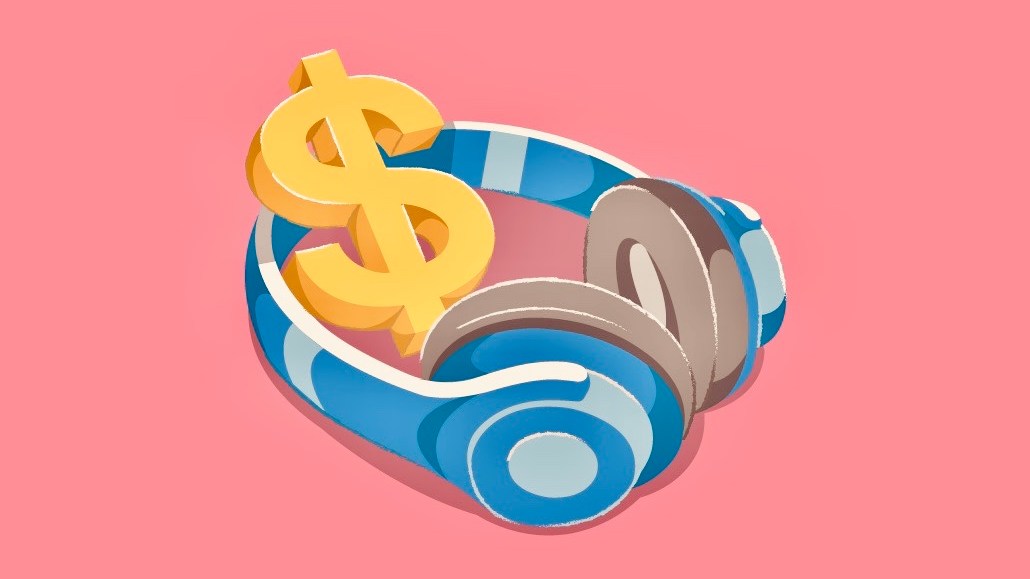
YouTube wants to make more money from the people listening to audio on the platform, and it’s turned to SiriusXM Media to do it.
The two companies have struck an exclusive deal that hands SiriusXM Media the rights to sell YouTube’s “audio-first” inventory in the U.S. — or the impression generated when someone is listening to something on the platform rather than watching. That includes background music streams, podcast playback and talk-format content.
YouTube came to the audio firm about a year ago with data showing how much of that behavior was happening on the platform, and concluded the expertise to monetize it wasn’t sitting in-house – laying the groundwork for the partnership.
“For the first time, we’re able to aggregate all of this audio inventory and better monetize that audio listening behavior on YouTube across every podcast that is actively being listened to, and that should flow through to the creators directly and be a net benefit,” said Scott Walker, chief advertising revenue officer at SiriusXM.
Going forward, SiriusXM Media confirmed that all inventory will be guaranteed impressions and advertisers who want to buy YouTube ads will need to buy it through SiriusXM Media. Financial details of the agreement were not disclosed.
The deal’s commercial logic rests on one assumption that audio and video budgets don’t compete. Most advertisers allocate separately for each — video gets one pot, audio gets another, and the two rarely cannibalize each other. The problem for audio has always been that those pots aren’t equally sized; audio accounts for around 30% of media time but attracts roughly 4% of ad spend. SiriusXM’s argument is that this deal helps close that gap without forcing a trade-off, and that the conditions for doing so are better now than they’ve ever been. The display and search budgets that might once have absorbed that slack are under pressure of their own, as LLM-powered answer engines erode the referral traffic that made the open web a reliable place to spend. That money has to go somewhere. By repackaging YouTube’s audio-first inventory as a distinct, guaranteed audio product, SiriusXM can position itself as the destination — selling it against the audio budget line, one that has room to grow precisely because it has been so chronically underfunded.
“Think about the way OpenAI, Anthropic and some of these other LLMs are changing the way people access and discover content, what is traditionally known as the open web display,” Walker said. “There’s a lot of traffic that was formally search referral traffic shifting to these answer engines.”
Currently, SiriusXM’s core subscription business is shrinking, according to the company’s earnings reports. During 2023, its self-pay subscribers were recorded as being around 34 million, which fell by 445,000 year over year, a further 296,000 decrease in 2024, and dropped another 301,000 in 2025. At the same time, its ad business is clearly the growing bet, noted by the year-on-year growth, achieving $1.76 billion in 2023, $1.77 billion across 2024 and 2025. In particular, podcast ad revenue grew by 12% in 2024, and 41% in 2025, per the most recent earnings reports, though specific breakout figures weren’t provided.
“In theory, this deal will let SiriusXM find the same people when they are on YouTube and fill in some of those gaps,” said Jamie MacEwan, senior research analyst at Enders Analysis, noting that it seems to be more about reaching scale and depth in a way SiriusXM’s own platforms alone can’t.
SiriusXM is effectively betting that advertisers will favor openness. But whether that bet pays off remains an open question.
“Two distinct plays are emerging: Spotify’s walled garden — owning the inventory, ad tech, and measurement — versus the YouTube-SiriusXM bet on opening the pipes and meeting buyers in the programmatic stack,” said Maija Hoehn, CMO at Broadhead. “For advertisers, it’s scale and interoperability on one side, exclusivity and first-party depth on the other. Which model wins at scale is still unsettled.”


More in Marketing
AI boosts discovery but reviews still seal the deal, new research shows
ChatGPT is where 16% of shoppers start looking for products. However, only 9% go there to actually buy something.

Future of Marketing Briefing: Advertisers have more ways than ever to choose a holdco, and free holdcos to choose from
Fewer holdcos, more ways to pick one: inside the changing agency pitch.
Walmart Connect pitches brands directly as it pushes lift studies ahead of holiday ad deals
Walmart Connect is using lift studies to prove ad performance directly to brands ahead of the holidays, signaling a tighter race with Amazon.