Join us Dec. 1-3 in Nashville for the Digiday Programmatic Marketing Summit
In Graphic Detail: Why OpenAI’s ad business is still a work in progress

OpenAI is reportedly heading toward a public market debut as early as September — a listing that could value the company at around $1 trillion. Right now though, it’s still learning how to be an ads business.
Just 15 weeks into its ChatGPT ad pilot and the platform is already dealing with many of the tensions that have defined every major digital ad platform before it: scale versus safety, automation versus control and advertiser expectations versus product reality.
Digiday charts the promise, and early tensions, behind OpenAI’s ad business.
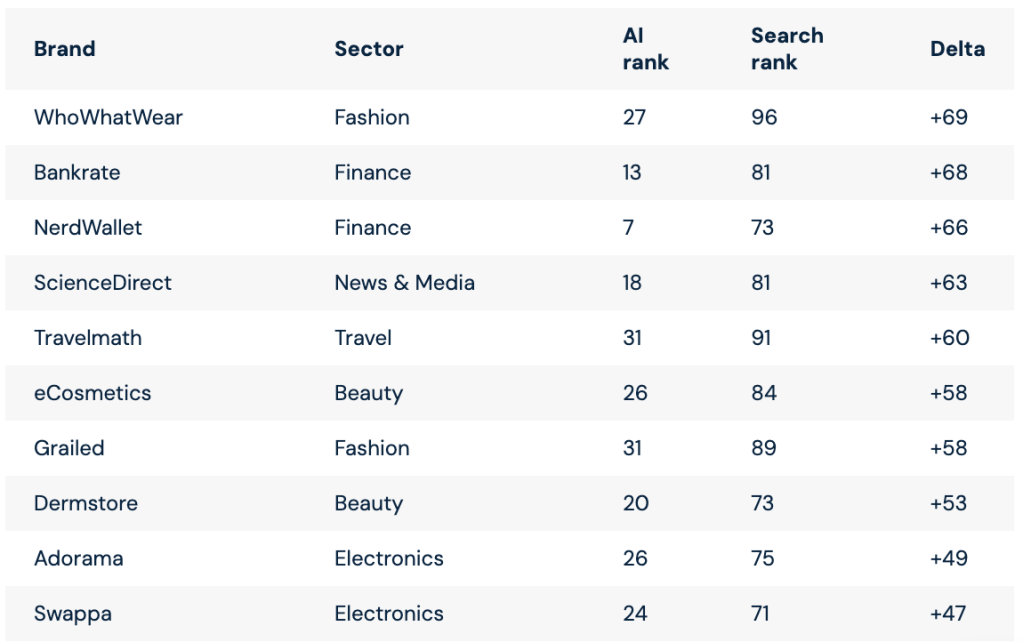
AI search is changing the rules of brand discoverability
There’s a clear divergence between traditional search and AI-driven discovery. And it turns out that a consistent group of brands surface far more prominently in AI search results, rather than their typical branded search.
Which makes it clear that brands can no longer see AI search as optional.
And Similarweb’s 2026 Generative AI Brand Visibility Index makes the case clearly. What separates these brands is how their information is structured and surfaced: pages designed in a way that makes content easy for LLMs to extract and interpret. As ads are now being integrated in a number of markets for ChatGPT, and as the rollout continues to expand, that same principle is increasingly what determines who shows up and who gets left behind. Effectively, discovery in AI environments is becoming structurally separated from traditional search ranking.
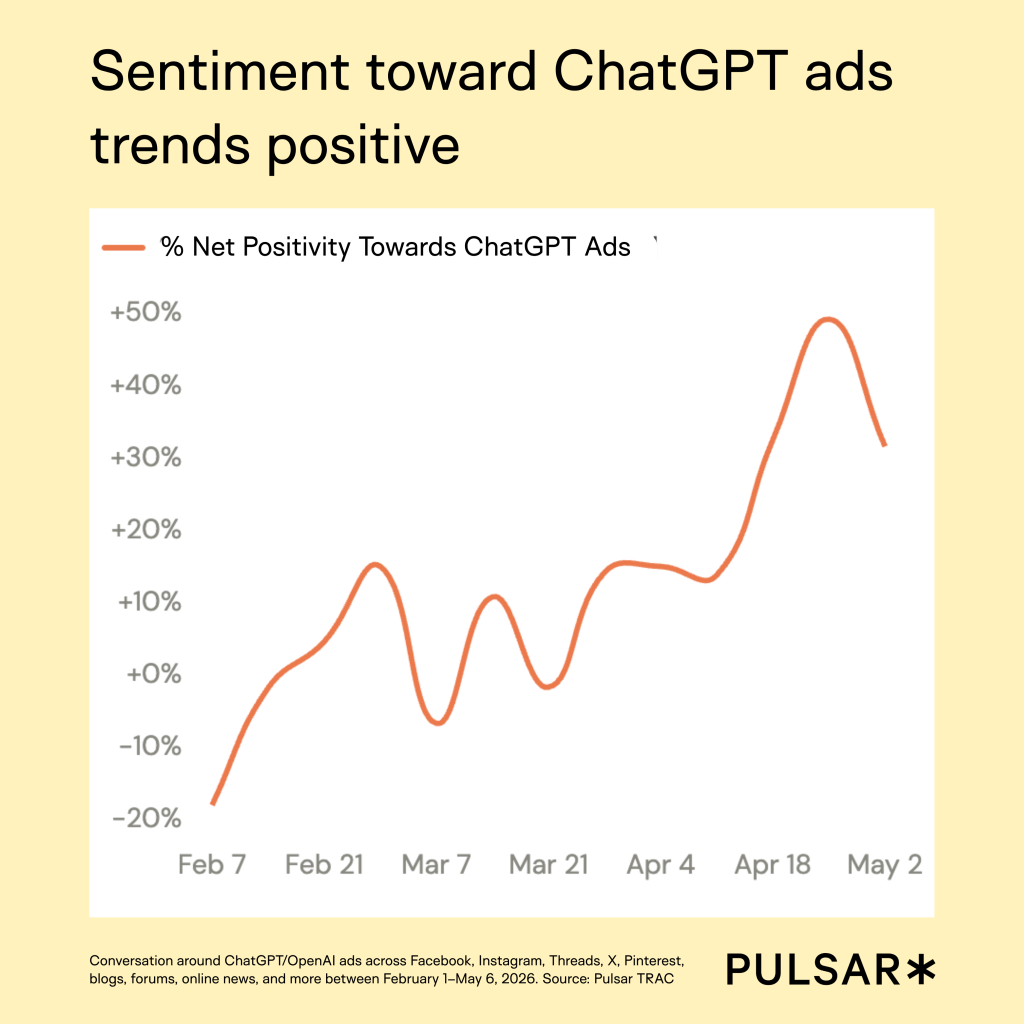
ChatGPT ads are actually viewed a lot more positively
Turns out, since the ChatGPT ads pilot began on Feb. 9, the sentiment toward it has seen a positive trajectory — though not without its swings.
Public reaction started out as a backlash-to-acceptance curve, according to Pulsar, starting with -17.9% at launch to 49.3% by mid April — a 67.2% increase. Which is no surprise. That earlier stage was marked by OpenAI’s Super Bowl ad and the broader conversation around it compared to Anthropic’s positioning, as well as OpenAI signing a deal with the Pentagon, while Anthropic had declined it.
“As the conversation expanded beyond core AI users, marketing and business communities became some of the strongest positive voices, reframing ads as a sign of platform maturity rather than decline,” said Dahye Lee, senior marketing innovation lead at Pulsar.
But improving sentiment alone doesn’t change advertisers’ experience inside the pilot. While perception has shifted toward optimism, early execution has still been defined by under-delivery, limited inventory and early-stage infrastructure constraints, as OpenAI prioritizes caution over scale in the early build out of its ad business. That gap between perception and execution remains central to the early tension in its ad rollout.
At the same time, ChatGPT usage is slowing
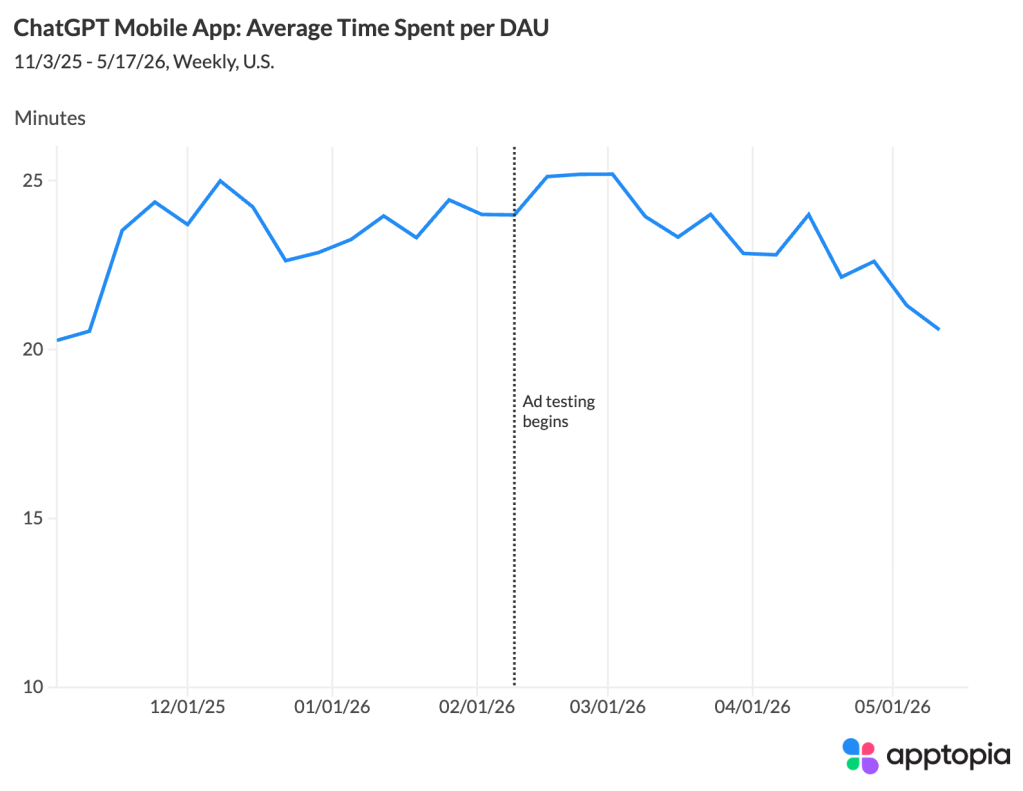
ChatGPT’s engagement levels aren’t moving in the direction you’d expect for a scaling ad business, or at least not yet.
Average time spent per user was broadly stable in the immediate weeks after ChatGPT introduced ads to its platform, according to Apptopia, but a clearer trend emerges as time goes on.
Between March 2 and May 11, daily time spent per daily active user fell 18.3%, from 25.2 minutes to 20.6 minutes, according to Apptopia. Even its power users — those who are within the top 10% by engagement — time spent declined 14.5% during the same time period. While the data doesn’t suggest that there’s a direct link between ads appearing and usage slowing, it does indicate a broader shift in engagement patterns during the early pilot rollout period. Taken together, it suggests engagement is not yet accelerating in line with monetization ambitions and expectations.
OpenAI has some hefty revenue targets to reach
Despite these early signals, expectations for monetization remain extremely aggressive.
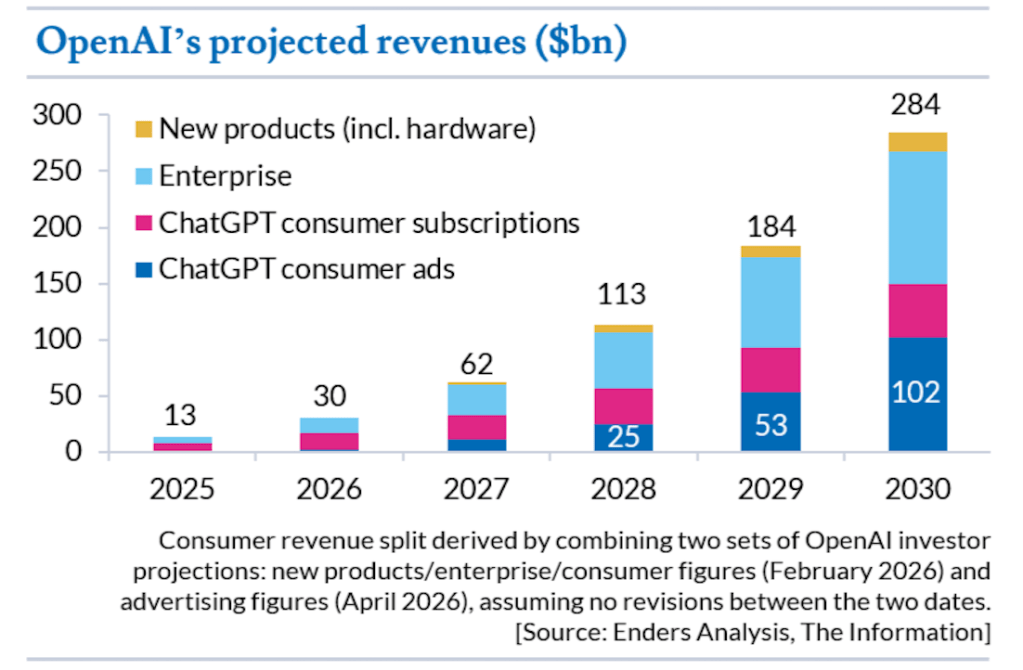
OpenAI has so far been confident in its ability to make advertising a meaningful revenue stream within the next few years.
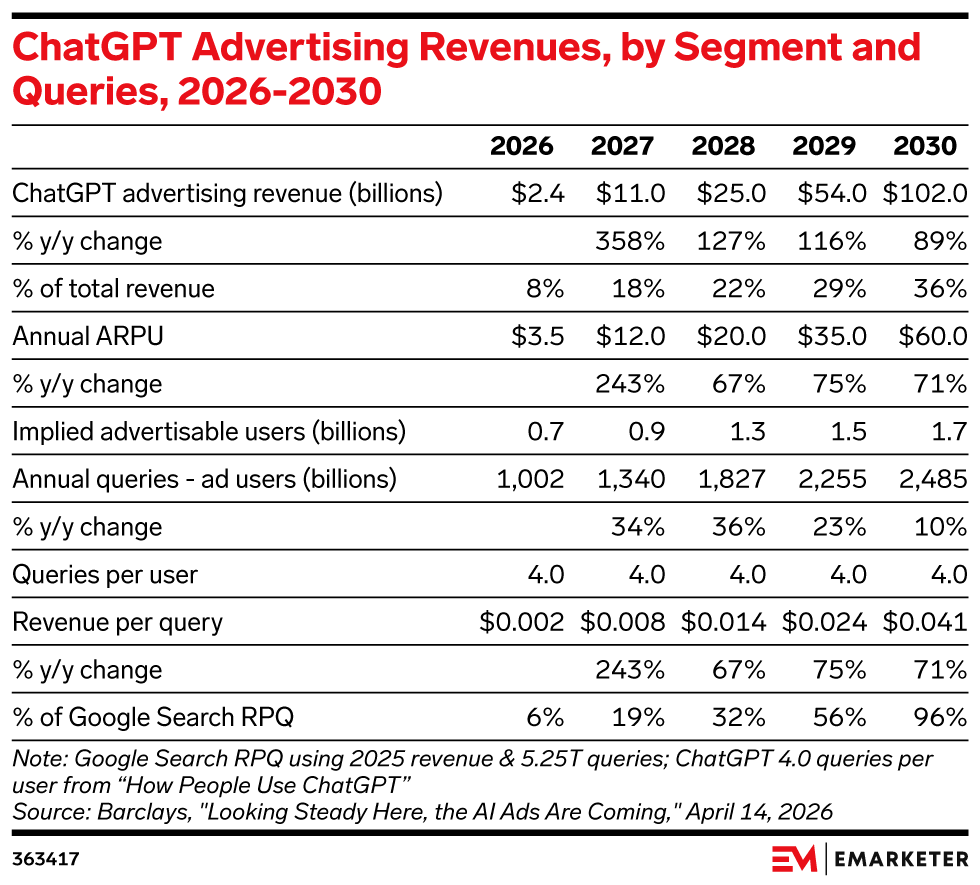
It was reported in April that OpenAI projects it’ll achieve $2 billion in advertising by the end of 2026, rising to $102 billion by 2030. And Enders Analysis has charted how it expects that to grow. Within the next two years, Enders projects that OpenAI will record about $25 billion in ChatGPT consumer ads — a 1150% increase from where it is now. That figure is expected to more than double in 2029 to $53 billion and again to $102 billion by 2030. The scale of those forecasts sits in sharp contrast to the early-stage constraints still visible in the pilot today — and to current engagement trends.
Monetization depends on increasing value per interaction
Ultimately, for OpenAI to reach those figures, it has to monetize each interaction more aggressively over time.
As conversational search matures, eMarketer expects revenue per query to increase from $0.002 in 2026, up to $0.041 by 2030, driven by higher-value commercial interactions and improved ad load within ChatGPT responses. And similarly, eMarketer projects that annual ARPU will increase from $3.50 in 2026 to $60 by 2030.
The question is no longer whether ChatGPT can carry ads, but how each conversation becomes monetizable at scale.


More in Marketing

Ruggable’s new ad spend strategy shifts focus to ShopMy creators
Ruggable is shaking up its marketing stack, pulling dollars our of Meta and into ShopMy creators ahead of a potential IPO.

Future of Marketing Briefing: The holdcos long, awkward courtship of the C-suite
What holdcos risk when they go over the CMO’s head.

Brands turn to content series and Jimi Hendrix to improve AI search performance
Guitar brand Fender and amp-maker Marshall both recently launched content series aimed, in part, at improving their visibility in AI search answers. It’s part of a greater pattern.