Media Briefing: In the AI era, subscribers are the real prize — and the Telegraph proves it

This Media Briefing covers the latest in media trends for Digiday+ members and is distributed over email every Thursday at 10 a.m. ET. More from the series →
This week’s Media Briefing dives into Axel Springer’s acquisition of The Telegraph, breaking down what assets are more valuable and how it positions the publisher for growth in the U.S. and the AI era.
- Layoffs at social-first publisher LADbible as it pivots to IP-growth strategy.
- GEO versus SEO: Here are the misconceptions.
The resilience of the Telegraph’s subscription business
Axel Springer’s acquisition of the Telegraph isn’t just about adding a legacy brand — it’s a bet on the value of its subscriber base and the newsroom that keeps those readers paying. And right now, that’s a lot more valuable than raw page views.
In an era where AI is eroding referral traffic and third-party distribution, a subscriber who pays directly has become the most valuable reader a publisher can own. Springer just bought over a million of them.
As AI makes information faster and easier to access for everyday users, the traditional news industry is facing fundamental disruption, stressed Amir Malik, managing director of digital transformation consultancy Alvarez & Marsal Digital. But for subscription-based news titles, reader loyalty can trump the disruptive effects of AI and free-access alternatives, he noted. “Journalistic voice and tone still matter. Therefore, a capture of the top subscription-based titles is a good investment for media conglomerates,” he said.
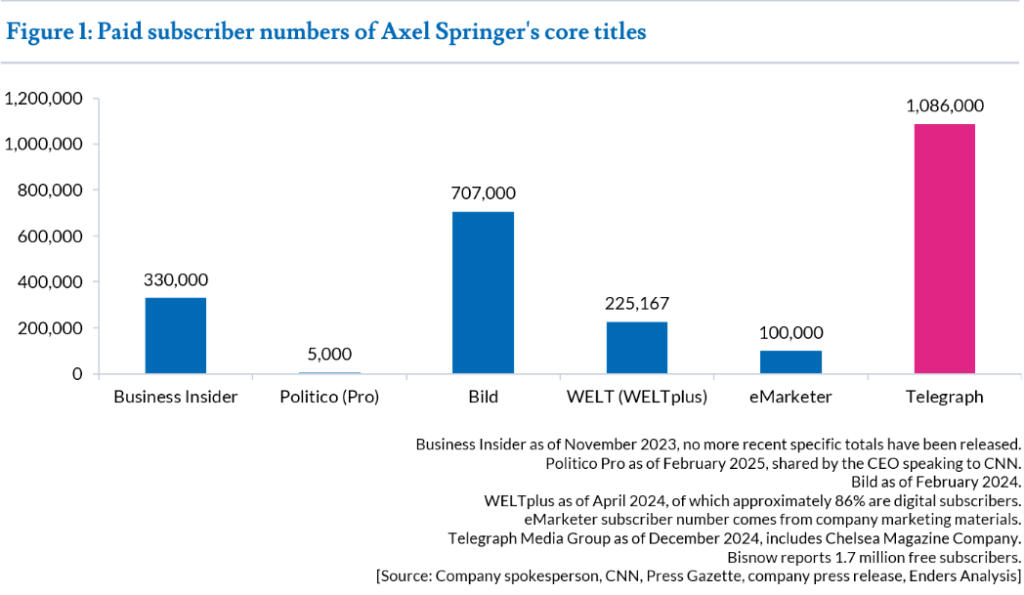
If you look at Springer’s English-language portfolio, the properties sit at very different points on the spectrum of platform dependency, noted head of publishing at Enders Analysis Abi Watson. Business Insider depends on search and social for most of its traffic, and paywalls haven’t exactly helped (though it has built a strong subscriptions foundation): when visits dropped, so did revenue. Morning Brew is a direct hit, but mostly at the top of the funnel. Politico Pro serves a tiny slice of paying professionals, though it’s extremely valuable. Combined, the English-language portfolio is ad-dependent and double-exposed — to both traffic shifts and advertising swings, stressed Watson.
“The Telegraph sits almost at the opposite end of the spectrum,” she said. “Its relationship with readers is direct, and 81 percent of its core revenues come from readers — whether through subscriptions or circulation — vs. 19 percent from advertising [per its latest earnings]. That’s a fundamentally different and more resilient model, and it rebalances Springer’s English-language portfolio away from ad dependency,” added Watson.
The Telegraph has a revenue structure that still leans on print – roughly 60 percent of the mix – with digital making up the remainder. Shifting that balance will be a priority for Springer, and it’s an owner with a strong track record of navigating exactly that kind of transition. CEO Mathias Döpfner’s framing: “digital is the new print, AI is the new digital” — signals where the real ambition lies.
For Springer, AI isn’t a single initiative but a three-pronged deployment: adapting content formats to individual users across audio and video; streamlining internal operations through automated drafting, tagging and summarization and reducing dependence on Google and Meta for traffic – a priority that has sharpened as referral traffic from both platforms has fallen, added Watson.
Quick numbers recap (mostly from The Telegraph’s latest earnings report).
- Axel Springer bought The Telegraph for £575 million ($773 million) from From RedBird IMI
- The Telegraph has 1.09 million paid subscribers; 842,000 are digital-only.
- Digital subscription revenue rose 18 percent to £81.1 million ($109 million) in 2024.
- Digital advertising revenue: £20 million ($27 million) in 2024.
- Total turnover: £279.4 million ($375 million).
- Daily subscriber page views were 6.5 million in 2024, and 2.4 billion subscriber page views in total.
- Total dwell time of 71.4 million hours on the Telegraph website and 74.9 million hours on the app.
- Video content was watched for a total of 15 million hours and viewed over 534 million times.
- Readership skews older: more than a third are over 60 years old, but it retains a strong hold on younger readers with nearly half aged between 18 and 39, per YouGov data.
Subscription growth keeps defying the ‘fatigue’ narrative
In a crowded subscription economy, people typically keep only a few paid media products. That means publishers that already have strong subscriber bases — like The Telegraph — hold something very valuable: habitual paying audiences. The subsequent recurring revenue, authenticated, direct relationship with audiences and first-party data are particularly valuable if traffic from search continues to become less predictable.
Most publishers across the world have tripled their digital subscription base since 2019, doubled monthly sales rates, and maintained churn below 5 percent, per INMA Subscription Benchmarks, an ongoing study tracking business performance of 317 news brands globally.
Subscriptions are climbing fast at The New York Times, WSJ, and The Guardian, while Bloomberg’s have remained steady and the Daily Mail continues to expand its relatively new subscription business into the U.S. and Canada.
Digiday’s third annual Subscription Index found that publishers increased subscription prices by 5 percent year over year in 2025, based on a cohort of 14 publishers.
“‘Subscription fatigue’ is like the Loch Ness monster. Many talk about it; nobody has really seen it,” said Greg Piechota, head of reader revenue and subscriptions program, INMA. “The real challenge is not subscription fatigue; it’s identifying new segments and targeting them effectively.”
Turning the U.S. into a growth market
Naturally, the expat market for any U.K. title in the U.S. is a ceiling, not a growth strategy. Pushing beyond the approximately 700,000 expat market (per U.S. Census data) will be table stakes. “The real goal must be American readers,” said Piechota.
The same goes for any advertising ambitions it will have in the U.S. market. If The Telegraph homes in on American readers, then they’ll have a “tight pitch out of the gate,” with clarity and data on what they’re selling — audience, ad products, packaging, and measurement strategy, which can give them a foothold to build on, said INMA’s advertising initiative lead Gabriel Dorosz.
“Keep it simple so you can build some momentum and gather some market-specific audience campaign data, which will be the first questions from potential clients,” he added.
Naturally, Springer can lean on a proven playbook from its U.S.-first brands, Politico and Business Insider, as it charts the Telegraph’s expansion. The U.S. news market is crowded. But the size of the opportunity is worth the risk, analysts say.
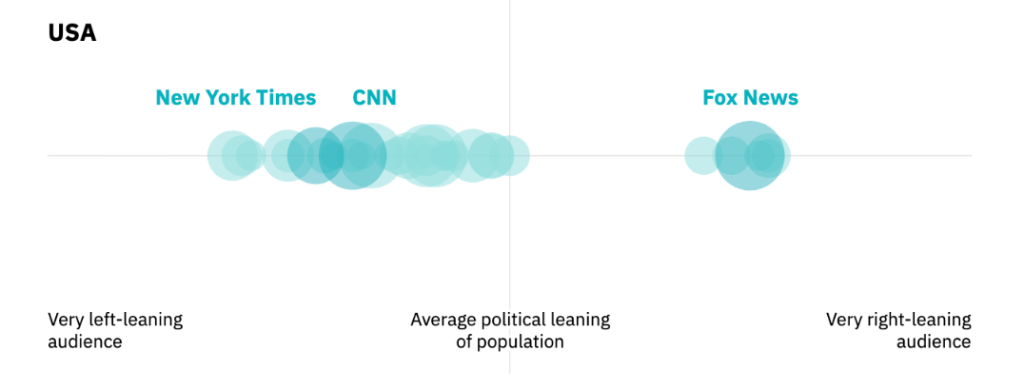
Oxford’s Reuters Institute analyzed audience polarization in the U.S. and found that multiple outlets engage audiences that skew left of the national average, while only a few focus on the right side of the spectrum.
“Brands such as Fox News and similar sit largely in the free opinion ecosystem — cable television, talk radio, podcasts, Substack writers — not in paid premium journalism. That leaves potentially a structural gap,” said Piechota. “A British right-leaning newspaper like The Telegraph could position itself not as another U.S. newspaper but as a proudly conservative and independent voice.”
Breaking into the U.S. comes with a familiar challenge: gaining brand recognition to drive direct traffic. U.K. competitors like the BBC, the Guardian and the Daily Mail have managed to crack it, though — all ranking in the top 20 U.S. news sites, according to Similarweb data.
Launching abroad no longer requires a massive new newsroom or infrastructure to start. Early investments in high-profile journalists with established audiences, strong editorial voices in key niches and an audience team that distributes content effectively across platforms will be good areas to prioritize, per Piechota.
“The goal is to build authority and influence, not simply headcount,” he said. “Rather than focusing on size, a better question is which roles create the most impact.”
It looks like The Telegraph is doing just that, currently hiring for two important roles – a U.S. chief correspondent (whose remit will include developing a team of U.S. reporters) and a U.S. bureau chief, both of whom will be based out of Washington, D.C.
On average, for every 500 paying digital subscribers, a publisher can pay a full-time editorial salary, according to INMA financial data benchmarks. Starting with a small number of hires and then scaling the newsroom in line with subscriber growth is the best bet, per Piechota.
The same goes for the sales structure. “The markets are different, but not radically, so conceivably stage one could involve a few sellers on the ground in the U.S. supported by ops from elsewhere, and they could get more ambitious from there on staffing and growth,” added Dorosz.
Update: An earlier version of this article referred to a 2014 spike in Bloomberg’s subscriptions, but they have in fact remained steady throughout that time.
What we’ve heard
“For the first time in a long time, there are four major DSPs duking it out with each other. And like, competition is good. You’ve got The Trade Desk, Google, Amazon and Yahoo. – they are all material and they are all duking it out. I think that’s a good thing [for publishers.]”
– Paul Bannister, chief strategy officer, Raptive.
Numbers to know
- $771 million: What Axel Springer paid for The Telegraph.
- 138.7 million: The year-over-year drop in LADbible Group’s Facebook video engagement.
- 52 billion minutes: How long audiences spent watching long-form, episodic creator shows last year.
- $22.8 million: the contract value of Thomson Retuers’ provision of an investigative database used by ICE.
What we’ve covered
- LADbible Group is cutting approximately a dozen staffers on its social video team based in Manchester, in the U.K. This comes after a round of layoffs to the social video team in London last fall, which impacted about 10 people, according to people familiar with the matter.
- CEO Solly Solomou said the cuts are part of its reprioritation around building scalable brand-led IP, deepening creator partnerships and investing in areas where we have greater control over distribution and long-term value creation.
Read more here.
AI surfacing is messy: Data shows publisher visibility and traffic often misalign
- Tracking AI search visibility remains a mess.
- The publishers most frequently cited in AI chatbot responses are also among those getting the most AI referral traffic. However, their rankings don’t align, suggesting visibility in AI answers doesn’t guarantee clicks.
Read more here.
GEO hype busted: How it differs (and how it doesn’t) from SEO
- Myth: GEO isn’t reinventing the SEO wheel: Most GEO tactics rely on the same fundamentals as SEO.
- Myth: GEO vendors can track AI visibility clearly: This is a murky business. Many AI visibility tools don’t have access to the actual prompts that users enter into AI search tools.
Read more here.
Long-form creators eye taking over TVs – and chasing bigger brand budgets
- According to Spotter, “creator TV” sits at an untapped center of the social video ecosystem, representing around 7,000 creators making long-form (defined as longer than 20 minutes) episodic content that pulls in more than 28 billion watch hours annually in the U.S.
- Digital marketers say they’re also seeing audiences follow creators from YouTube channels onto TV screens.
Read more here.
What we’re reading
YouTube expands AI deepfake safeguards
YouTube will now use AI to flag deepfakes involving politicians, government figures, and journalists.
Politico founder plots new Washington newspaper war
One of Washington, D.C.’s top media investors is aiming to reignite a historic rivalry by taking on the struggling Washington Post.
The IAB Tech Lab has officially launched its AI licensing framework
This framework — called AI Content Monetization Protocols — will set standards around how publisher expect to be remunerated for their content. Whether LLMs engage remains an open question.
Thomson Reuters staff want ICE access to company tools cut off
More than 200 Thomson Reuters employees have signed a letter to management asking that the company not renew the ICE contract when it expires in May.
Divided media landscape leaves Iran information-starved in wartime
Iran’s fractured media environment makes it especially difficult to access reliable information during wartime.


More in Media

How a ‘TikTok doctorate’ made 26-year-old Griffin Johnson a venture capitalist
Griffin Johnson made it big on TikTok back in 2019, now he runs a VC firm and uses his marketing expertise in the Derby world.

Media Briefing: Publishers debate the value of AI licensing and GEO
Publishers may be gaining visibility in AI search, but execs say the lack of traffic and licensing revenue is raising doubts about the payoff.

Meta’s bid to woo creators to Facebook just might work, despite its recent legal woes
Meta’s recent legal woes likely won’t deter creators from trying out its new Facebook Creator Track, according to marketing experts.