Media Briefing: Google’s latest core update a reminder that pageviews can’t remain the primary metric
This Media Briefing covers the latest in media trends for Digiday+ members and is distributed over email every Thursday at 10 a.m. ET. More from the series →
This week’s Media Briefing looks at the impact of Google’s latest core algorithm update on publishers’ search visibility, and how the changes signal a shift in rewarding scale and pageviews.
- Top U.S. news publishers lose search visibility
- The Atlantic sues Google, Arena Group leans into creators, and more.
- With AI-generated content so easy to make, it’s crunch time for brands, creators, and platforms. With consumer sentiment staunchly against AI, originality and authenticity are the major difference-makers in 2026.
- Brands are largely avoiding generative AI in deals with influencers and creators, and favoring authenticity more than ever.
- The Financial Times was the first U.K.-based publisher to strike a licensing deal with OpenAI in 2024. Matt Rogerson, FT’s director of global public policy and platform strategy, believes 2026 will be when big tech companies alter their stance on AI licensing to avoid future legal risk
- Digiday spoke with Rogerson about what’s changed — and why publishers may be entering a more constructive phase when it comes to AI remuneration.
- Yahoo’s demand-side platform has become a source of genuine curiosity — and in some cases cautious enthusiasm — among media buyers.
- Conversations with senior agency leaders point to tangible product progress: a clearer AI roadmap, an expanding commerce media footprint, and a more coherent identity spine.
- This year, TechRadar publisher Future wants to win the AI visibility game. The company rolled out a proprietary AI visibility tool, which has increased the volume of mentions and citations in AI search engines like Google’s AI Overviews and OpenAI’s ChatGPT, improving the brand visibility of its titles.
- Future is also selling it as part of branded content packages to brand clients to boost AI summary citations.
- 2026 will be the year authenticity gets repriced in the creator economy. Creators will focus more on cultivating a loyal community through thoughtfully crafted content, rather than chasing virality.
- With AI-generated content flooding social media platforms, embracing the messiness and imperfection of being human will help creators stand out.
Top U.S. news publishers lose search visibility
For years, big publishers treated Google as a distribution utility: publish a lot, cover everything and let domain authority do the rest. The December core update — rolled out Dec. 11–29 — is another sign that bargain is breaking. In multiple readouts, volatility hit news hard, and the sites that appear to be holding up best are those that behave less like general-interest news hubs and more like “the best answer” engines.
“A lot of the offshore, low-credibility news sites that randomly surged over the past year are gone. They grabbed visibility without earning trust, and this update looks like a long-overdue quality correction,” said Michael King, founder and CEO of a content marketing and SEO agency iPullRank.
Analysis by Aleyda Solís, international SEO consultant and founder at Orainti, found that sites with narrow, category-specific strength in search appeared to gain visibility against broader, generalist pages in several verticals. Publishers lost rankings for “best of” and broader queries that Google had previously treated as informational, according to Solís.
While it’s too early to draw conclusions, Solis’ early analysis from the December core update – the fourth major Google algorithm update in 2025 – looks less like a traditional SEO reshuffle and more like Google hardening its rankings to support AI-driven search experiences. Content that clearly resolves user intent — often niche, utility-led, and consistent — is easier for Google to trust, excerpt, and summarize, while scale-driven news output increasingly looks like noise rather than signal.Whether that reflects a deliberate move toward AI-optimized rankings remains an open question.
“Inside Google, there isn’t a clean line between classic search and AI search. The systems overlap heavily,” King said.
What is more clear to publishers, is that Google’s latest core update is a reminder that pageviews can’t be the North Star they once were.
63% of top U.S. news publishers lost search visibility
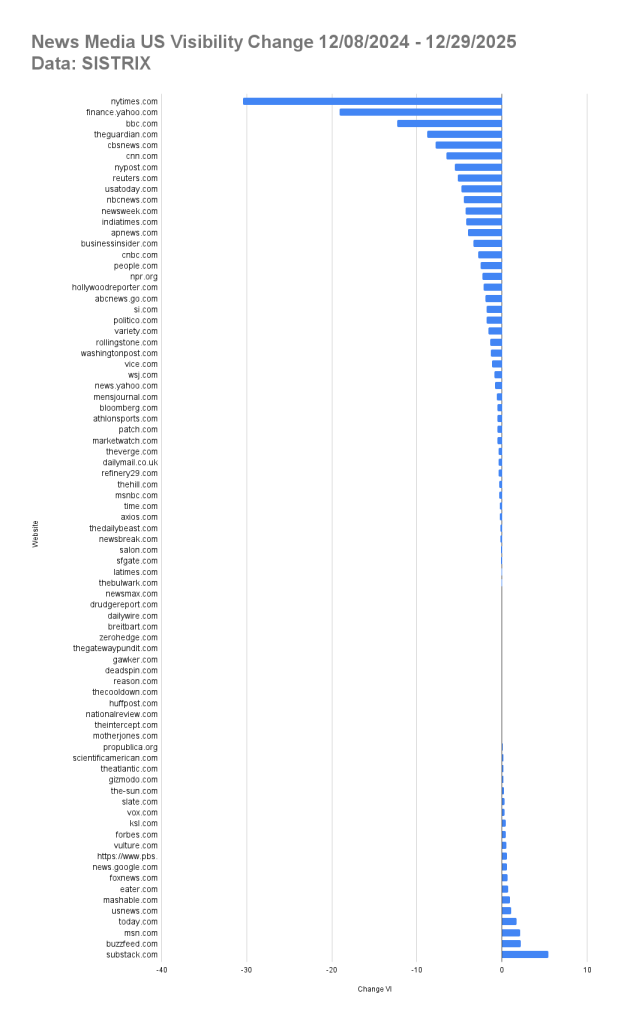
According to Digiday’s analysis of search visibility data from Sistrix of 79 news websites in the U.S., 29 of those sites (about 37%) experienced an increase in their search visibility score during the December core update, while the rest lost visibility.
The most notable increases in search visibility scores – which measure how visible a site is in Google search results (and how well that site is ranking) – were at Mashable (36.8% change), Substack (30%), Vulture (29.4%), MSN.com (21.7%) and The Intercept (19.3%).
The sites that experienced the biggest drops in their search visibility score included MSNBC (a 71% decline), Athlon Sports (59.2%), Newsweek (59%), Yahoo News (50.6%) and New York Post (45.6%).
News websites that experienced double-digit declines in their search visibility scores included Reuters, Politico, AP News, CBS News, NBC News, Daily Beast, Business Insider and The New York Times.
The New York Times, Yahoo Finance and BBC experienced double-digit declines in their search visibility scores. Meanwhile, Substack, BuzzFeed, MSN.com, Today.com and U.S. News increased their visibility scores by over a point.
More than two-thirds of major U.K. news websites saw search visibility drop during the December Google core update, according to Press Gazette. More than half of sites saw a double-digit percentage decline, with publications like The Guardian, The Telegraph, The New York Times and The Independent losing prominence in Google search results.
It’s still unclear how much this will impact traffic.
The upshot: the impact of Google’s latest update has been mixed. One publishing exec said they haven’t been able to put their finger on a pattern yet, in terms of why some of their sites were impacted by the algorithm change and why some weren’t. Another said they were still recovering from the July 2025 update, so December’s barely registered as anything different to the now-expected volatility.
The head of SEO at a large lifestyle publisher, who spoke on the condition of anonymity, said most of their sites saw an improvement in search visibility after the December core update, calling it a “nice New Year’s gift.”
Heads of SEO and audience have told Digiday it’s a bit like chasing your own tail if you make major SEO and content strategy changes in response to each update, and that the ultimate goal is to stick to traditional SEO guidelines while focusing on deepening audience engagement and conversions. The first publishing exec said spending too much time trying to understand these changes can be a “fool’s errand.”
“If you react to a mid-rollout snapshot and optimize for something that gets reverted, you’ve wasted effort,” iPullRank’s King said. “You don’t [change your fundamental SEO strategy] because the algorithm had a mood swing.”
Ultimately, publishers expect traffic from search engines to almost halve over the next three years, according to a new report from the Reuters Institute for the Study of Journalism, which included the views of 280 media leaders from 51 countries.
The report cites Chartbeat data showing that Google traffic from organic search to over 2,500 sites was down by a third globally between November 2024 and November 2025, and by 38% in the U.S. Google Discover traffic is also down 21% year over year, according to the report.
With the latest update, Google Discover “has been far more volatile than usual, which still feels like a pure zero-sum game,” King said.
Pageviews can no longer be the “God metric” it once was
This all leads back to why many publishers are on the quest for a new metric other than pageviews to measure the success of their businesses. Last year, one of the biggest shifts in SEO was that traffic can no longer be the golden metric for a successful SEO strategy. Heads of SEO at publishers told Digiday at the end of last year that they were spending significantly more time figuring out which KPIs to optimize for going forward this year. Many publishers are turning to subscription and registration conversions and engagement.
“We need to shift our success metrics internally because that is going to lead us to fully break away from thinking about scale or being distracted by scale, and really thinking about depth instead, said Forbes chief innovation officer Nina Gould. “We haven’t settled on exactly what those metrics are, we’re leaning toward a blended metric. We still need to get a [big] volume of people through the door but it makes sense to get the focus on the right people.”
Meanwhile, publishers’ visibility in AI Overviews has been “mixed” in the last 30 days, according to Prasanna Dhungel, managing partner at marketing intelligence firm GrowByData. While he has seen a “massive rise” in AIO visibility from mid December onwards,” that hasn’t correlated directly for publishers’ visibility in AIOs. However, according to King, sites that lost broad visibility in this update also lost AI Overview presence.
“For news publishers, SEO tweaks are no longer the lever. They don’t really control their own fate in search anymore,” King said.
— Jessica Davies contributed to this story.
What we’ve heard
“For us, we’ve seen nearly all our sites increase. Some remarkably.”
— A head of SEO at a lifestyle publisher on Google’s December core update impact to their sites’ search visibility.
Numbers to know
Over 3,000: The number of journalism job cuts in the U.S. and U.K. in 2025.
$30 million: The amount Semafor, the three-year-old startup media company, raised in a new funding round that values the company at $330 million.
$199: The annual cost of The Atlantic’s new family subscription product.
30: The number of people laid off at Politico.
What we’ve covered
After an oversaturation of AI-generated content, creators’ authenticity and ‘messiness’ are in high demand
Read more here.
Q&A with Financial Times’ head of global public policy and platform strategy on AI scraping
Read the annotated Q&A here.
Media buyers say Yahoo’s DSP is one to watch
Read more here.
Future starts to sharpen its AI search visibility playbook
Read more here.
Digiday’s extensive guide to what’s in and out for creators in 2026
Find out what’s in and out for content creators in 2026 here.
What we’re reading
The Atlantic sues Google over its digital ad model
The Atlantic has sued Google and its parent Alphabet, alleging they operate an illegal monopoly over digital ad tech, suppressing publishers’ revenues, TheWrap reported.
Google says it won’t pay for unpaywalled content for AI training
A top public affairs exec at Google told the U.K.’s Lords Communications and Digital Committee that the tech giant won’t pay for unpaywalled content for AI training, Press Gazette reported.
Arena Group leans into creators, commerce
Arena Group is looking at acquiring the IP of media brands, physical consumer products and e-commerce that can plug and play, according to A Media Operator.
McClatchy execs clash with newsroom union over AI
McClatchy executives are clashing with its newsroom union on how the company wishes to implement A.I. in the newsroom, with some initiatives having the potential to turn McClatchy into one of the most aggressive adopters of A.I. in journalism, Status reported.
Inside Hearst’s AI editorial strategy
Tim O’Rourke, vp of editorial innovation and AI strategy at Hearst Newspapers, discusses how the publisher is approaching innovation, what makes a newsroom AI trustworthy, and where he sees the biggest opportunities ahead, in a conversation with Storybench.


More in Media

People Inc.’s Jon Roberts on the AI licensing boom – and the revenue lag
People Inc’s Jon Roberts discusses the boom in AI content licensing marketplaces — and the revenue that could materialize for publishers.
YouTube is building infrastructure for the full creator-brand partnership life cycle
YouTube’s Gemini-powered Creator Partnerships promises to alleviate pain points in the influencer marketing pipeline.

Joint signings highlight growing convergence between creator and Hollywood agencies
What a spate of joint signings between Reign Maker Group and Paradigm Talent Agency tells us about diversifying talent and owning media in the creator economy.