Join us Dec. 1-3 in Nashville for the Digiday Programmatic Marketing Summit
Media Buying Briefing: Buyers grapple with incoming Amazon reporting changes
This Media Buying Briefing covers the latest in agency news and media buying for Digiday+ members and is distributed over email every Monday at 10 a.m. ET. More from the series →
Changes in the way that key media platforms measure impressions mean that performance and pricing benchmarks may be thrown into disarray come the new year.
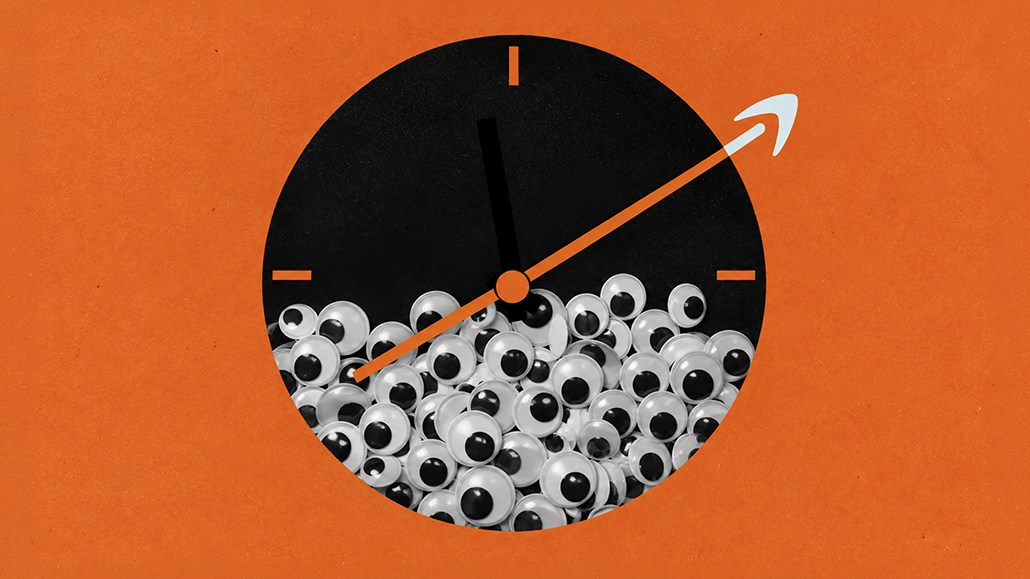
Amazon has estimated brands will see 63% fewer impressions for display ads appearing across its retail properties, including its homepage, product pages and search results, according to a notice distributed among advertisers seen by Digiday. It’s due to the platform’s decision to shift from counting impressions the moment they begin downloading to a user’s device, to when they actually render on the user’s screen, from Jan. 1. Google announced a similar transition at the beginning of September, effective Feb. 17; spokespeople from both tech companies declined to comment.
In turn, six buyers who spoke to Digiday said they’re working to amend reporting methodologies and soothe client nerves.

Buyers fear that a reduction in reported impressions could mean that supply is constrained, driving up CPMs. “If there’s going to be fewer impressions, your CPMs will be higher,” explained Hannah Schatz, vp of programmatic operations at Coegi.
At the same time, the stricter impression reporting methodology means that lower-impact display placements further down Store pages will become even less desirable for advertisers — while top-of-page slots that stand a greater chance of influencing shoppers will see an increase in demand.
“There’s going to be probably more competition on the platform,” said Nola Ladd, awareness media supervisor at media agency Collective Measures.
Amazon has not issued guidance regarding the expected impact on pricing or costs, or whether it might update its billing methodology around the new impression reporting, according to Stagwell Media Platform’s global product managing director, Dru Sil.
“The implications are up to us to discover,” he said.
While the drop in impressions might unnerve some clients, it’s unlikely to provoke advertisers to reduce spending. Sil suggested that most advertisers will maintain spending levels, in order to establish new performance benchmarks in January and February.
“I don’t expect clients to like dramatically scale up budgets to try to get ahead of the curve. You’re likely going to continue to run what you’ve been running because you have an expected outcome that you’re trying to obtain from Amazon, regardless of the specific ad format,” said Sil.
He added: “You need to build that baseline anyway, right? And the only way to build that baseline is to be running ads.”
Benchmarking may be the real problem buyers face when they shake off the new year’s hangover.
Automated reporting processes, or media mix models that use impressions as a key input, might need to be recalibrated to account for the expected drop in reported impressions. “If you have a lot of automated processes, optimizations, reconciliations, built around these data sets already, you’re going to have to do a little bit of work,” said Paul DeJarnatt, vp and head of investment at Novus.
For most buyers, Amazon’s and Google’s tinkering with impression reporting merely underlines the importance of focusing on outcomes, rather than media KPIs, to understand campaign performance.
“The bottom line is, we don’t expect this to change campaign results. The shift will make reporting metrics look different, but it shouldn’t move ROAS or CPA, which are the outcomes our clients care about,” said Jared Smith, senior director of strategy and innovation, January Digital.
“Impressions, CPMs, they shouldn’t be north star metrics,” said Ernie DeColte, svp of media at indie agency Level. “They’re tool metrics we use to optimize towards business impact. This might be a wake-up call to a few advertisers. Maybe it’s time to think about buying differently.”
Still, communicating this change to clients who might be alarmed when they see impression counts fall off a cliff (or CPMs spike) is something media buyers across the industry are attempting to get ahead of.
“The client, even though that metric is misleading, is used to seeing a big number,” said Ladd.
“They’re used to seeing really low CPMs. They’re used to seeing really great impression volume, and that change and that difference is going to require agencies and media experts to really think about the way that they present success to the client,” she added.
Color by numbers
Just because it’s got a donut graph doesn’t mean a report is saying very much. According to an Experian survey of 400 marketers, the profusion of dashboards and data isn’t helping marketers back up their decisions.
- 80%: the proportion of marketers who say the pressure to prove the impact of marketing is higher than before
- 76%: Over three-quarters of marketers say they have more tools and data than ever before, but 28% say they can consistently connect marketing with commercial growth
- 26%: The proportion of marketers who said they’re fully prepared for Q4
- 43%: Almost half of marketers surveyed said that delivering growth is harder than it was three years ago.
Takeoff & landing
- Omnicom Media had a good week last week, picking up global media AOR duties for Lufthansa Group, which includes multiple airline brands besides the core name, including Swiss, Austrian Airlines and Brussels Airlines. (The incumbent was WPP Media.) The holdco also nabbed pan-Asian media duties for Pernod Ricard, work that will be handled by Initiative.
- Throw another proprietary AI log onto the agency fire: Performance agency New Engen rolled out Bakery, its proprietary AI-powered platform developed by its Donut Studios creative practice to help brands scale the development of high-performing advertising creative.
- Personnel moves: WPP’s VML promoted Debbi Vandeven, its global chief creative officer to also be global president, effective in January and reporting to incoming global CEO Eric Campbell … Havas Media Network named Carey Loh to be CEO of its Singapore operations, succeeding Pankaj Nayak … Publicis’ Epsilon named Matt Simpson its first-ever chief international officer to accelerate international growth … Omnicom Media in Australia tapped Asier Carazo to be its first chief strategy officer, a new group-level role … Outdoor specialist agency Backbone hired Vanessa Allen as senior director of media and Chris Gibbons as director of performance media. — Michael Bürgi
Direct quote
“In the past, a company like Unilever, buying big media in Brazil from TV Globo, had a significant competitive advantage. Now you are buying from Meta or from Google or from Amazon or from Walmart or from TikTok, and that model doesn’t favor a scale of purchase. It favors the quality of engagement you generate on the platform.”
—Unilever CEO Fernando Fernandez, speaking during its Capital Markets Day last week, on why better creative could be the secret to making its marketing operation work harder.
Speed reading
- Ronan Shields covered the latest results from The Trade Desk, which posted a decline in revenue as its ill fortunes continue.
- I wrote about whether ad agencies should consider putting a hard ceiling on the amount of AI tokens their staff can consume, as a means of curtailing tech spending.
- Michael Bürgi spoke to the CEO of Playfly Sports about the shifting tectonics of sports coverage and local TV rights.
- Krystal Scanlon broke a smart story on the incentives Reddit is offering to advertisers, as the platform’s execs work to squeeze more Q4 revenue from bran


More in Media Buying

Playfly’s CEO explains why leagues are looking to consolidate local sports rights
Local sports rights have gotten more complex and confusing as the regional sports network business changed. The leagues are now looking to simplify that offering.

AI is turning ad tech into a fight for the brain behind the buy
As AI automates advertising workflows, the contest is shifting to who can make the decisions that deliver results.

Can web users trust ad tech’s server-side shift?
IAB Tech Lab’s Rowena Lam joined the Digiday Podcast to break down how Trusted Server works and address questions about the user privacy implications of ad tech’s server-side shift.