Join us Oct. 26-28 in Newport Beach for the Digiday Media Buying Summit
WPP CFO says The Trade Desk operates in a smaller slice of the ad market
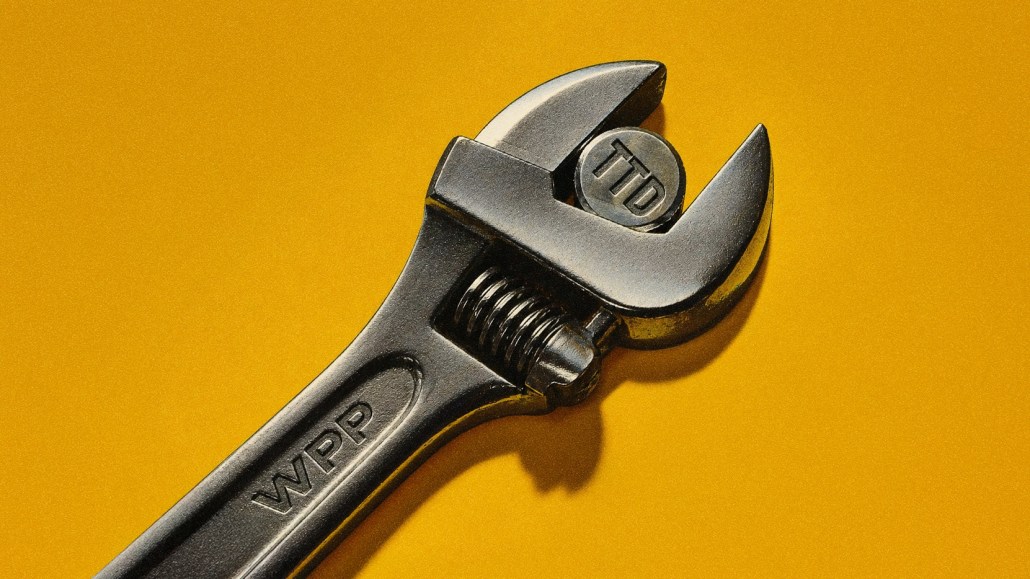
When analysts asked Joanne Wilson about The Trade Desk yesterday (April 28), WPP’s CFO was measured but substantive.
In fairness, she had to be. The holdco, like Publicis, Omnicom, and Dentsu, reportedly reduced the amount of ads it buys programmatically via the ad tech firm. It was that pullback that prompted The Trade Desk’s CEO, Jeff Green, to accuse the holdcos of manipulating programmatic supply chains to extract undisclosed margins on their clients’ ad dollars.
So when an analyst asked Wilson whether that friction between agencies and demand-side platforms signaled something structural, the question carried weight. Her answer carried more.
Wilson said WPP works with “a number of DSPs and SSPs,” making decisions “project by project, client by client.” The priority, she said, is “effective investment of our clients’ media spend and full transparency — transparency for our clients and transparency for our partners.” As for The Trade Desk specifically, it “operates in the open internet, so it’s potentially a smaller segment of the overall advertising market.”
When another analyst pressed for a harder number — the percentage of client money flowing through DSPs — they were told by another WPP exec on the call that the “open internet is the long tail” — i.e., a relatively small share of the overall market that “over time, is forecast to get relatively smaller.” No specific figure was provided.
Two things stood out throughout these exchanges. The first was the transparency framing — notable given that undisclosed fees and opaque supply chain practices sit at the heart of Green’s allegations. The second was the characterization of the open internet as a small and declining slice of overall spend, which has the effect of limiting the perceived significance of WPP’s DSP relationships at precisely the moment they are under scrutiny.
The open web has simply stopped becoming the easiest place to invest ad dollars, with more money flowing to streaming, paid social and retail, noted Matt Barash, chief commercial officer of Nova Studio. “Money isn’t leaving the open web because it doesn’t work. It’s leaving because other channels currently prove they work faster, cleaner, and closer to revenue,” he said. “Those platforms provide an element of partnership rather than vendorship that holdcos are clearly leaning into as they rethink their future roadmap and strategy.”
Investment closely correlates with time spent and consumer attention and that remains firmly entrenched in paid social and streaming, he stressed.
The holdco’s own numbers do little to contract it.
In 2023, WPP spent an estimated $1.1 billion with The Trade Desk globally — figures that came to light through the lawsuit brought by former GroupM exec Richard Foster against WPP. For context, it spent an estimated $1.4 billion on Meta in the U.S. alone. Yes, the numbers are dated but the forces driving them have only accelerated since. Alphabet, Meta and Amazon are forecast to collectively absorb 58.8% of global spend outside China by 2027, according to Warc. The walled gardens are, in other words, getting taller. The open internet is getting smaller. And the holdcos, rather than fight that shift, are increasingly building their own tech and data capabilities to sit closer to where the money is actually going.
What they do spend on the open internet will be sweated harder as a result — the margin opportunities that come with controlling the buying process are, after all, precisely what this dispute is really about.
Industry observers note that media agencies — especially holding company outlets with multiple revenue lines to protect or (more pertinently) evolve — are increasingly scrutinizing their media supply chains.
One source, who declined to be named in order to maintain relationships, noted how the current climate stands out from earlier supply-path optimization efforts.
This amounts to a shift from a “default on” to a “default off” mindset, among such parties. Gone are the days when the holdcos trusted all the vendors, and therefore spend money on them by default. Now, they are more ardent in their scrutiny, whereby vendors have to demonstrate the value of a new feature it offers before they will be awarded additional budget.
WPP Media, in particular, is said to be revisiting its approach to the online ad auction, as it detracts from its scaled buying power.
“From what I’m hearing, GroupM [WPP Media’s former moniker] does not want to participate in auctions,” said the source, adding that holding company agencies increasingly don’t want to participate in a simple price-based auction through an exchange.
Per the source, this means whenever WPP Media values an impression, it wants a direct, dependable path so that WPP’s bid is always actually shown to the publisher.
Five years ago, the trajectory was already clear — open auction was heading toward becoming a marginal revenue source, accounting for 10% to 20% of publisher revenue, noted Matt Prohaska, CEO and principal of Prohaska Consulting. The fact that it became a dominant revenue channel was arguably an accident of scale rather than a sustainable model. “Programmatic direct will continue to trend up in walled gardens and non-walled as quality rises above tonnage,” he said.
A tale of two halves
The public rebukes. The calculated audits. The commercial concerns. It all represents a significant souring of a relationship that, not long ago, looked like one of advertising’s more durable partnerships. The tensions that unravelled it were years in the making. As the holdcos built out their own digital buying arms and programmatic capabilities their interests and The Trade Desk’s began to pull in opposite directions — quietly at first, then in Green’s case, very loudly indeed. Now they are its prominent critics.
The traditional DSP is losing its central role in the ad buying stack as spend migrates toward platforms that control their own exclusive inventory: Amazon, YouTube, Walmart and similar closed ecosystems where the audience data, the inventory and the transaction all sit within the same walls, noted an exec who requested anonymity to maintain their DSP relationships. “TTD doesn’t really have a competitive offering. They dropped the ball when they were rumored to be considering a Roku acquisition in hindsight,” they added.
Where The Trade Desk money goes is an open question. Some argue Google and Amazon, The Trade Desk’s most formidable rivals, stand to gain most from the holdco pullback. Others point to the supply-side platforms — ad tech vendors that have spent years trying to pivot from helping publishers sell ads to helping advertisers buy them. Then there are those who note that at least one holdco has a dog in the fight: Publicis operates its own DSP through Epsilon, giving it a competing alternative to The Trade Desk and, some would argue, a commercial incentive to hasten its decline — something the group’s CEO Arthur Sadoun has denied. Whatever happens next, the programmatic supply chain will look different. The only real dispute is who ends up running it.


More in Media Buying

Publicis is selling directly to AI-anxious CEOs as it steps away from traditional pitches
Publicis boss Sadoun says agency group is skipping CMOs in more new business pitches, as Groupe notches up new business wins.
Ad Tech Briefing: Zeta goes big as Apple casts a shadow over Advertising Week
Advertising Week New York saw more ad tech M&A, plus, the rise of the “universal buying platform.”

‘An important capability for us’: PepsiCo CEO on Publicis switch
Pepsico’s Ramon Laguarta used a recent appearance in front of investors to champion the company’s decision to hand its global media account to Publicis Groupe.