Join us Oct. 26-28 in Newport Beach for the Digiday Media Buying Summit
‘Everything is coming down’: ChatGPT ads are getting cheaper
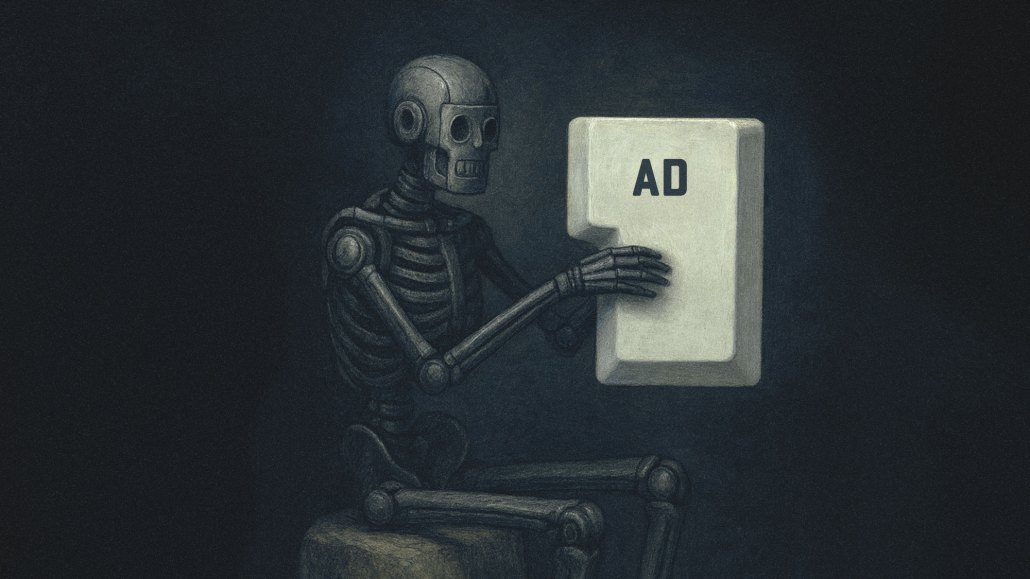
Advertising in ChatGPT is already getting cheaper. The rate advertisers pay to reach every thousand users has fallen from $60 at launch nine weeks ago to as low as $25 now — and counting.
It’s early days, but marketers quoted Digiday a range of prices.
Ad agency Jellyfish is currently onboarding its first client into the pilot. Jai Amin, the agency’s chief of media activation, said that while the $60 base rate holds, he’s seeing averages closer to $45 depending on composition for inventory.
Others are seeing it dip further. One ad exec said on condition of anonymity that they’ve been seeing CPMs range between $35 and $25 in recent days when buying the ads via Criteo. Elsewhere, the dip is steeper. Ad Age has reported prices as low as $15, though it’s unclear whether that was also routed through Criteo.
Normally, ranges like this can be chalked up to auction dynamics. At a basic level, high demand drives prices up, low demand brings them down. But ChatGPT doesn’t have a live auction yet. The more telling signal is the entry threshold; the minimum spend required to participate has fallen from $250,000 at launch to $50,000, widening the pool of advertisers and, with it, the range of what they’re willing to pay.
“It feels like everything is coming down, preparing for a wider auction accessibility to fit [a] global rollout,” said Ashley Fletcher, CMO of Adthena, whose clients have been part of the pilot since the start date on Feb. 9.
Even so, a CPM in the $25 to $45 range remains steep for a platform that is, by most measures, still experimental. The pattern, though, isn’t new. Netflix launched its ad tier at CPMs of around $55 to $65 in 2022. Within a year they had fallen to $20 to $30 as inventory scaled.
But Netflix could afford to take that long. It had something OpenAI doesn’t have yet — a clear value exchange users understood and trusted. They watched great content, ads were the price of being able to do that at a cheaper subscription. The proposition was explicit. ChatGPT’s appeal, by contrast, has been built partly on the sense that its answers are unmediated — that when it recommends a product or service, no money has changed hands. Introduce advertising and that perception becomes more difficult to maintain, regardless of what OpenAI says about keeping paid placements separate from organic responses. Until OpenAI can prove that ads inside a conversational interface deliver enough value to users that advertisers actually see it in their results, the CPM debate is somewhat academic.
“Google and Meta own industry measurement, and that’s the real moat, not the UI,” said Robert Webster, founder of AI marketing consultancy TAU. “Post-click is easy. Post-view at $60 CPM is hard. Until someone independent can verify what a ChatGPT impression is actually worth, advertisers are taking OpenAI’s word for it. That’s where the $102 billion projection lives or dies.”
For context on just how steep that climb is, consider where the rest of the market sits.
Facebook averages $4.82, Instagram $7.63, Google Display $10.33 and TikTok $3.02, according to Gupta Media. Those are mature platforms with years of scale, established measurement and proven ROI behind them. The more instructive comparison may be LinkedIn — currently $39.19 — which advertisers have long accepted as expensive because the context justifies it. OpenAI is making the same argument, it just hasn’t had as long to prove it, but it isn’t wasting any time trying.
Cost per action and cost-per-click models are in development alongside a conversion tracking that would give advertisers the attribution infrastructure the current pilot lacks. If those land, the CPM debate becomes secondary. Advertisers will care whether the performance data holds up.
Few platforms have moved this fast. In nine weeks, OpenAI has gone from no ad business to a self-serve ads manager, a Criteo partnership, a dramatically lower entry threshold and a dedicated ads leader in David Dugan. The speed reflects the pressure. OpenAI is bringing through $2.5 billion this year, Google and Meta aren’t standing still and its $102 billion ad revenue projection for 2030 leaves little room for a slow build. The pricing will take care of itself if the performance holds up.
OpenAI did not respond to Digiday’s request for comment.


More in Marketing
Brands turn to content series and Jimi Hendrix to improve AI search performance
Guitar brand Fender and amp-maker Marshall both recently launched content series aimed, in part, at improving their visibility in AI search answers. It’s part of a greater pattern.

Inside Dentsu’s plan to make entertainment a part of every brand’s budget
Why Dentsu thinks entertainment is the next agency account up for grabs.

Ikea’s CMO sees LLMs as the newest place a brand has to hold its line
LLMs have widened the brand. Ikea’s CMO thinks the basics still hold.