Join us Dec. 1-3 in Nashville for the Digiday Programmatic Marketing Summit

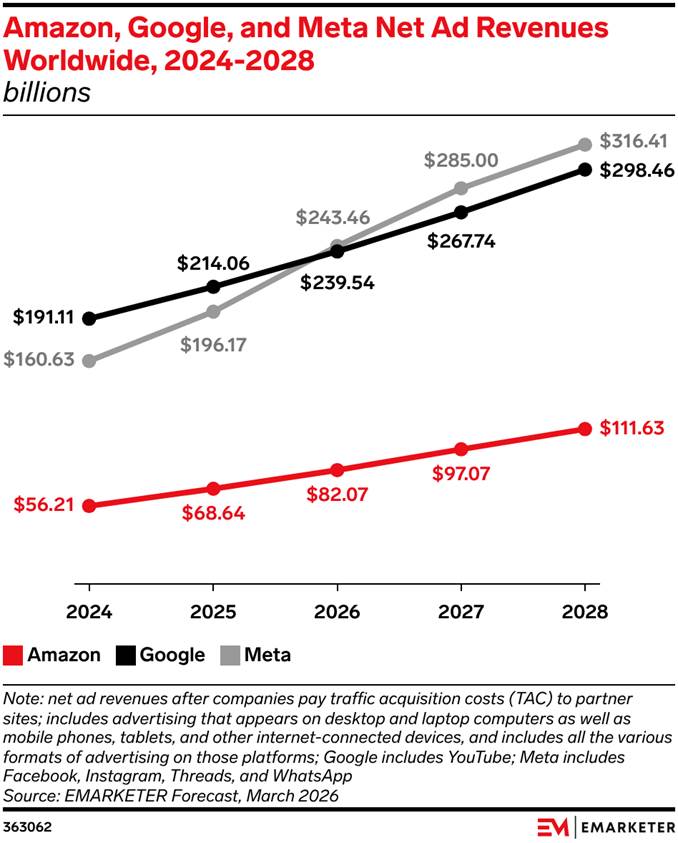
Tipped to become the largest advertising company in the industry in 2026, Meta is quietly laying the groundwork for a move into CTV advertising, according to multiple sources familiar with the discussions.
While the exact nature of its intentions remains unclear, such a move would extend its performance advertising offering onto the biggest screen in the home.
Digiday sources, all of whom requested anonymity to maintain relationships, say Meta has held a series of exploratory meetings since early 2025 with supply-side players, including Magnite and Comcast-owned FreeWheel — both of whom own two of the most prominent video ad servers on the market — as well as TV manufacturers, or “OEMs,” and publishers, to assess how it could access CTV inventory at scale.
While no product has been formally announced — and several sources cautioned that plans remain fluid — the nature of those conversations has led many to believe that Meta is likely probing a way to extend its advertising demand into third-party CTV inventory, in a model similar to Meta Audience Network, or “FAN” as many still call it.
‘FAN for the living room‘
Several sources described the likely end-state as a form of “audience extension” for CTV — effectively allowing advertisers to use Meta’s targeting and optimization tools to reach users on streaming inventory beyond its owned-and-operated apps.
That interpretation stems from the type of partners Meta has engaged. Conversations with SSPs and ad servers suggest Meta is less interested in building its own CTV supply from scratch, and more focused on plugging into existing infrastructure.
“They need the pipes,” said one source, adding that while Meta has the demand and data, it still requires access to premium video inventory aggregated by SSPs or controlled by TV manufacturers.
Those familiar with early-stage discussions said Meta had progressed beyond purely theoretical conversations in some cases, requesting inventory availability — a sign that at least some commercial scenarios were being modeled.
Still, there is no consensus on how far along those plans are, with some suggesting Meta’s momentum fluctuated at different points over the past year, while separate Digiday sources claimed such meetings have been taking place since early 2025.
A spokesperson for Meta, which announced plans to cut 10% of its global workforce on April 23, said it had nothing to share when contacted by Digiday for comment.
Similarly, a spokesperson for FreeWheel was unable to provide comment on the record, while Magnite did not respond to Digiday’s outreach.
SMB budgets
Meta’s core strength lies in performance advertising, particularly among small and mid-sized businesses, with the vast majority of its 2025 revenue ($201 billion) expected to have come from mobile ads. Extending that capability into CTV — historically dominated by brand advertising — would unlock a new pool of spend.
Industry players point to the growing intersection between mobile performance and CTV inventory as a key driver. As one source described it, the “CTV-to-mobile” loop — where ads viewed on TV drive measurable actions on mobile devices — is becoming an increasingly attractive proposition for advertisers who measure the success of their ad campaigns with direct-response metrics. This would align with Meta’s existing strengths: deterministic user data, cross-device identity, and AI-driven optimization. In theory, those capabilities could help solve one of CTV’s longstanding challenges — attribution.
Jordi de Los Pinos, CEO of Smadex — an ad tech company that initially specialized in mobile but is expanding to the CTV space — told Digiday that the $100 billion app install/retention market has historically been channeled into mobile display.
“These advertisers commanding 12-figures of demand are able to grow their businesses that much faster with fresh access to the CTV ecosystem’s massive supply of attention,” he added. “It would make a lot of sense for Meta to press its advantage in the budding CTV-to-mobile wave.”

Mike Brooks, an ad industry consultant with extensive experience in the CTV and mobile app space, explained to Digiday that migrating from serving ads on mobile screens to larger devices in users’ homes makes sense. He forecast that all major companies with strong mobile “own and operated” media businesses will expand into CTV to better compete with Amazon Prime Video and Google-owned YouTube.
“There’s real power in large owned-and-operated media and ads businesses extending their tendrils between CTV and mobile. There are advantages in creative, where interactive ads supercharge performance, like we’re seeing in the early days of Amazon’s click-to-cart dominance,” added Brooks. “Then there’s an advantage in measurement: you can create proprietary links between phones and TVs without being subject to the woes of IP-based measurement.”
SMBs are central to the opportunity. Several sources noted that if Meta could effectively productize CTV buying in the same way it did with social, simplifying access and lowering barriers to entry for smaller advertisers that have historically struggled with the complexity and cost of TV. It would also give it a “cross-screen story,” bringing it in direct competition with Amazon and Google — these three companies command more than half of all ad spend combined.
No confirmed launch
There are early signs of product experimentation. Meta quietly introduced “Reels TV” in late 2025, which some sources described as a stepping stone toward broader CTV ambitions.
There is no indication of an imminent launch, and sources stressed that Meta has not publicly committed to a specific roadmap. Instead, the pattern of meetings — with SSPs, OEMs, and other intermediaries — suggests the company is still in planning mode.
That caution is notable given Meta’s mixed track record in this area. Its acquisition of video SSP LiveRail in 2014 was ultimately written down after issues, including fraud and supply quality, undermined the business — a history that may inform its current, more partnership-led approach.
CTV competition
Meta’s push into CTV comes as competitors converge on the same opportunity from different directions.
YouTube is investing further into performance advertising, while Amazon continues to integrate commerce and CTV through Prime Video. Meanwhile, newer entrants such as tvScientific and Vibe are building businesses around performance CTV for SMBs — effectively targeting the same advertiser base that Meta dominates.
That competitive pressure may be as much a driver as growth ambitions. Several sources framed Meta’s interest in CTV as a way to “recapture” budgets that have begun to shift toward emerging performance channels and platforms.
Bottom line
While the extent of Meta’s CTV ambitions is unclear, there is consistent, sustained outreach to supply partners and a clear focus on extending its demand into new environments.
If it follows through, with a familiar playbook also in place. As with FAN, the goal would not be to own the media but to own the demand, then use its data, tooling, and scale to facilitate ad buys across the open internet.
However, one source cautioned that Meta should better curate any third-party source of ad inventory it offers, as poor governance was seen as the main reason it had to shutter earlier elements of FAN.
And if Meta can make CTV behave like social — measurable, self-serve, and performance-driven — it could reshape not just its own growth trajectory, but the economics of TV advertising itself.
Commenting on his outfit’s recent forecast, Max Willens, principal analyst, eMarketer, noted that Meta’s projected usurping of Google as the world’s top advertising operation concerned its net revenue, rather than its gross figure.
“If you do the gross figures, Google is still ahead, largely because of YouTube, which is such a huge part of our Google number,” he said, noting that much of Meta’s ad automation efforts are contributing significantly to its results. “The simple reality is that they have gotten a massive amount of buy-in from their huge base of advertisers.”
Willens further pointed to Pinterest’s purchase of tvScientific as further evidence of a social, and primarily mobile, platform evolving its advertising offering with a presence of CTV screens.
“The reality is that social networks have increasingly become consideration checkpoints for many consumers as they decide what to buy,” he added. “In particular, Meta is well-positioned to help in the CTV context because of its massive scale, extensive reach, and strong advertiser base.”


More in Future of TV

Future of TV Briefing: YouTube, Tubi top streamers’ share of ad exposure time
This week’s Future of TV Briefing looks at Comscore’s new Score Report that gauges TV and streaming companies’ share of audiences’ ad exposure time.

Future of TV Briefing: TikTok Shop success = small creators + more videos
This week’s Future of TV Briefing looks at how “more videos from smaller creators” is the recipe for success on TikTok Shop.
Future of TV Briefing: Hispanic TV-and-streaming viewership in 4 charts
This week’s Future of TV Briefing looks at how Hispanic audiences spend their time between traditional TV and streaming.