Future of TV Briefing: YouTube, Tubi top streamers’ share of ad exposure time

This Future of TV Briefing covers the latest in streaming and TV for Digiday+ members and is distributed over email every Wednesday at 10 a.m. ET. More from the series →
This week’s Future of TV Briefing looks at Comscore’s new Score Report that gauges TV and streaming companies’ share of audiences’ ad exposure time.
- Commercial time
- Netflix’s content chief changes, Fox’s agentic ad deals and more
Commercial time
YouTube isn’t only the streaming service that people spend the most time watching on TV screens. It’s also the one they spend the most time watching ads on.
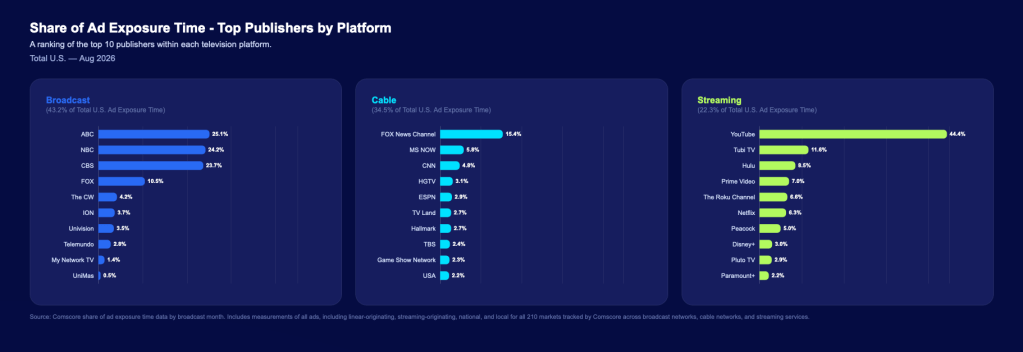
In August 2026, YouTube — excluding YouTube TV — accounted for 44% of ad exposure time among streaming services, or roughly 10% of ad exposure time across streaming, broadcast and cable TV overall. Tubi ranked a distant second at a 12% share among streamers and roughly 3% across traditional TV and streaming. Scroll down for charts breaking down the top 10 streaming services by share of ad exposure as well as stats on streaming vs. broadcast vs. cable TV ad exposure shares.
This data is from Comscore’s new The Score Report. Comscore’s report is like the measurement provider’s version of Nielsen’s The Gauge report. But whereas Nielsen’s reports on total watch time, Comscore’s focuses on ad exposure time. That metric is a combination of viewing time and ad loads, and it’s measured using Comscore’s Comscore TV measurement currency product and its automatic content recognition technology.
“We’re calling it share of ad time, but essentially add up every minute of advertising that a consumer is exposed to across broadcast, cable and streaming in a broadcast month, and then we’re calculating the share that goes to each of those channels and then individual platforms, all the way down to the local market level as well,” said Kevin Burns, chief of staff and interim chief revenue officer at Comscore, in an interview.
Considering how streaming has eclipsed broadcast and cable TV in total watch time in Nielsen’s report, it may be surprising to see that streaming’s share of ad exposure time falls short of traditional TV in Comscore’s report. Then again, anyone who’s had to sit through however many minutes of gambling ads during this year’s Major League Baseball playoffs may think the breakdown is dead-on.
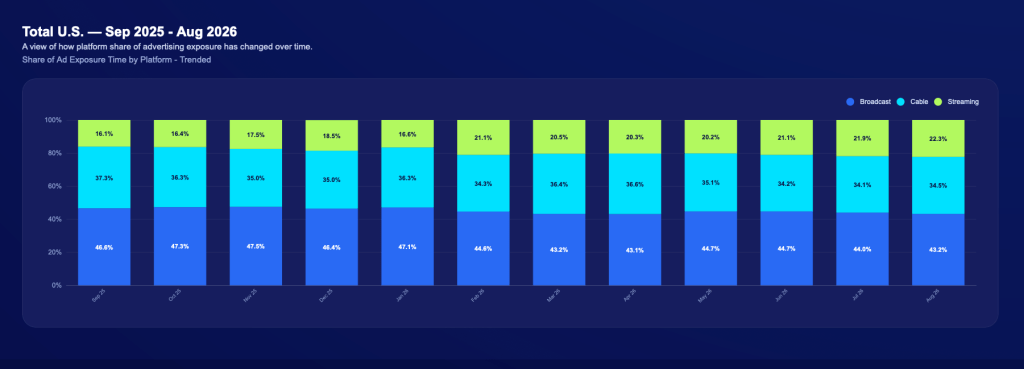
Streaming’s ad exposure time share has been on the come-up, though. A year ago, it sat at 16%, whereas broadcast’s share was at 47% and cable was at 37%, Burns said. Then streaming’s share stuck at 19% for five months. Then “Legendary February” happened, which was NBCUniversal’s name for the single-month combination of the Super Bowl, Winter Olympics and NBA All-Star Game. These events were aired on traditional TV but also streamed, which seemed to help boost streaming’s share of ad exposure time to 21%.
Sports also appears to be a major factor affecting individual streaming services’ ad exposure time shares. For example, in June, Peacock, Tubi and Fox One each recorded share increases, likely thanks to the World Cup, according to a Comscore spokesperson.
Interestingly, though, Netflix had the third-largest share of ad exposure time among streaming services in June. But then, the number-three ranking has regularly changed hands among streamers. Amazon Prime Video had it the month before Netflix, then Peacock seized it in July, then Hulu grabbed it in August. YouTube and Tubi, meanwhile, have held the top two slots the whole time.
OK, but what’s the point of this ad exposure time report? Like, Nielsen’s watch time report reflects a clear competition among TV and streaming companies: Get people to spend more time watching your TV network(s) and/or streaming service(s) than your rivals’. So is the aim of Comscore’s to incentivize companies to compete to make people spend the most time sitting through ads?
No, according to Burns.
“Our goal is not to declare winners or declare this is the one right thing to do. We’re a measurement company. We like to think of ourselves as the scorekeeper and not a commentator in the booth. And so the goal really is to present the data and allow folks to draw their own conditions,” he said.
Sure, scorekeeper, not commentator. But Comscore did decide what score to keep. And it chose share of ad exposure time. And if a company wants to tout its ranking on Comscore’s The Score Report, that company would be proclaiming, “We’re number one at getting people to sit through ads.” Which, honestly, is probably a good sales pitch to advertisers.
But I can’t help but think that this would further incentivize companies to juice their ad loads. Will a company’s high Score Report ranking make or break their upfront next year? Probably not, but I can’t imagine it would hurt.
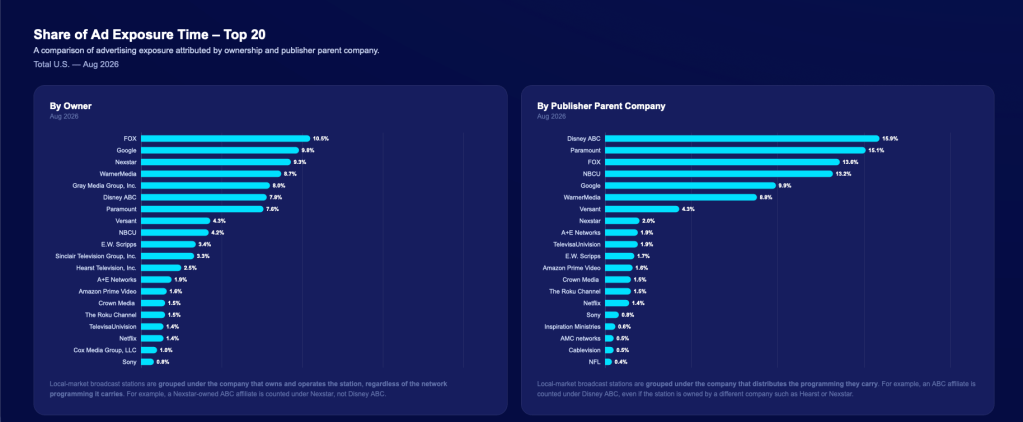
But I’d also like to imagine a report ranking companies based on average hourly ad load per viewer. This report would rank companies in reverse, like in golf, where the lower the ad load, the higher the ranking. Sure, that encourages companies to limit their ad revenue, but it also would discourage them from bombarding audiences with ads like, well, like traditional TV, which ranks highest in share of ad exposure time. And look at where that’s gotten it.
What we’ve heard
“There’s a lot of waste if you buy Thursday Night Football, and it’s only really benefiting you when [a game is played] in those specific regions that your product is sold.”
— Horizon Media’s Adam Schwartz
Numbers to know
$2.7 billion: Netflix’s expected ad revenue for 2026, down from its previous forecast of $3 billion.
6%: Percentage of Netflix’s employees that the company announced it is laying off.
27 million: Number of creator-led businesses in the U.S. that can be eligible for small business loans, thanks to a classification change from the Small Business Administration.
-6.7%: Year-over-year decline in basic cable ad revenue in 2025.
20%: Percentage of U.S. adults who regularly get news via TikTok.
What we’ve covered
How Amazon turned its Thursday Night Football into a two-pronged pitch to capture ad dollars:
- As the NFL season and holiday shopping season both kick off, U.S. advertisers are devoting more budget to Amazon’s ad inventory.
- Prime Video has charted a 6% increase in TNF advertisers so far this season, and since 2022 it’s brought over 80 brands new to TNF.
Read more about Amazon’s Thursday Night Football ad pitch here.
Ownership, control, margins: the brand playbook for microseries is still taking shape:
- Brands are testing two routes into creator-led microseries: partnering with an established hit to tap its audience, or building a series around their own brand.
- But with ROI hard to pin down, and questions about who owns the IP, neither path is a sure bet.
Read more about brands’ microseries playbook here.
Inside Dentsu’s plan to make entertainment a part of every brand’s budget:
- Somewhere down the line, a brand will probably hire Dentsu as its global entertainment agency, with a brief that has nothing to do with the creative or media accounts.
- Dentsu is a producer and financier on the upcoming Angry Birds Three film as well as its lead marketer, and has found room in the film for two clients (she declined to name them).
Read more about Dentsu’s branded entertainment push here.
Ruggable’s new ad spend strategy shifts focus to ShopMy creators:
- Since last August, Ruggable has shifted about 10% of its overall spend from performance channels, like Meta, into brand channels, like influencers and connected television.
- The brand plans to grow that spend by another 15% to 20% next year.
Read more about Ruggable’s creator marketing shift here.
What we’re reading
Netflix’s content chief ouster:
Netflix fired chief content officer Bela Bajaria as the company has been dealing with weaker audience engagement amid her “gourmet cheeseburger” programming strategy, according to Puck.
To replace Bajaria, Netflix has hired former Disney and Fox exec Peter Rice, who has a reputation for overseeing award-winning programming in addition to crowd pleasers, according to CNBC.
Fox has added Omnicom, Stagwell and Simulmedia to the list of companies it’s working with to use AI agents to execute ad deals and improve audience targeting, according to Adweek.
Rather than acquire the AI chatbot platform outright and assume its legal issues, Disney asked Character.AI to file for bankruptcy so the House of Mouse could buy its intellectual property and take on its employees, according to Wired.
Supreme Court’s video privacy case:
The Supreme Court has begun hearing oral arguments on a case that will determine whether the Video Protection Privacy Act applies to online companies like Meta sharing people’s data for advertising purposes, according to The Washington Post.


More in Future of TV

Future of TV Briefing: TikTok Shop success = small creators + more videos
This week’s Future of TV Briefing looks at how “more videos from smaller creators” is the recipe for success on TikTok Shop.

Future of TV Briefing: Hispanic TV-and-streaming viewership in 4 charts
This week’s Future of TV Briefing looks at how Hispanic audiences spend their time between traditional TV and streaming.

Future of TV Briefing: TV ad industry’s measurement currency frustrations hit (another) boiling point
This week’s Future of TV Briefing looks at a new task force being formed by the Coalition for Innovative Media Measurement to tackle the TV ad industry’s measurement currency conundrum.