Join us Dec. 1-3 in Nashville for the Digiday Programmatic Marketing Summit
AOL survey: Most brands are bringing programmatic video buying in-house

The vast majority of brands plan to bring their programmatic video trading in-house, if they haven’t already, an AOL report on the state of the European video marketplace revealed.
Just under a half of brands surveyed said they had moved some of their programmatic video buying capabilities in-house, with another 47 percent of brands saying they plan to do so in the next 12 months.
Brands want to gain full control of their ad ecosystem and integrate internal data. Some, including Deutsche Telekom, Hotel.com and MoneySupermarket in the U.K., have already taken that step. They believe in-house programmatic buying is more efficient, and they lack of confidence in agencies.
Nick Reid, UK MD of TubeMogul, questioned the survey numbers, saying that “larger brands and corporations have expressed certain ambitions to take programmatic in-house within the next 12-24 months, but they aren’t there yet.” Doing so requires staff overhauls and re-training, and some brands feel agencies do contribute to overall strategy.
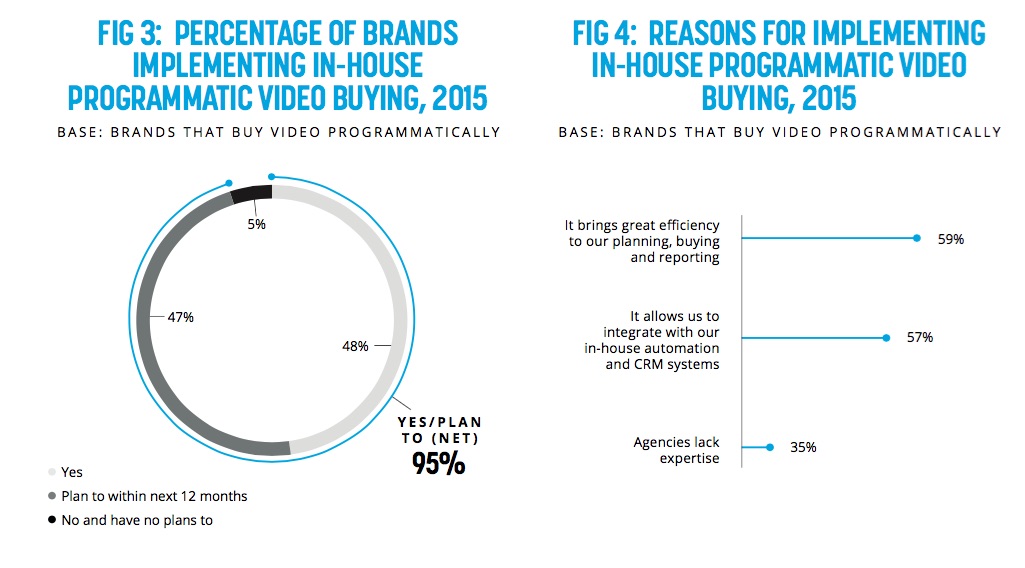
The report surveyed 411 brands, agencies and publishers representing the U.K., France, Netherlands and Germany.
Continued video and mobile growth were other themes of the report. In the U.K., advertisers spent £4 billion ($6.1 billion) on digital advertising in the first half of 2015, according to the report, citing the IAB. Of this, £292 million ($447 million) was spent on video, a 51 percent increase. Only tablet advertising saw a higher growth of 115 percent, accounting for £68 million ($104 million) of total spend.
Mobile ad spend has also seen year-on-year growth of 50 percent, according to the IAB. AOL’s report found that mobile video was the only channel that publishers and buyers both increased their spend in 2015 compared to the previous year (to 29 and 28 percent of their budgets respectively).
The report also found that the click-through rate (CTR) is still the dominant metric, even though there’s a desire to move away from it partly as video advertising is seen as more of a brand-building tool.
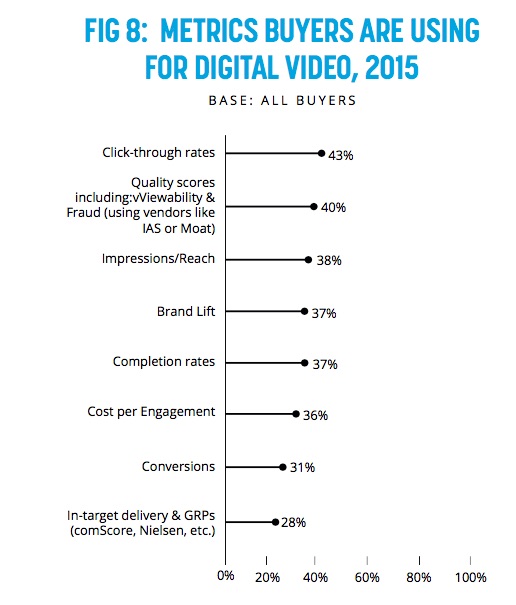
Ruth Zoher, head of programmatic at Mindshare, said the use of metrics is evolving. “We can’t throw away everything we have learned to-date and come up with completely new metrics,” she said. “Yet at the same time, we need to stop borrowing metrics from the past that are not relevant to today’s challenge.”


More in Marketing

Salesforce’s $5.7 billion Braze deal puts marketers at an ecosystem crossroads
The deal promises faster, more connected marketing, while raising questions about vendor lock-in and how brands stand out as AI automates campaign execution.

AI boosts discovery but reviews still seal the deal, new research shows
ChatGPT is where 16% of shoppers start looking for products. However, only 9% go there to actually buy something.

Future of Marketing Briefing: Advertisers have more ways than ever to choose a holdco, and free holdcos to choose from
Fewer holdcos, more ways to pick one: inside the changing agency pitch.