Join us Oct. 26-28 in Newport Beach for the Digiday Media Buying Summit
U.S. CPG manufacturers are sitting on excess capacity, which could be a boon for brands

This article was first published by Digiday sibling Modern Retail.
CPG manufacturers in the U.S. are sitting on excess capacity that’s just waiting to support a new wave of brand growth.
Keychain, a platform that connects brands with manufacturers, released its 2026 CPG Intelligence Report this week, which included a survey of over 1,000 CPG manufacturers. Results showed that one major theme they’re grappling with is significant overcapacity: About 1 in 10 factories is running more than half-empty, and about 1 in 3 has at least 31% of its production capacity unused.
“You have more machinery and more people available to run it, but very few factories are running 24/7. Most are running one to one-and-a-half shifts a day,” said Keychain CEO and founder Oisin Hanrahan.
How did we get here? Hanrahan said it’s partly a result of investments made six to eight years ago, when manufacturers took advantage of 0% interest rates and tax breaks to build out their products. Then Covid-19 arrived, disrupting overseas options and consumer behavior. Hanrahan said that time led manufacturers to invest in more capacity to meet forecasted demand.
“Those factories made those investments three or four years ago,” he said. “The machines are just showing up now, but the demand curve has changed.”
For brands, excess capacity means a moment of leverage, such as obtaining lower minimum order quantities or becoming more competitive on pricing. This means it’s a ripe time for CPG startups, Hanrahan said. “If manufacturers were super busy, you wouldn’t see so many new brands getting started because they simply couldn’t get made,” he said.
There can be an upside for the manufacturers, too. Those who added more capacity are 2.1 times more likely to expect revenue growth of 20% or greater, according to the Keychain survey. Last year, about 15% hit that number, Hanrahan said.
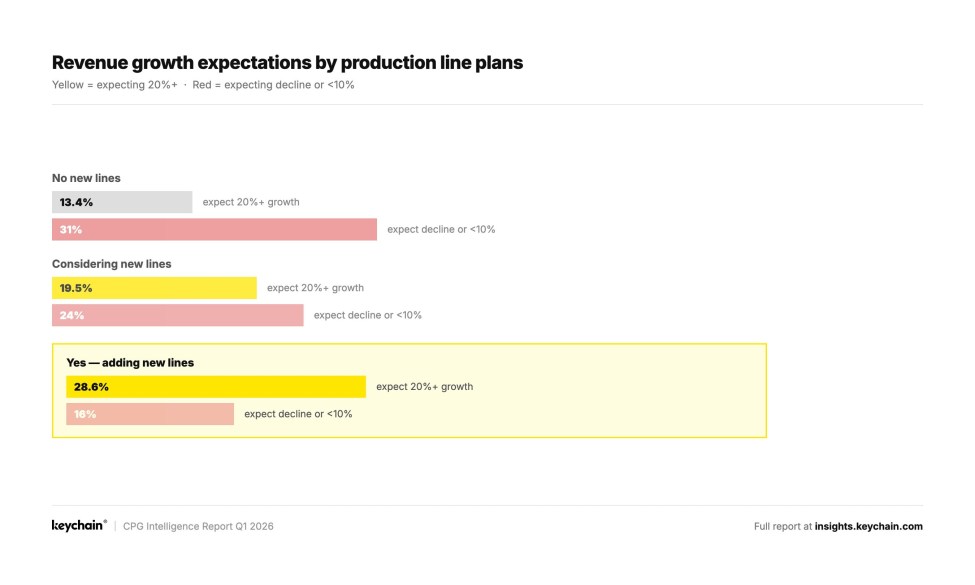
Overall, meaningfully shifting manufacturing usage can take multiple quarters or even years. Hanrahan said manufacturers have long lead times because they need to train employees and adjust operations to get new lines up and running. He also said that the current slowdown of the population growth curve and the rise of GLP-1 drugs are poised to shift CPG demand in the medium to long term.
All this leads to a more measured approach to growth, Hanrahan said, and a greater focus on how software and AI can help manufacturers reduce errors or run more efficiently with the systems they already have. Some examples are implementing faster sensors that can detect if something is off in a new batch, or software that can forecast consumer demand more accurately.
“The lead time for machinery is long. You can actually change your software stack relatively quickly,” he said.


More in Media

Reach CEO touts Google AI deal as a template, steps up pressure on OpenAI over scraping
Digiday spoke with Reach CEO Piers North about his plans to make its Google AI content deal a blueprint framework for other LLM deals, and its recent cease-and-desist letter to OpenAI.

Social commerce edges past SEO at The Independent for the first time
The Independent’s social-commerce revenue edged past its SEO-based commerce revenue for the first time in September, CEO Christian Broughton said at Digiday’s Media Strategies event in London this week.

Ownership, control, margins: the brand playbook for microseries is still taking shape
Creator-led microseries are hot, and brands want in, but everyone’s still figuring out the structure of the deals and the content itself