Join us Dec. 1-3 in Nashville for the Digiday Programmatic Marketing Summit
Nike versus Adidas: Who’s winning the World Cup’s brand head to head?
For competing apparel brands Nike and Adidas, the World Cup is a golden opportunity, but one that finds the rivals in very different positions.
An apparent recovery last October, when revenues increased 1% amid a tough trading environment, turned out to be something of a false dawn for Nike. Its most recent set of results (published March 31) showed flat revenues and shrinking gross margins.
While Nike’s leadership attempts to turn the ship around, its old rival Adidas sees an opportunity to close the gap internationally, and grow its business in the U.S. CEO Bjørn Gulden told investors in March, during its fourth-quarter earnings call, that Adidas aimed to double the size of its American business – and gun for the No. 1 spot everywhere else. The company enjoyed improving margins and revenues rose 14% during that quarter.
“All responsible people should have the ambition of being No. 1,” Gulden said. “It is important now that we keep the leadership where we have it, and in addition to that, [that we] specifically target the American consumer.”
For Nike, the World Cup is a major moment in a sporting summer among several — marathon and tennis season are also important for its footholds in those sports, noted eMarketer analyst Sky Canaves. For Adidas, it’s an opportunity to own soccer and ride the rising popularity of the sport in the U.S. to commercial success. “Nike has a much broader presence across sports,” said Canaves. “For Adidas, the World Cup is a lot more significant for its brand and its sales.”
Both companies released star-studded brand campaigns ahead of the tournament’s kick off. Nike put out “Rip the Script,” featuring Cristiano Ronaldo, Vinicius Junior, Erling Haaland and dozens of other soccer figures causing chaos on the set of an ad shoot. Adidas opted for “Backyard Legends,” a narrative treatment led by Timothee Chalamet, Bad Bunny and another border-spanning bevy of soccer stars.
Ahead of Nike’s next earnings announcement next week, Adidas appears to have had the edge commercially. Spending on Adidas apparel surged 70% in May, compared with the previous year, and held strong into June, according to data from M Science. But summer’s far from over yet.
Analysis of the performance of each company’s World Cup effort on social media shows how each campaign carries forward their commercial goals. It also provides a contrast playing out between Nike’s broad reach, yielding a bigger splash and an Adidas plan focusing closer on soccer itself, yielding a greater rate of engagement with fans.
Talent strategy
Despite the similarities — narrative filmmaking and star power — data shared by social monitoring firm Meltwater gives the lie to two different strategies behind the campaigns. Nike’s film featured a broader array of sports personalities alongside its collection of soccer players, including LeBron James and BLACKPINK’s Lisa, suggesting it was intended to appeal to a slightly broader audience via basketball and K-pop compared to Adidas’ soccer-exclusive spot.
That shows up in Meltwater’s social listening analysis. Among posts directly discussing the campaign, Lisa was mentioned in roughly 30% and LeBron discussed 20% of the time. By contrast, discussion around Adidas’ spot appeared to focus on the inclusion of non-sports star Chalamet (54%) and soccer legend Lionel Messi (40%). In basic terms, each brand’s casting strategy mirrored their commercial preoccupations: Adidas focused on soccer only, while Nike used the moment as a cross-sports cultural vehicle.
Distribution plan
Data from Tubular suggests each campaign followed a slightly different distribution strategy, too.
In the weeks following its campaign launch, Nike uploaded 217 videos across its social platforms, versus nearly 1,000 clips published by Adidas following its launch. Nike appears to have enjoyed a higher rate of engagement for its activity, collectively gaining 400 million cross-platform views, potentially a result of its video activity more closely supporting “Rip the Script” compared with Adidas’ video strategy, which has showcased a broader array of subjects.
“The companies did seem to have two vastly different approaches. Nike has seemingly put more concentrated resources into ‘Rip the Script’ being ubiquitous around the World Cup, to pair with a talent-heavy cast,” explained a Tubular spokesperson.
The social impact
Social listening data from Sprout Social, collected once both campaigns were out (June 5-17) shows how well each hero post performed on social platforms. On Instagram, Nike’s campaign garnered 2.4 million likes and 58.7 million views. Adidas’ reach was lower, with just 7 million views, but it gained a greater number of likes (2.56 million), suggesting a higher rate of engagement among web users.
Across their entire range of activity, the two brands are closer across most metrics, gaining 3.64 billion estimated impressions (Nike) and 3.43 billion (Adidas).
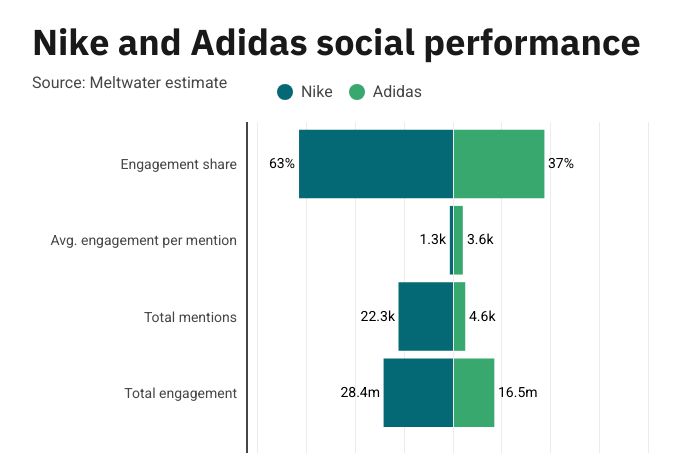
Meltwater’s figures concur. The company measured a higher absolute reach and a higher number of social media mentions (22,300 versus 4,600) and engagement for Nike, but a higher rate of engagement for Adidas, in the first three weeks following each campaign’s launch. “Nike won on sheer scale,” said a Meltwater spokesperson. “Adidas was smaller but hotter per post.”
Earned media value
Ultimately, however, that social noise only matters insofar as it translates into dollar or Euro bills. CreatorIQ estimates suggest that Adidas gained more earned media value (EMV) than Nike in the first three weeks following the release of each advertiser’s brand campaign. Across 6,700 posts involving almost 3,000 creators, the company generated $48.9 million in EMV.
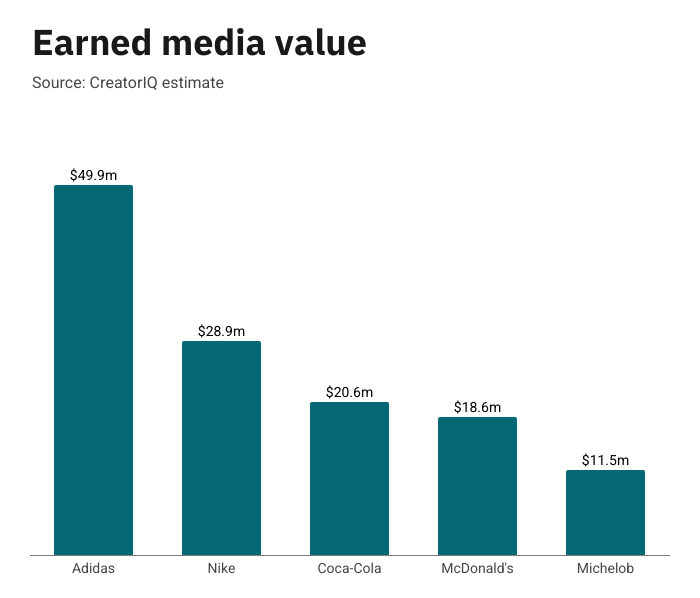
By contrast, CreatorIQ estimated Nike saw a return of $28.9 million in EMV across a smaller footprint – 4,400 posts by 1,900 creators.
Nike’s next quarterly results may provide a clear sign as to whether the broad reach its campaign has enjoyed can be converted into sales among soccer enthusiasts. We’ll be keeping a close eye on those results, and on how each brand pivots and modulates its approach throughout the rest of the tournament.


More in Marketing
In Graphic Detail: What Apple’s identity block means for the ad money
How Apple’s identity block hits publishers’ wallets, and why Apple can afford it.
Anthropic’s ad bill is soaring, according to IPO filing
Anthropic’s IPO filing shows an ad-free AI company with a fast-growing ad bill.

Salesforce’s $5.7 billion Braze deal puts marketers at an ecosystem crossroads
The deal promises faster, more connected marketing, while raising questions about vendor lock-in and how brands stand out as AI automates campaign execution.