Join us Dec. 1-3 in Nashville for the Digiday Programmatic Marketing Summit
Nike versus Adidas: Who’s spending more in race to claim the World Cup crown?

The World Cup’s quarter final stage is set to bring the sport’s big rivalries into sharp relief. France versus Morocco. Norway’s Erling Haaland versus England’s Dan Burn. And, of course, Nike versus Adidas.
The former’s second-quarter earnings, posted at the beginning of the week, contained some clues that the American apparel-maker is enjoying a FIFA dividend despite not sponsoring the competition.
According to Nike CEO Elliot Hill, the company has sold 2.5 times the number of kits it moved during the 2022 tournament. “The World Cup is always a moment to prove ourselves. It’s one of the toughest battlegrounds in sport, and we’re coming with our best,” he said.
Despite flat year-on-year annual revenue growth and a fall in direct sales, the market responded positively to Nike’s recent results, particularly the upswing it’s enjoyed in wholesale revenues — a sales channel Hill has previously pinpointed as key to the company’s long recovery.
Meanwhile, early retail data suggested Adidas merchandise sales also surged during the tournament’s first half. Adidas has enjoyed a 58% share of team jersey sales, compared with Nike’s 36%, per M Science data.
Although both firms launched glitzy brand campaigns prior to the Cup’s kick off, their differing strategies — sponsorship and social versus outsider status married to big TV spending — have become clearer now the tournament is in full swing.
According to Mediasense analysis, Adidas’ sponsorship activations and brand campaigns (“Backyard legends”) have proven the most successful of any FIFA partner, scoring highly for its relevance to soccer culture, fan participation and the “extendability” of the campaign itself.
On the other hand, Nike’s quasi-anarchic “Rip the Script” spot has provided a means for the company to cut up and clip its campaign into dozens of individual moments. The decision to spotlight Haaland as the spot’s last-minute villain also looks wise, given how the Norwegian striker has broken into the wider consciousness following his cool demolition of Brazil.
“The Adidas campaign is a more traditional big creative idea while Nike thought about it as a franchise. Brands are scaling content, but Nike is scaling culture,” said Ishan Chatterjee, vp of global growth at Mediasense.
There’s still a lot to play for, however.
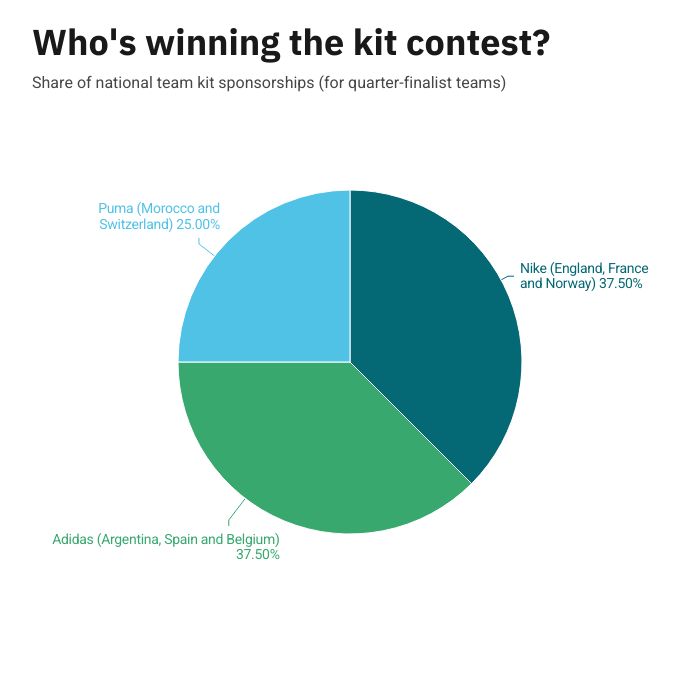
Kit sponsorships provide sportswear makers with a chance of putting their stamp on iconic World Cup moments. Adidas started the tournament with 14 kits to Nike’s 12, but of the eight squads remaining, Nike and Adidas’ designs each adorn three. Puma, which began with 11 teams, still has two — Morocco and Switzerland — in play.
(Numbers aside, Adidas’ Magritte-inspired away shirt for Belgium is surely the coolest kit still in contention.)
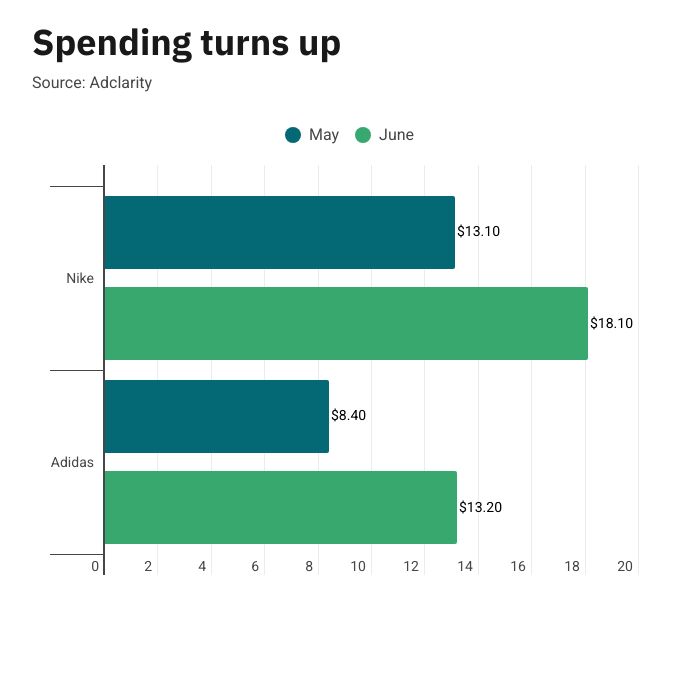
As the tournament kicked off, both companies shifted up a gear in their media investments. Nike’s larger spending power in the U.S. shows. Between May 1st and June 30th, the brands deployed a combined $52.8 million in ad spend, according to figures from AdClarity (the above figures are in millions of dollars). The American brand outspent its German counterpart throughout.
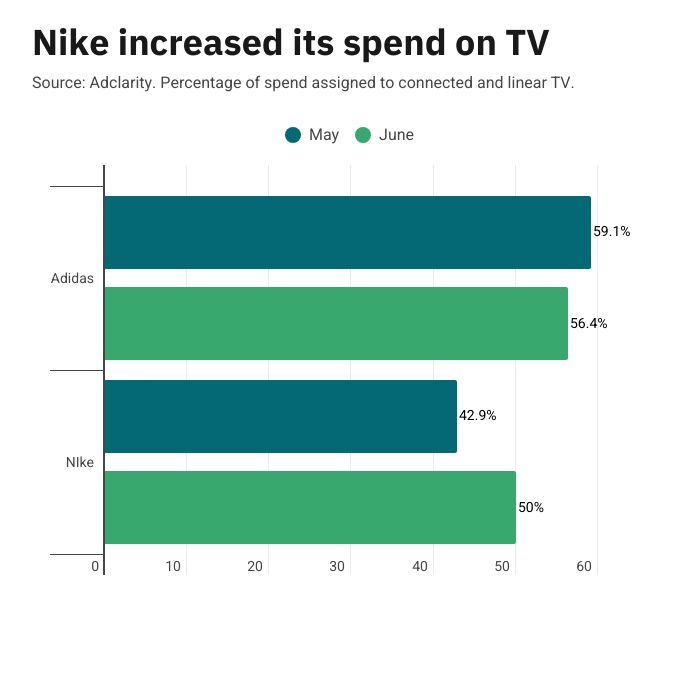
In particular, AdClarity data showed that Nike focused much of its spend through May and June on TV, increasing from 42.9% to 50% of its overall media spending — perhaps an attempt to make up for the brand awareness it might have gained, if it were a sponsor like Adidas.
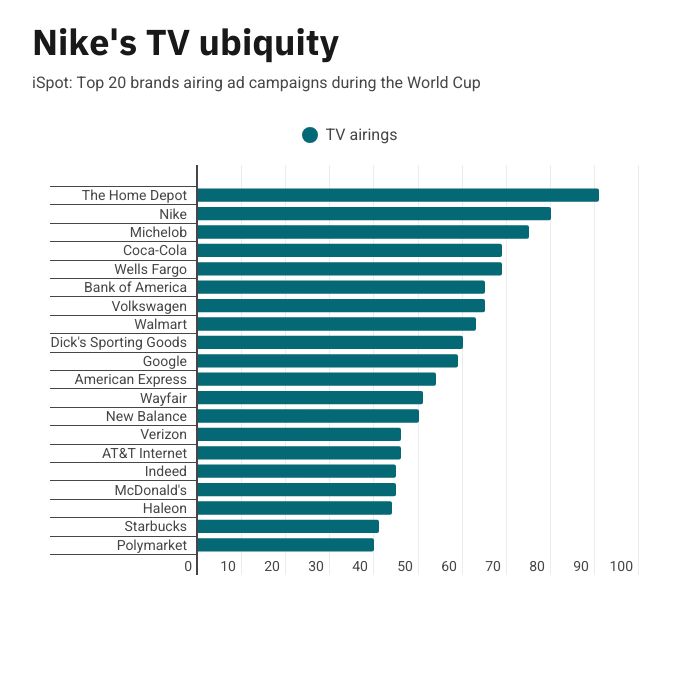
In fact, Nike has been among the most-seen brands running ads on linear TV during the World Cup. According to iSpot data, the company ran its spot 80 times so far, exceeded only by Home Depot. Adidas, by comparison, ranked 30th among the brands monitored, running its spot only 32 times.
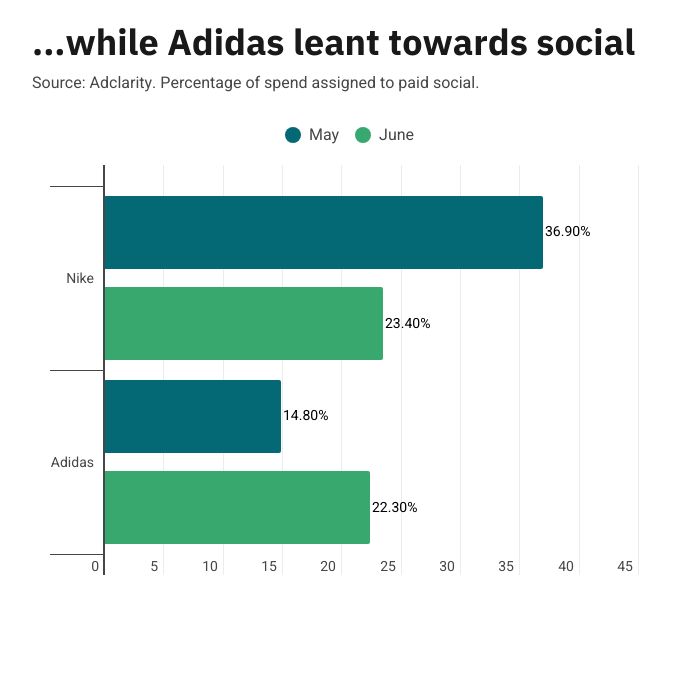
Meanwhile, Adidas put its dollars where the conversation was: on social. May through June, the company dialed up its investment on paid social just as Nike was dialing back its own spending on Meta properties and TikTok.
That sets up a neat run into the final stages of the tournament, with Nike aiming to steal the brand spotlight by appealing to game viewers at home, and Adidas gunning for soccer fanatics discussing the highs and lows of each remaining game online.


More in Marketing

Target bets on buzzy TikTok brands like Mellow Sleep to revamp its home category
This fall, there’s been a steady drumbeat of new brands launching in the big-box retailer’s home category.
Ruggable’s new ad spend strategy shifts focus to ShopMy creators
Ruggable is shaking up its marketing stack, pulling dollars our of Meta and into ShopMy creators ahead of a potential IPO.

Future of Marketing Briefing: The holdcos long, awkward courtship of the C-suite
What holdcos risk when they go over the CMO’s head.