Join us Dec. 1-3 in Nashville for the Digiday Programmatic Marketing Summit
Instagram influencers are creating their own TV-style ad breaks

What’s old is new again.
Instagram influencers are starting to put their own placeholders before and after their sponsored posts, similar to an ad break on TV.
Whenever well-known interior design influencer Medina Grillo shares a sponsored Instagram Story there’s a placeholder titled “Ad break” that runs before the video starts. Underneath the title is a message from Grillo that explains how the sponsored Story they’re either about to watch or have watched funds her content. The TV-style ad break is Grillo’s own attempt to be more transparent about how she makes money to her followers that’s not reliant on several different labels that could potentially clutter her posts.
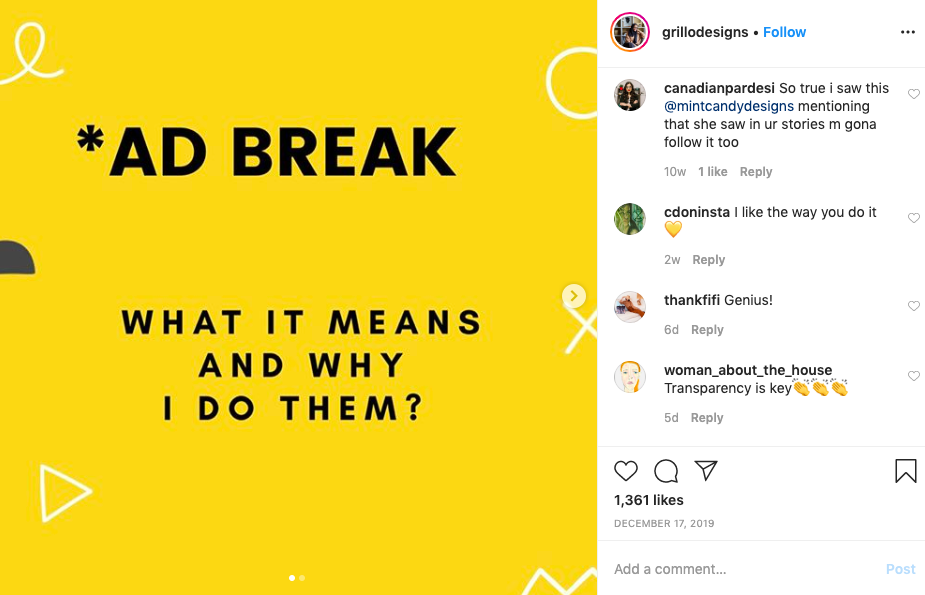
Since Grillo ran first her version of an ad break five months ago, other influencers are starting to do the same. Some of those influencers, like The Frugality blogger Alex Stedman have designed ad break placeholders that share the same look like the rest of their posts so as not to interrupt the aesthetic flow of content. Conversely, fashion influencer Tar Mar has been more straightforward with their ad breaks. The fashion influencer puts a blank, black screen with the word “ad” on it that runs ahead of her sponsored stories.
The move could blunt criticism that influencers often don’t clearly label marketing posts. Last year, the Advertising Standards Authority in the U.K. banned an ad posted by influencer Olivia Buckland for not being clearly signposted, for example.
In theory, Instagram Story ads are meant to feel more natural than other ads that can pop up, but they can also go too far like when an influencer stars in a Story Ad which is placed immediately before, or after, or among, their own organic one.
Some influencers have either seen others get cautioned by the Advertising Standards Authority in the U.K. or have been cautioned themselves, which has convinced them to be “extra careful” to disclose everything, said Ana Thorsdottir, head of business development and partnerships at influencer marketing platform Tagger Media.
It’s a similar story in the U.S. where the Federal Trade Commission has cracked down on advertisers and influencers not disclosing their partnerships and reviews based on incentives. Last October, the FTC banned skin-care company, Sunday Riley, from leaving fake reviews on its product.
And yet this heightened scrutiny from regulators can push influencers to share too much detail as evidenced by those fashion influencers who share lengthy lists of clothing items and where they were from, said Thorsdottir. The disclosure of ads and gifts clutters once clean and creative posts, she said.
“These ad breaks won’t affect performance and engagement metrics as audiences really don’t care about ads so much as long as they are in line with the content the influencer is always posting,” said Thorsdottir.
But putting those pre-recorded Stories alongside their own, which tend to be shared in real-time, can look odd to an influencer’s fans when they flit back and forth between the past and present without warning, said Gemma Glover, an influencer strategist at Engine Creative.
“I have asked influencers if their engagement lowers during the ads and they have said it hasn’t if anything it increases as their followers can sometimes be more engaged and also they are prepared that it is paid for content,” said Glover.
Traditionally, advertisers have wanted to get as much reach and engagement as possible from influencers and there’s a perception that over-signposting sponsored posts could knock those metrics, said James Silverstone, an account director at influencer creative agency the Projects.
“If advertisers chose to work with influencers who really, genuinely represent their brand then there shouldn’t be any problem,” said Silverstone. “If audiences really understand the partnership then they will appreciate the transparency.


More in Marketing
In Graphic Detail: What Apple’s identity block means for the ad money
How Apple’s identity block hits publishers’ wallets, and why Apple can afford it.
Anthropic’s ad bill is soaring, according to IPO filing
Anthropic’s IPO filing shows an ad-free AI company with a fast-growing ad bill.

Salesforce’s $5.7 billion Braze deal puts marketers at an ecosystem crossroads
The deal promises faster, more connected marketing, while raising questions about vendor lock-in and how brands stand out as AI automates campaign execution.