Join us Dec. 1-3 in Nashville for the Digiday Programmatic Marketing Summit
Future of Marketing Briefing: Inside Guinness’ go-slow approach to creators
This Future of Marketing Briefing covers the latest in marketing for Digiday+ members and is distributed over email every Friday at 10 a.m. ET. More from the series →
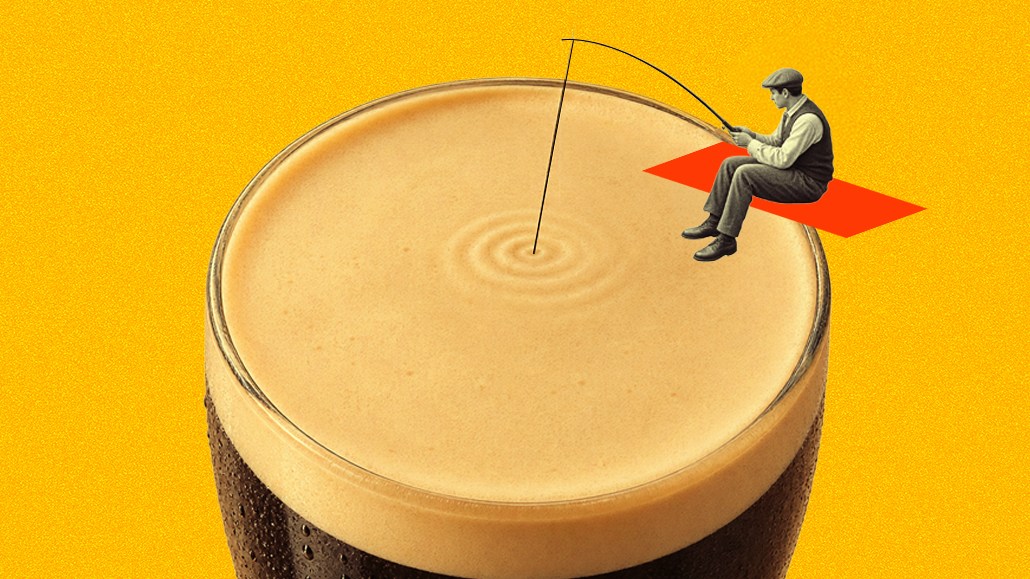
For a brand that takes nearly two minutes to pour, Guinness is in no great hurry where creators are concerned.
It has little interest in signing up creators en masse the way some of its rivals have. Rather, that side of its marketing will build organically, at the brand’s own pace, said global marketing manager and head of sport Paddy Carberry.
Speaking during a live recording of the Unofficial Partner sports business podcast in partnership with agency Sid Lee, the marketer made the case for why: “The minute we start getting involved in trends and social media stuff, all of a sudden we become the dad dancing at the disco.”
Few things kill a brand’s cool faster than chasing it — and Guinness has plenty to lose these days. Carberry traces much of the turnaround to the pandemic. With the pubs shut and most suppliers chasing unpaid bills, Guinness “extended our credit to all of our customers,” he continued, and it sent its unsold beer off to fertilize Christmas trees. Landlords and bar staff noticed, and that counted for a lot, since in Carberry’s view nobody has more sway over what gets ordered than the person pulling the pint. The brand’s ads played up the wait for the pub to come back so by the time the doors reopened, Guinness was one of the pints people had missed.
Guinness’ apprehension toward creators, therefore, is understandable. Its cool was earned behind the bar and a flood of sponsored posts could undo that work faster than a badly poured pint. Creators still played their part in the revival, mind. Most of them, however, weren’t on the payroll. London’s pint-rating accounts turned judging other people’s pours into a spectator sport and Kim Kardashian and Olivia Rodrigo did the brand plenty of favors without a Diageo brief. “Splitting the G” had been doing the rounds in pubs since at least 2018 when it earned an Urban Dictionary entry.
Over that period Guinness has nudged things along where it made sense. Its social team spent 2014 amplifying rituals drinkers had already invented and adding a layer of curated influencer partnerships. As Carberry tells it, the skill lies in knowing which moments to touch and which to leave well alone.
“While we lean into creators in appropriate ways we probably do less than you’d expect,” said Carberry.
And yet Carberry and his team seem more connected with how people view the brand than ever. Its “Singing Pints” campaign, which launched in 2023 but was revived over the summer, was inspired by the viral #SingingGuinness TikTok Trend where pubgoers poked faces into the creamy foam head of their pints and blew across them to make the foam “mouths” open and close.
“We took what was the consumer playing with the brand and amplified it into a TV spot,” said Carberry. “That was one of most successful pieces of content for the last 10 years.”
Creators are clearly part of Guinness’ future, just in a smaller role than the creator economy narrative would have it. Guinness seems more focused on community management and how creators fold into that. That puts it closer to where influencer marketing began. Before follower counts became a media currency, brands courted bloggers with tight-knit readerships and locals whose word carried on their own patch. The industry then spent a decade turning those relationships into a reach game. Guinness still takes part but it does so carefully.
“Guinness might not consciously be signing people up as creators, but ‘splitting the G’ has turned plenty of ordinary drinkers into exactly that,” said Jon Williams, founder and chief creative officer at Freedom Works. “They’re creating something to show their mates, in a pub, around a brand. That should be an ambition for any marketer: giving people something they want to do in real life, which then gives them something worth sharing on a screen.”
It also has less room for error than most brands. In the U.K., anyone drinking in an alcohol ad has to be, and look, over 25. The brand also can’t advertise anywhere where more than a quarter of the audience is under 18 and that’s a hard thing to promise on TikTok. The Advertising Standards Authority banned Au Vodka ads last year for exactly that, and Cranberry noted that advertising regulations are “stricter and stricter around the world.”
What we’ve heard
“While these results are above what we expected for this quarter, this level of growth is, of course, well below the level of growth that we expect from ourselves in the future… I’m encouraged by our progress, and I am proud of our team. But I want to be very clear, we are not satisfied.”
— The Trade Desk’s CEO Jeff Green when discussing the company’s quarterly revenues during the Q3 2026 earnings call.
Numbers to know
34%: Average percentage of a brand’s video that TikTok viewers watch on the app
$3.4 million: Amount by which The Trade Desk’s revenue declined during Q3 2026
$34.1 million: Total CTV revenue that Nexxen reported during its Q3 earnings
14%: Percentage by which Nvidia’s stock dropped following the resignation of its CEO
What we’ve covered
OpenAI’s new business agents give brands a free way into the conversation it’s also selling as an ad
OpenAI now lets brands publish a free “business agent” in ChatGPT, the organic twin of the sponsored agent it’s been selling as an ad since September.
Why brands like Anthropologie are commissioning creator-created shows instead of posts
Brands like Anthropologie are paying creators to make original series, such as short comedy shows, rather than one-off sponsored posts, betting it builds lasting audience habits, sometimes with money moved out of traditional influencer budgets.
LinkedIn brings its B2B ad targeting to U.K. connected TVs
LinkedIn is bringing its CTV ads to the U.K., letting advertisers target streaming viewers by job role, industry seniority, though agencies doubt the premium pricing and targeting accuracy are worth it.
Reddit dangles seasonal ad credits but advertisers still want better proof it works all year round
Reddit is offering Q4 ad credits to win advertisers, but doubts about its measurement and ad tools make it hard to turn seasonal spend into year-round budgets, and slowing ad revenue growth and falling search referral traffic don’t help.
What we’re reading
EU says ‘rabbit hole’ video feeds on TikTok violate its digital rules
The EU says TikTok’s For You feed breaks its digital rules by pulling users into harmful content “rabbit holes”, and it’s demanding redesigns, with fines up to 6% of revenue possible, per AP News.
Microdrama Platform Canvas Aims to Build a Netflix-Style Brand Around Creator-Led Shows
Canvas, a New York microdrama studio, wants to build a Netflix-style brand by fully funding short series made with creators, per Net Influencer. Creators get a 30% to 50% share of the IP, and Canvas makes its money from app subscriptions.
Just a quarter of U.S. adults trust creators to always disclose brand deals
A Morning Consult survey of about 2,000 Americans found only around a quarter of U.S. adults think creators reliably disclose paid brand deals, which points to a sizeable trust gap, per Tube Filter.
ByteDance reportedly plans a Muse-like AI agent within weeks
ByteDance is reportedly weeks away from launching a Muse-style AI assistant, according to The Next Web. Co-founder Zhang Yiming has reportedly told staff it may take until 2029 or 2030 to compete with Anthropic and OpenAI at the frontier.


More in Marketing
D+ Research: Marketers express revenue optimism for 2026 holiday season despite economic pressures
Marketers expect their 2026 holiday revenue to increase 1% to 31% or more in comparison to their 2025 holiday revenue.

Mattel brings Barbie, Hot Wheels to TikTok Shop
Mattel’s TikTok Shop store debuts this week with roughly 20 products across Barbie, Hot Wheels, Fisher-Price and Monster High properties.
LinkedIn brings its B2B ad targeting to U.K. connected TVs
Long gone are the days when LinkedIn was just a job-searching site.