Join us Sept. 14-16 in Miami to connect with top publishing leaders
Few marketers require performance guarantees for branded content

This research is based on unique data collected from our proprietary audience of publisher, agency, brand and tech insiders. It’s available to Digiday+ members. More from the series →
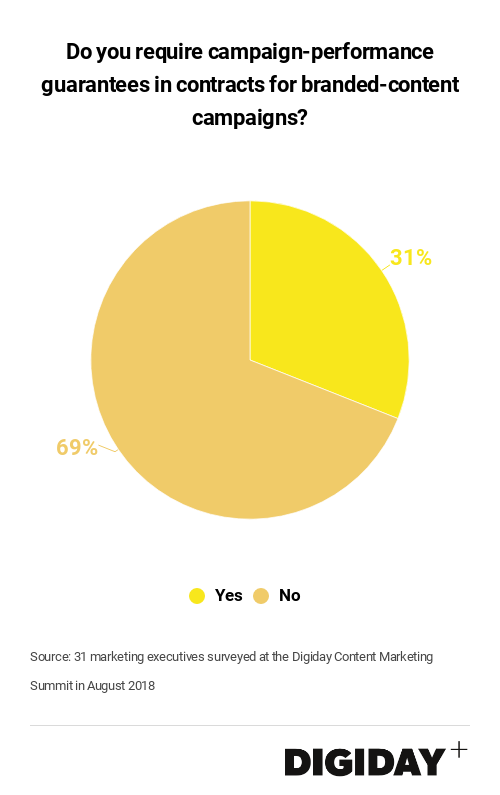
Less than a third of marketers and agencies are requiring performance guarantees for the branded-content campaigns they purchase from publishers, even as the tactic becomes an increasingly significant part of marketers’ strategies.
Of the client and agency marketing executives surveyed at the Digiday Content Marketing Summit in August earlier this year, just 31 percent said they currently ask for campaign performance guarantees from publishers. Such guarantees can be used to ensure campaigns deliver on a range of requirements, such as content views, click-throughs, time spent on page or email signups.
Some publishers have begun using performance guarantees to better compete for advertisers’ dollars. The Telegraph offers to meet certain brand awareness metrics, for example. Meanwhile, Forbes promises that for advertisers meeting certain spending limits it will refund clients their money if they fail to see certain metrics met.
But accepting performance guarantees can come with risks for publishers, including delivering a poor experience by using branded content past its shelf life, using up valuable inventory to meet campaign goals, or having to purchase traffic from third-parties. Such measures can quickly eat into the margins publishers can glean from sponsored content campaigns.
The ability for publishers to meet campaign guarantees can also depend on which metrics those campaigns are being measured by. Publishers are more likely to offer guarantees for engagement metrics than, hard sales, for example.
Ben Kunz, executive vice president of strategy, at Mediassociates adds, “[say] a client wants something like leads in the form of email addresses. It’s very hard for publishers to control all the variables that contribute to a person signing up so they might not want to take the risk of guaranteeing that.”
According to Barry Lowenthal, CEO of The Media Kitchen, campaigns more often come with guarantees around softer metrics such as time spent on page or completed video views.
Despite the risks publishers face, both Lowenthal and Kunz agree performance guarantees are becoming more commonplace. As marketers’ scrutinize their ad spend more carefully, many are now looking to performance guarantees to help validating their purchasing decisions and to compare the impact of branded content campaigns against other channels.
“If you look at Facebook, its performance guarantees are what’s driving interest from marketers. That’s putting a lot of pressure of publishers to move into this sort of arena”, Kunz said.
But even without performance guarantees, Lowenthal said that publishers are familiar enough with their own properties to make promises they can typically keep. Especially if they expect to attract repeat business. “A good publisher is going to have a lot of benchmarks, they’ll know how content will perform within a certain environment and if they can meet certain standards.”
For example, The Washington Post is able to track metrics like scroll depth and time spent on content in addition to its own unique scoring system for marketers. Other publishers including Hearst UK and the BBC are developing new metrics and tests to prove the efficacy of their branded content.
Marketers have also started to change how they view branded content which could result in different expectations. One anonymous attendee at the Digiday Content Marketing Summit said, “[working] with publishers to do content essentially means it’s a media buy, so it’s a lot more investment.” If branded content campaigns starts costing more, it’s reasonable that marketers would want more safeguards on performance.
Lastly, Lowenthal said publishers’ concerns over having to pay for content distribution to meet performance requirements isn’t pushing them away from accepting guarantees. “The client always pays for everything at the end of the day. A good agency is going to put boundaries around where the publisher’s going to get distribute the brand’s content. They’re going to make sure that they’re part of the conversation so if the publisher is buying inventory on an open exchange, they can ensure that the inventory is brand safe and good for the client.”


More in Marketing

Future of Marketing Briefing: One more helping, for gluttons still hungry for Publicis and PepsiCo takes
Yes, more thoughts on what it means, or doesn’t, that Publicis walked away from competing for Coca-Cola’s media dollars to grab PepsiCo’s instead.

Instacart launches custom AI assistants for retailers
Retail giants like Walmart, Kroger and Amazon have launched AI assistants allowing consumers to ask for recommendations or curated shopping lists. Now, Instacart has made it easier for other retailers such as regional grocers to follow in their footsteps.

AI reshapes agency economics, but their contracts are still scrambling to catch up
AI is changing agency work. Agencies are adding provisions to existing contracts instead of rewriting their MSAs.