Join us Dec. 1-3 in Nashville for the Digiday Programmatic Marketing Summit
Amid a difficult transitional year, The Trade Desk posts a rare quarterly revenue decline

The latest batch of ad tech earnings disclosures was made public after the bell yesterday, with The Trade Desk posting a rare annual revenue decrease, only the second in its decade as a publicly listed company, and a sign of the scale of its turnaround challenges.
The industry’s largest independent demand-side platform, whose immediate rivals are Amazon and Google, recently trumpeted the return of The Trade Desk cofounder and CTO Dave Pickles to help mount its comeback after a challenging 18-to-24 months.
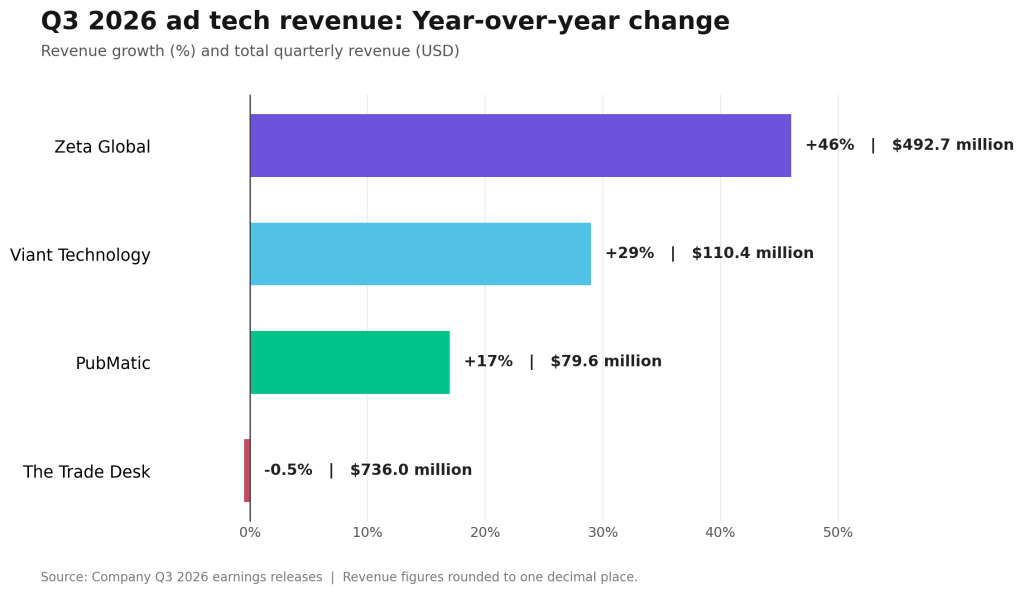
The DSP posted Q3 revenue of $736 million, representing a 0.5% annual dip – the last such dip occurred at the depths of business uncertainty during the Covid-19 pandemic – a sign of the scale of the turnaround challenge it faces.
Meanwhile, its ad tech cohorts posted revenue increases during the reporting period on the same day (see chart below), another sign of the sector’s mixed fortunes.
Jeff Green, cofounder and CEO, The Trade Desk, noted the company’s reorganization efforts of the last year, which included a 15% headcount cut during Q3, plus its third-party audience and agentic offerings, plus its plans for more transparent measurement for advertisers.
“I’m extremely excited to have him [Pickles] more deeply engaged with the team as we move into this next chapter,” Green told analysts, “we spent the last year changing our company because the industry has changed and is continuing to change.”
Execs there pointed out that revenue performance during the period was “meaningfully ahead of the outlook we provided,” noting how video, including CTV, now accounts for more than half of its revenue mix, with the DSP also forecasting that its Q4 revenue would be “at least $755 million.”
In a prepared statement, Jeff Green said, “We are moving with greater urgency across the company,” but acknowledged, “we are still operating below the level of growth we expect from ourselves.”
Facing questions from analysts, Green later outlined the company’s planned tactical changes, as well as when it expects to return to more sustainable growth, noting how the company needs to “make the power of The Trade Desk easier to use, easier to adopt and easier to prove incremental outcomes.”
He added, “Open measurement is expected to better prove incremental outcomes… while open measurement will be implemented this quarter, we expect the product to improve our growth next year and provide a tailwind for years to come.”
Mixed fortunes and M&A
Under further questioning from analysts, Green noted how The Trade Desk – a company that has been notably reticent over mergers and acquisitions – was more open than ever to M&A given the current technological landscape.
However, that shouldn’t be mistaken for a change in the company’s attitude to writing checks for more ad tech, even if it does lead to more lines of business. “Our philosophy on M&A has not fundamentally changed,” he told analysts.

“We’re looking [at M&A prospects] more now than we historically have, but that said, it’s also critical to take away that our standards are also higher than ever,” Green said, adding that his leadership would never want to “derail” its current trajectory “simply because we bought a company.”
Green’s comments came the same afternoon as Zeta Global posted revenue of $493 million, up 46% year on year, making it one of the fastest-growing companies in terms of revenue throughout the period, with the company further raising its Q4 revenue guidance to the range of $521 million to $525 million, a figure that would represent up to 33% annual growth.
Meanwhile, rival DSP Viant posted $110.4 million in Q3 revenue, a 29% annual increase, as well as the purchase of generative AI company Waymark, with management noting they expected Q4 revenue in the region of $130.5 million to $133.5 million.
Elsewhere, supply-side platform PubMatic posted revenue of $79.6 million, up 17% year on year, with company leadership keen to underline an ongoing industry trend that many feel is helping to bring more equity to the historic power imbalance between the buy- and sell-side of the industry.
“AI is accelerating the shift from sell-side targeting to sell-side decisioning, enabling buyers to act on richer intelligence closer to the inventory and first party [sic] insights,” noted Rajeev Goel, PubMatic CEO, in a prepared statement, which also forecast Q4 revenue in the range of $91 to $93 million, a prospective increase of 15%.


More in Marketing

The case for and against AI token capping
Apple is placing strict limits on its staffers’ AI token consumption. Should the marketing sector take a similar path?

Reddit dangles seasonal ad credits but advertisers still want better proof it works all year round
Q4 credits may bring advertisers to Reddit, but concerns about measurement and its ad capabilities make it harder to secure year-round spend.

Ogilvy and CAA launch partnership to clone celebrity talent for AI ads
Big names like actor Terry Crews and athletes could soon appear in AI-generated ads across the web. But they will be marked as such.