
This Ad Tech Briefing covers the latest in ad tech and platforms for Digiday+ members and is distributed over email every Tuesday at 10 a.m. ET. More from the series →
Ad tech executives were keen to quell fears about their companies’ prospects amid the ongoing AI disruption, as Wall Street analysts peppered them with questions about declining revenue returns.

Despite record revenues, AppLovin’s growing e-commerce revenue stream came in below analyst expectations, and the company likewise suffered from the markets’ increasingly negative view of SaaS business models.
Analysts directly probed whether generative AI lowers barriers to entry for the in-game advertising sector – a concept that has been widely debated on LinkedIn and elsewhere since the birth of the AI boom.
Similarly, management teams at Criteo, PubMatic and Magnite all fielded questions about “agentic” AI — from recommendation engines to agent-to-agent protocols – during their corresponding grilling by analysts.
A common theme was requests for clarity on monetization timelines vs. hype cycles, with executives generally cautious in their responses, arguing that early proof-of-concept experiments show strong relevance or efficiency gains, but revenue contributions will be gradual and partner-dependent.
Meanwhile, AppLovin’s management rebuttal was more forceful, pressing home the thesis that AI increases content supply which, in turn, increases the value of discovery and auction infrastructure.
Separately, Zeta and DoubleVerify leaned more heavily into AI differentiation. Both emphasized that models alone are commoditized; proprietary data — identity graphs, verification datasets, commerce intelligence — are the real moat.
Elsewhere, across a series of earnings calls during the latest round, the markets had another overarching question: do the upsides outweigh the downs?
Magnite’s earnings call focused on connected TV overtaking online video display ads as its largest revenue segment, with the responses framing the shift as part of a structural migration of budgets into programmatic streaming.
Management at both Pubmatic and The Trade Desk similarly highlighted CTV and retail media as secular tailwinds, even as their respective Q1 revenue guidance was perceived as soft, with teams also trumpeting their financial discipline to talk up their prospects.
Share repurchases featured prominently at AppLovin, Taboola and Magnite, but all of this was overshadowed by activity at The Trade Desk – whose stock price dropped sharply in early market trading after its Q4 earnings call.
In a bombastic move to telegraph confidence in the company’s stock, which included rare criticisms of both Wall Street and the press, The Trade Desk’s founder and CEO, Jeff Green, purchased $148 million on company stock late last week, with the measure – the biggest purchase of his life – having the desired impact on the market following the March 5 move.
One unifying takeaway from this earnings cycle’s Q&A sessions, it is this: the ad tech cohort believes AI will expand the total addressable market and reinforce scaled platforms — but investors are still demanding proof that near-term headwinds won’t dilute that long-term promise.
Numbers to know
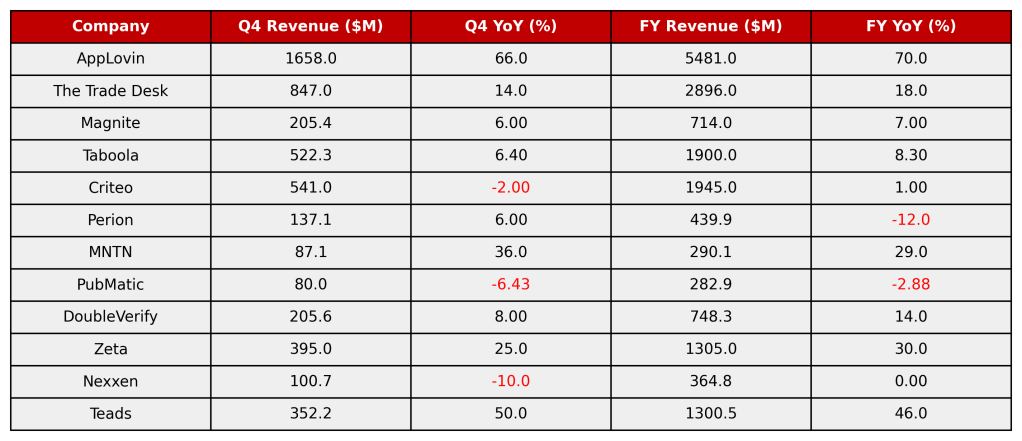
Key revenue numbers for publicly listed ad tech companies in 2025.
What we’ve heard
“Global recession caused by mass white-collar unemployment? Seems bad for advertising.”
— One ad tech executive, pondering the point of advertising if nobody has money to buy anything
What we’ve covered?
Yahoo pauses IAB membership amid a series of quiet cost-saving measures
Three separate sources, all of whom asked to remain unidentified to maintain relationships with Yahoo, told Digiday the outfit has made multiple, subtle cost-saving moves across the globe in recent months.
Pitch deck: How ChatGPT ads are being sold to Criteo advertisers
OpenAI and its first ad tech partner Criteo are framing their pitch around conversational advertising — a format that’s long been promised but rarely delivered at scale.
What we’re reading
Online ads just became the internet’s biggest malware machine
A new report found that malicious ads overtook email scams and direct hacks as the primary channel for malware in 2025.
AI-Driven Software Startup Mega Raises $11.5 Million In Funding To Help SMBs Drive Sales
On Monday, Mega announced $11.5 million in Series A funding, led by Goodwater Capital.
Netflix Taps Amazon’s Shopping Data to Sharpen Ad Targeting
Starting in Q2 in the U.S., brands buying Netflix inventory through Amazon’s demand-side platform will be able to apply Amazon Audiences — advertiser segments built from Amazon users’ shopping, browsing and streaming behavior — to their campaigns. This allows brands to tap into what the company describes as “trillions” of shopping, browsing and streaming signals to reach viewers based on real-world purchase behavior.


More in Marketing

‘Predictability has become a luxury’: As the Iran war drags on, ad markets are starting to sweat
Whatever hope remained that this would be a short war is fading. And with it, the assumption that the economic damage would be too.

Walmart-Vizio’s CTV measurement faces incrementality hurdle
Walmart’s Vizio deal promises closed-loop CTV measurement, but brands are waiting for data clean rooms and proof of incrementality.

How E.l.f. Beauty is using AI to alleviate the workload of its workforce
E.l.f. Beauty’s chief digital officer, Ekta Chopra, shared the four pillars that guide the beauty brand’s approach to AI implementation.