Join us Oct. 26-28 in Newport Beach for the Digiday Media Buying Summit
Future of TV Briefing: The streaming ad industry finally has levers to pull on quality
This Future of TV Briefing covers the latest in streaming and TV for Digiday+ members and is distributed over email every Wednesday at 10 a.m. ET. More from the series →
This week’s Future of TV Briefing looks at how the IAB’s Redefining Media Types Standard could address the streaming ad market’s call for quality controls.
- Quality check
- Paramount-WBD’s pause, Netflix-YouTube’s tug-of-war, Nielsen-VideoAmp’s exit and more
Quality check
“The advertising market does not systematically price impressions according to their true economic value.”
That’s a line from the Coalition for Innovative Media Measurement’s research paper “Quality Matters: Navigating Quality in Media Buying and Measurement.” Published in May, the research paper sums up a growing call in the TV and streaming ad market: Media quality needs to be somehow accounted for in ad buying.
But how?
Well, the other foot seems to have dropped earlier this month in the form of the Interactive Advertising Bureau’s Redefining Media Types Standard. While only a draft currently in public comment — hopefully leaving open the door for an improved name — the framework aims to create a classification system for media quality to be accounted for in ad buying.
RMTS (how is an advertising organization so bad at acronyms?) is less a reimagining of digital video advertising’s programmatic properties than a repackaging. It tackles troubling taxonomies like how to categorize free, ad-supported streaming TV services; whether ads playing on TVs in bars, airports, etc. should be considered CTV; and how do social video platforms fit in the puzzle. It doesn’t directly answer the question of whether YouTube is TV — and isn’t explicitly designed around media quality — but it does seem to give advertisers the means of defining that answer for themselves.
“It sounds like it’s a good step towards a shared language between sellers and buyers to align on the value of the inventory that one wants to sell and the other one wants to buy,” said Jesse Math, a former agency executive who now serves as svp of partnerships at marketing mix modeling firm Keen Decision Systems.
The framework reclassifies digital video in two main areas. First, based on the device-based viewing environment using three options: large screen, lean back (i.e. a TV screen in a person’s home); personal screen (i.e. a person’s phone); public ambient display (i.e. a TV in a restaurant or at a gas station pump). Second are categories based on viewing and operational attributes, including whether sound is enabled, if an ad is skippable, what types of targeting signals are available, the genre and timeliness of content (i.e. if a show is live, the first run of an episode or a rerun).


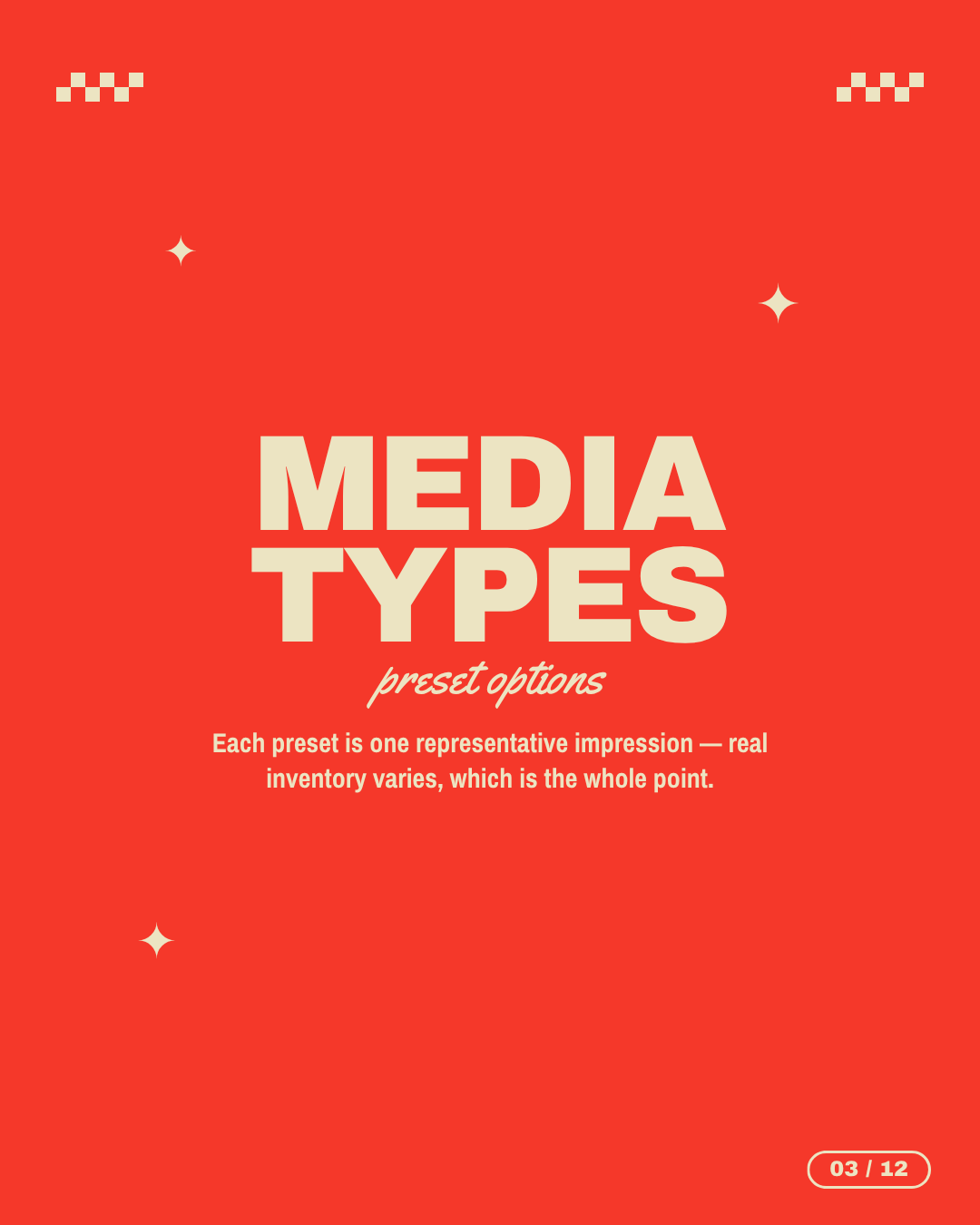
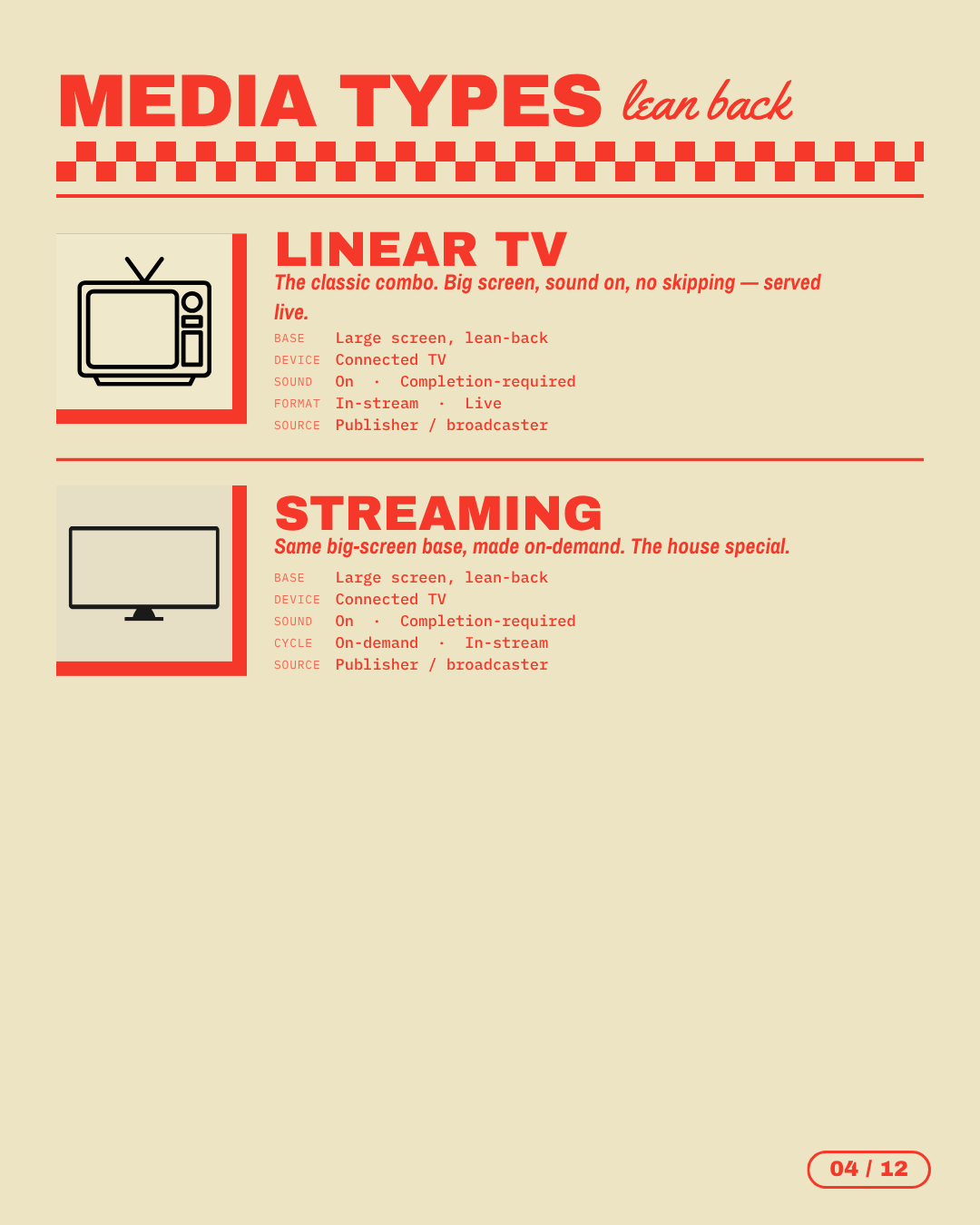
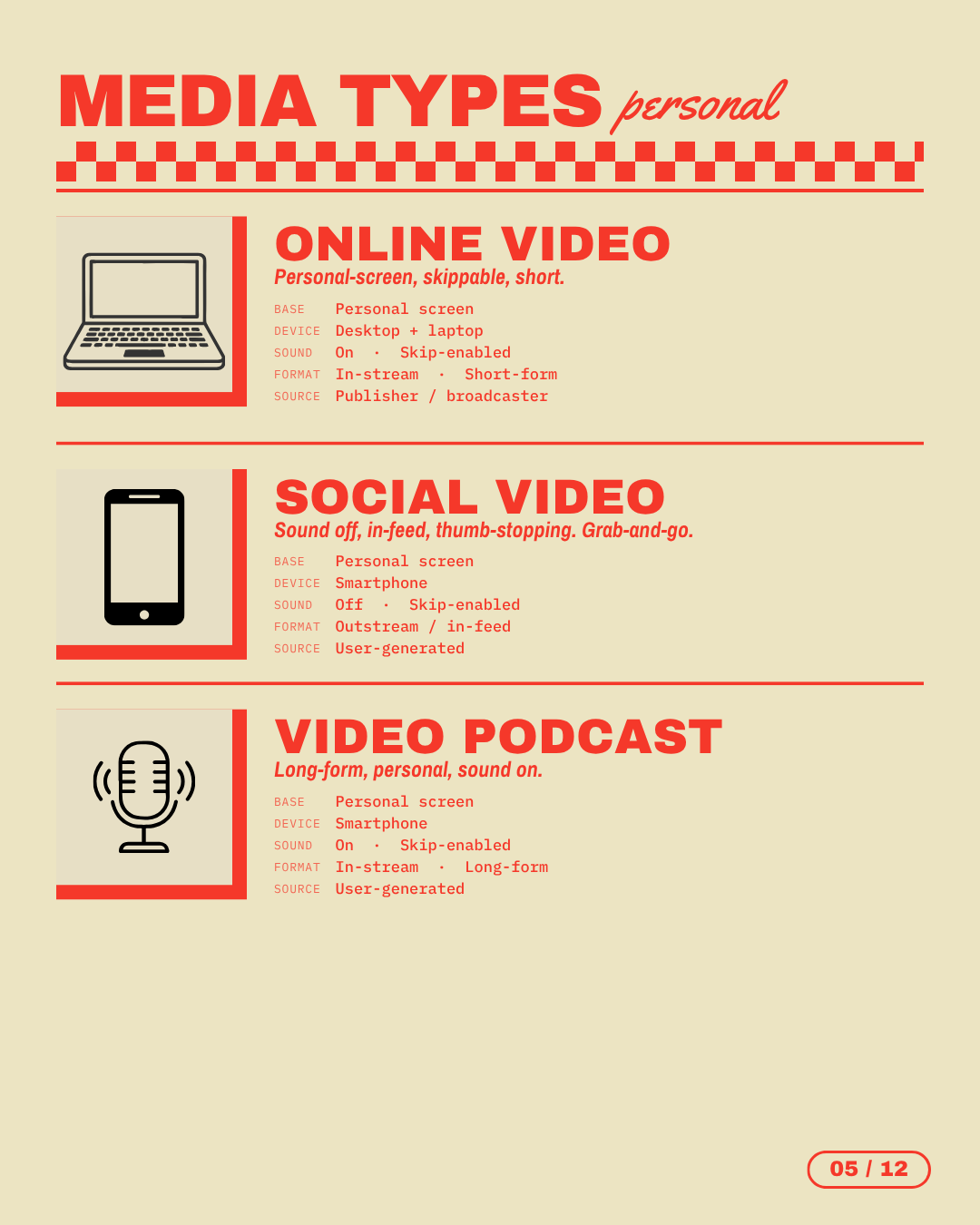



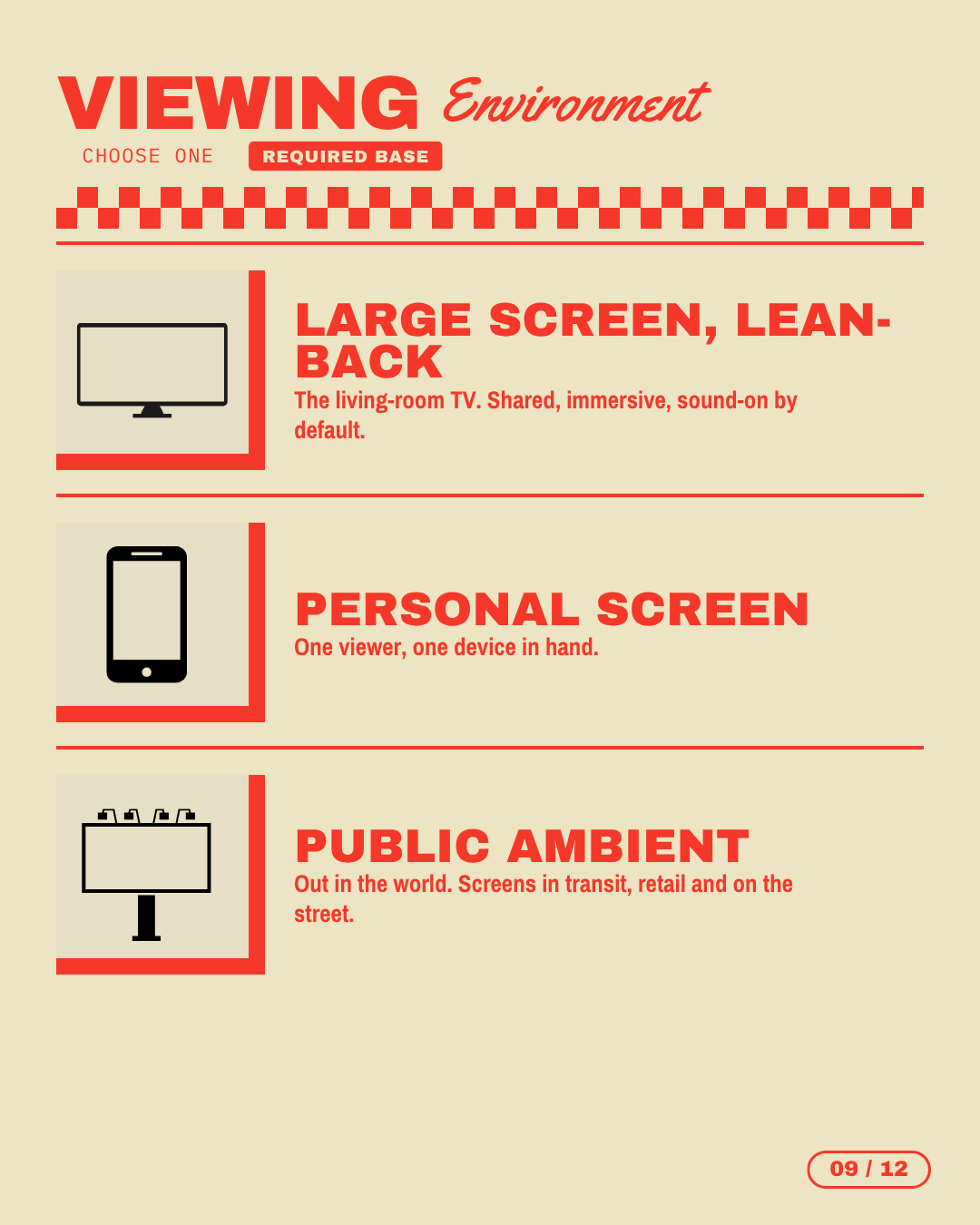
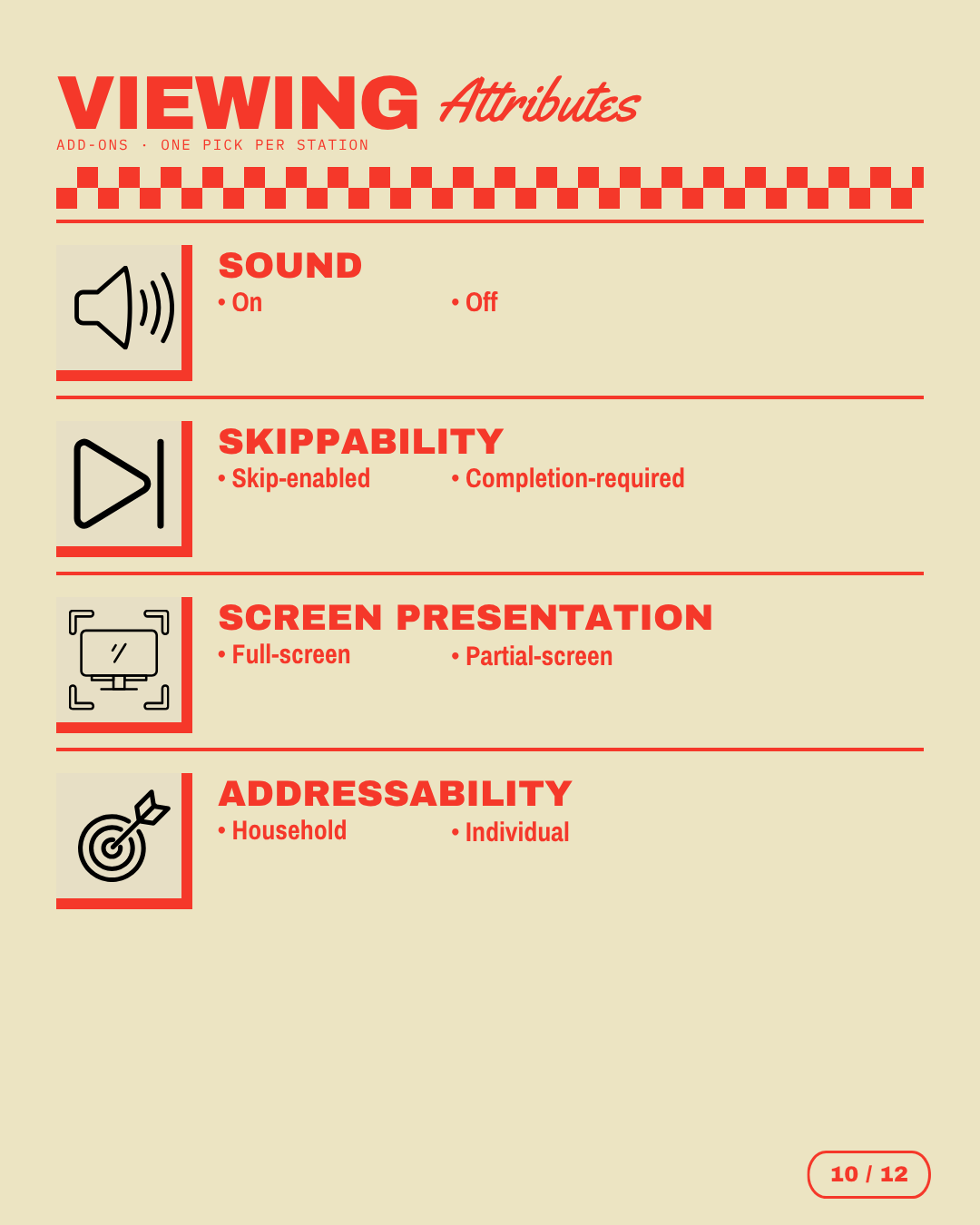

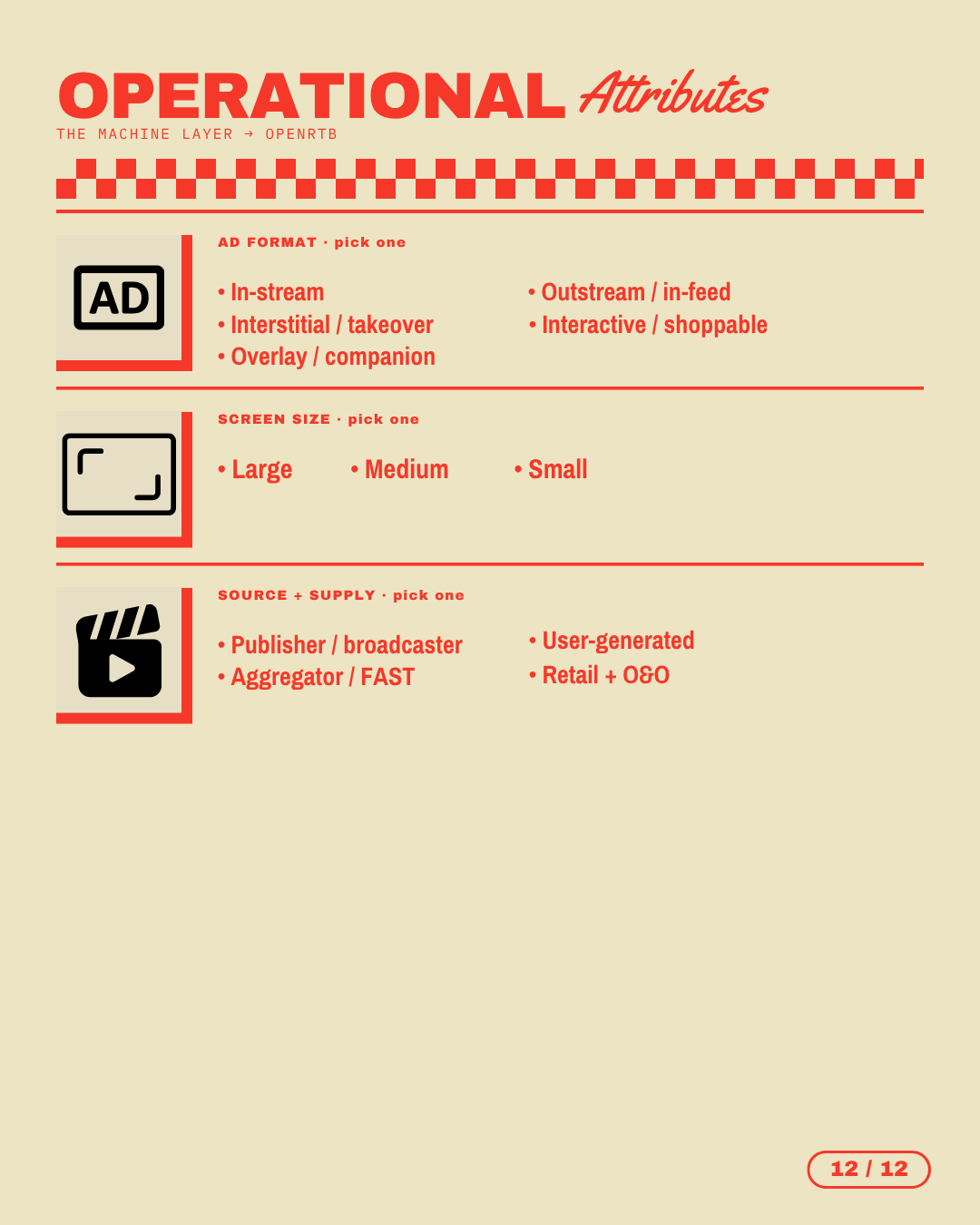












The point is an ad buyer will be able to programmatically configure a campaign based on what they consider to be quality media. And that configuration could — emphasis, could — also help to tackle issues where media is misrepresented by a seller (or, generously, where the seller is taking a very loose interpretation of existing media definitions, such as inventory on airport terminal TV screens being tagged CTV).
“In the video landscape there continues to be a ton of smoke and mirrors,” Math said. He added, “There are a lot of especially small to mid-sized businesses that are buying what they think is the big screen, and then they are getting a whole mix of stuff. And CPMs are blended across all ad types, and it’s not what they think.”
I’m not about to say RMTS solves this quality conundrum once and for all. It takes a more binary approach, whereas CIMM’s study calls for media quality to be treated as “a spectrum, not as a binary state,” per the paper.
But something like (a renamed) RMTS seems necessary (why not Video Quality Signals?). The definition of what counts as TV has never been blurrier. Case in point: YouTube is the most-watched streaming service on TV screens, and yet many ad buyers do not consider YouTube to be TV. Meanwhile, streaming ad inventory is increasingly being purchased programmatically. That ups the importance for buyers and sellers to properly appraise the quality of media. Otherwise, as more digital-native advertisers enter the streaming ad market, the sellers especially risk the development of an audience-centric marketplace a la online display and social.
“They treat CTV like they treat Meta. Meta has almost conditioned marketers to be like, ‘I just buy Meta, and I don’t really care if it runs next to a 45-year-old mom story or some random creator,’” said Danny Weisman, co-founder of agency Obsessed Media, referring to digital-native advertisers. He added, “Whereas if you just buy CTV, it’s like saying ‘sports’ [or] anything with an umbrella term, there’s so many different ways to buy it. There’s so many bad ways to buy it, especially programmatically.”
Alternatively, the uncertainty around the quality of video ad inventory purchased programmatically can have the effect of discouraging advertisers from participating in that part of the marketplace.
“We prefer to go direct I.O. because it’s just too complex. It’s too complicated. There’s too many studies out there of siphoning money away, and I just need to know I’m running on Hulu,” Weisman said.
Implementing a taxonomy for media quality now also seems necessary when looking ahead to the future of ad buying. Yes, I’m talking about agentic ad buying. Companies including NBCUniversal, Butler/Till and PubMatic are already employing AI agents for streaming advertising. Considering how much of the streaming ad market has become automated via programmatic, that paves the path for the next phase of automation via AI agents.
But who wants an AI agent to make the call on whether an ad package from Paramount that includes Pluto TV meets an advertiser’s quality threshold? The answer should be nobody. But then there will need to be a way for an ad buyer to train an AI agent on what the ad buyer considers to be quality media. The ad buyer’s recipe. Which is where RMTS (or maybe something like Placement-Level Unified Taxonomy of Operations?) can come in especially handy.
“We need to guide AI more as agentic buying rolls out, and therefore we need to put these guardrails in place,” said Weisman.
What we’ve heard
“There have been times where there have been things placed into plans that we would not consider streaming.”
— Anonymous ad buyer
Numbers to know
300: Number of movies and TV shows on Netflix’s service that used generative AI.
$3 billion: How much Netflix expects to generate in total ad revenue this year.
540,000: Number of full time equivalent jobs in the U.S. supported by YouTube’s creator ecosystem in 2025.
What we’ve covered
Five things the World Cup taught marketers about creators:
- CMOs know creators matter. The real issue is managing them at scale.
- Quality (and access) beats raw volume.
Read more about creator marketing at the World Cup here.
Accenture and Whalar on their playbook for the creator economy:
- Digiday caught up with Bryan Yasko, managing director at Accenture Song, and Emma Harman, co-CEO of Whalar, to learn more about the combined company’s plans.
- Whalar is giving Accenture important pages in the new playbook centered around creators and the tools needed to measure their effectiveness.
Read more about Accenture’s Whalar acquisition here.
Creators are crashing through Hollywood, but there’s a ceiling:
- Hollywood has courted creators for several years, but in the past few months, there’s been a full-blown creator invasion.
- Creators aren’t replacing Hollywood stars, but they are leveraging their brands and views to get Hollywood-style representation, or build new production pipelines around IP with built-in audiences.
Read more about creators breaking into Hollywood here.
Why a once-anonymous creator unmasked herself to build a bigger media brand:
- In 2018, Kristi Cook was an anonymous YouTuber making videos about internet celebrity drama and gossip on a channel
- Since revealing her identity in 2023, Cook’s follower count has steadily grown, adding more than 300,000 followers on YouTube and 120,000 subscribers.
Read more about Kristi Cook’s creator playbook here.
Digital video ad spending is booming — trust in premium inventory isn’t:
- Marketers are expected to spend $80 billion on digital video ads in the U.S. this year.
- According to the IAB’s report, direct I/O, programmatic guaranteed, and self-serve — considered the more trusted CTV buying methods — saw 43% of buyers express ‘somewhat to no confidence’ in the quality of the inventory they’re buying.
Read more about CTV inventory transparency here.
What we’re reading
A federal judge put a two-week freeze on the deal following the antitrust lawsuit filled by a dozen state attorneys general, according to The New York Times.
Netflix and YouTube’s creator tug-of-war:
Netflix’s non-exclusive deals with top YouTube talent has YouTube chief Neal Mohan considering whether to respond, according to Bloomberg.
The World Cup’s next rightsholder:
FIFA is looking to cash in on the latest tournament’s success with deals for the 2030 and 2034 editions that could cost $4 billion total, according to The Wall Street Journal.
The Google-owned platform broke down the types of inauthentic videos it will no longer allow to get a cut of ad revenue, according to TechCrunch.
VideoAmp and Nielsen’s MRC exit:
The rival measurement providers withdrew from the Media Rating Council’s accreditation process, as if the measurement mess could ever tidy up, according to MediaPost.
The VideoAmp-Nielsen item has been updated to remove the word “currency” because the measurement that Nielsen withdrew is not a currency-grade measurement.


More in Future of TV

Future of TV Briefing: Hispanic TV-and-streaming viewership in 4 charts
This week’s Future of TV Briefing looks at how Hispanic audiences spend their time between traditional TV and streaming.

Future of TV Briefing: TV ad industry’s measurement currency frustrations hit (another) boiling point
This week’s Future of TV Briefing looks at a new task force being formed by the Coalition for Innovative Media Measurement to tackle the TV ad industry’s measurement currency conundrum.

YouTube invests in AI agents, live ‘gamification,’ and editing tools to keep creators close
Made On YouTube announced a spate of new features for the creator platform; here are the most important ones and what they mean for creators.