Join us Dec. 1-3 in Nashville for the Digiday Programmatic Marketing Summit
Magazines are looking to mobile as something more than another platform for repurposed content and tiny banner ads.
Glamour Magazine, for instance, is betting mobile can become an integral component of ad campaigns and allow it to provide ad services that are well beyond a glossy full-page placement to provide the kind of all-encompassing campaigns brands are demanding nowadays.
“Magazines need to have a complete 360-strategy,” Jenny Ryan Bowman, executive creative services director for Glamour Magazine, said at the Mobile Marketing Forum in New York.
In September 2011, Glamour used a mobile app from vendor SpyderLynk to drive Facebook likes. Fifty advertisers participated, yielding 250,000 scans and 50,000 likes, collectively. Moreover, conversion rates for several key metrics were significantly higher than traditional advertising mediums. Of the readers who snapped or scanned the social snap tag, 67 percent of them liked the magazine/brand to access deals, and 18 percent shared those deals with friends. The program’s unique users were equivalent to approximately 4 percent of Glamour’s circulation. Of the various offers, sweepstakes and sample offers provided the highest conversion rates of 85 percent, with discounts and other promotional offers following close behind at 71 percent.
“We also got a really engaged reader,” Bowman said. “They don’t like brands lightly. This allowed us to drive 50,000 likes for our advertisers and create something that had never been done before.”
Glamour then built a mobile shopping wall in a Tesco supermarket in Korea to test out the theory that consumers may be willing to shop from their mobile devices. Korean consumers could come over and snap the tags on the items they needed, and by the time they got home, their groceries were there waiting for them.
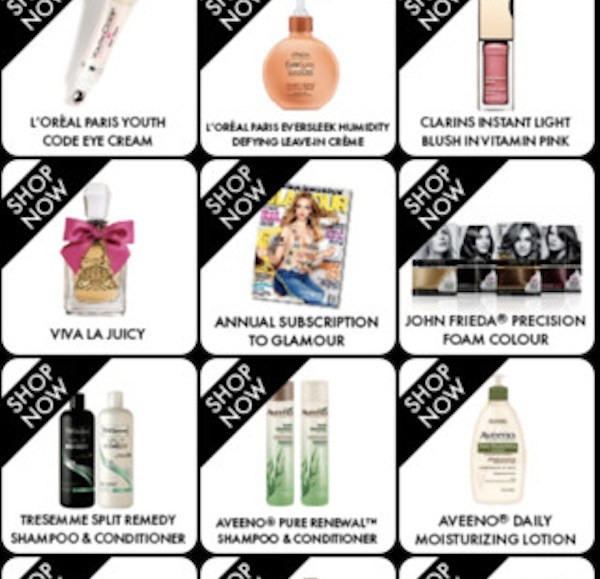
The success of the effort in Korea brought this same type of program to the United States, with a beauty wall in New York City that consumers could shop by snapping the items they wanted to add to a shopping cart within a dedicated mobile app. The products could also be purchased via the the March edition of the magazine using the snap-tag technology. Buyers could share their purchase via Facebook as well.
“Someone told me something really interesting, and that is that online you have five minutes to convert someone to purchase, and on mobile you have 60 seconds,” Bowman said. “This notion of snap to buy came from this.”
Following this test, Glamour rolled out Glamour On Demand in March 2012, which was basically a taxi-fleet takeover. Fifty New York City cabs were souped up with SpyderLynk technology that let passengers purchase beauty products by hovering their smartphones over special tags within the cabs. Those results were so-so. Bowman said one flaw was that the phone needed to be placed right over the tag, and that inside of a moving taxi cab, swerving in and out of lanes, that was impossible. It made it difficult for people to snap.
“We are still figuring out the best way to take advantage of the convergence of mobile, social and commerce,” Bowman said. “These tests prove there are opportunities for us here. We are thinking about doing something for the holidays, but we are not yet sure what. Stay tuned.”


More in Media

The Hill adds interactive election tools to subscription offering ahead of the midterms
The Hill is betting on interactive subscriber-only features to help grow its new subscription business ahead of the 2026 midterms.

The Daily Mail tests GEO with brands ahead of AI visibility product
The Daily Mail is running around a dozen GEO tests to work out what works before turning its AI visibility offering into an official product early next year.

Meta delays rollout of updated commercial terms amid publishers’ collective pushback
Meta’s updated commercial terms have galvanized publishers into a coordinated pushback over the company’s use of their content.