Join us Oct. 26-28 in Newport Beach for the Digiday Media Buying Summit
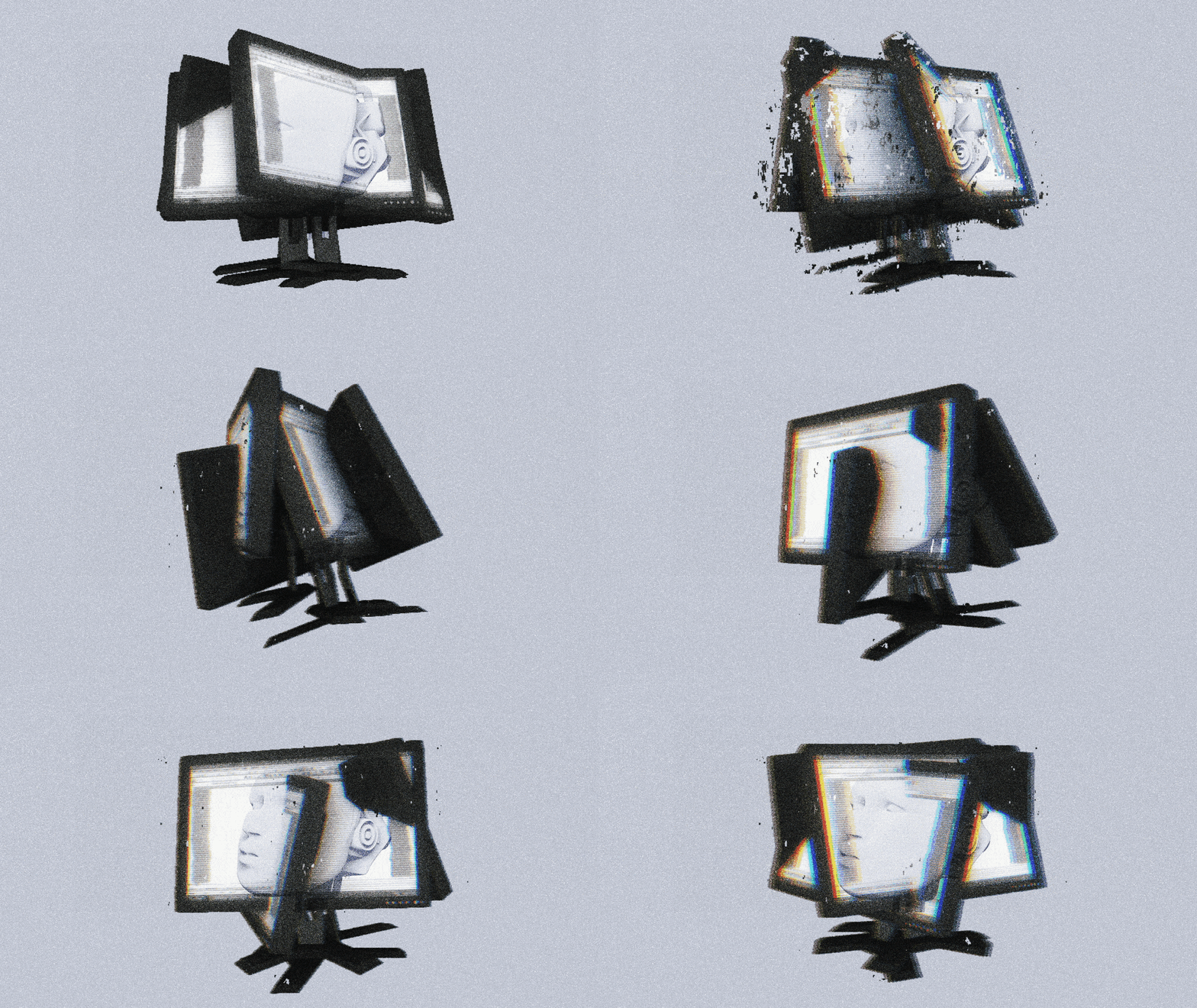
Adobe wants Firefly to do for AI-native creators what Photoshop did for a generation of ad creatives — become the tool they can’t work without.
Though Firefly, the tech firm’s AI tool for content creation, launched three years ago, the company is now squarely focused on pulling creators under its umbrella. It just launched a campaign featuring YouTubers like Kinigra Deon (5.8 million subscribers) and Airrack (18.3 million subscribers) showing off how they use Firefly in their creative processes. The campaign ran online, with Adobe keen to appeal directly to creators of all sizes.
“The challenge we see from our creators and customers is that it’s not just about more content, it’s about making better content at scale without losing your voice,” said Stacy Martinet, vp of marketing and communications at Adobe.
The hope is that the campaign will highlight the spate of features Firefly offers, like audio tools that allow for the creation of fully licensed audio tracks, generative voice overs, an AI video editor, an in-studio mood board, and the addition of new models as well as an expansion of its partner models (which includes Google, ElevenLabs, OpenAI, Runway, Topaz Labs, and Luma AI).
Getting creators to buy into these efforts is a microcosm of a much bigger test. AI has raised the stakes for a company built on iconic creative tools. The question now is whether Adobe can remake itself fast enough to stay indispensable without alienating the type of creative people who made these tools matter in the first place. It’s a challenge made that much harder since the same AI wave it’s trying to ride has also handed capable, cheap creative tools to a new class of competitors — OpenAI, Runway et al — who aren’t weighed down by legacy products or professional user bases to protect.
In response, Adobe has a free Firefly tier, though it only offers 25 generative credits a month. The $10/month standard tier gives creators 2,000 credits and the $200/month premium tier gives 50,000 credits).
“Creativity isn’t a straight line, and the tools you use shouldn’t force that either,” said Martinet.
Because, for as much as AI is empowering creators, it’s also constraining them. Speed compresses a day’s-long edit into hours, and in turn ups the odds of feeds being flooded with content audiences learn to tune out. Tools that once required real budgets are now available to anyone, which means everything increasingly looks and sounds the same. And generating at scale without commissioning original work is useful right up until the copyright status of that output turns a viral moment into a legal problem.
The company that understands that, and in turn, manages to embed itself into how creators work day-to-day, stands to capture one of the more durable revenue streams in media and advertising. Adobe is betting that’s still it. For now, some creators are buying it. Three of them interviewed for this article all stressed that Firefly is but a tool in the creator’s belt, one that is increasingly intriguing in a sea of generative AI tools and, quite frankly, slop.
Take LinkedIn creator Gigi Robinson, for instance. She uses Firefly Boards to build mock-ups and concepts for photoshoots. Adobe partner Val Zhang uses it to remove crowds in public spaces, and she’s also used it to generate entire videos. She thinks the relationship between creators and generative AI is only growing stronger.
Elsewhere, conceptual artist Pablo Rochat, who has 1.3 million followers on Instagram and a partnership with Adobe, told Digiday he uses Firefly to create images from scratch, as well as the boards feature to help “spark new ideas.” But for Rochat, it’s part of the process.
“It’s not a replacement for taste, judgement, or originality,” said Octavio Maron, chief creative partner of creative innovation at Dentsu, said. “The creativity, the intention, the point of view — those don’t come from the model. So, will wholly AI-generated content resonate? It can, when it’s good. And it falls flat when it isn’t. Same as everything else.”


More in Media
Ad industry tallies early losses from Apple’s Safari tracking block
A week after Apple’s Safari block, the ad industry is still waiting for the other shoe to drop.

Welcome to Creator University: Inside the colleges building creator economy programs
As more young folks seek to enter the creator economy, universities are offering classes covering every layer of the still-growing ecosystem.
For some publishers, agentic advertising is still a question of ROI
Despite the hype around agentic media buying, some publishers remain skeptical of its potential to deliver meaningful revenue.