Join us Oct. 26-28 in Newport Beach for the Digiday Media Buying Summit
Spirits brands look to sports, sponsorship and celebrity playbook to convert younger consumers
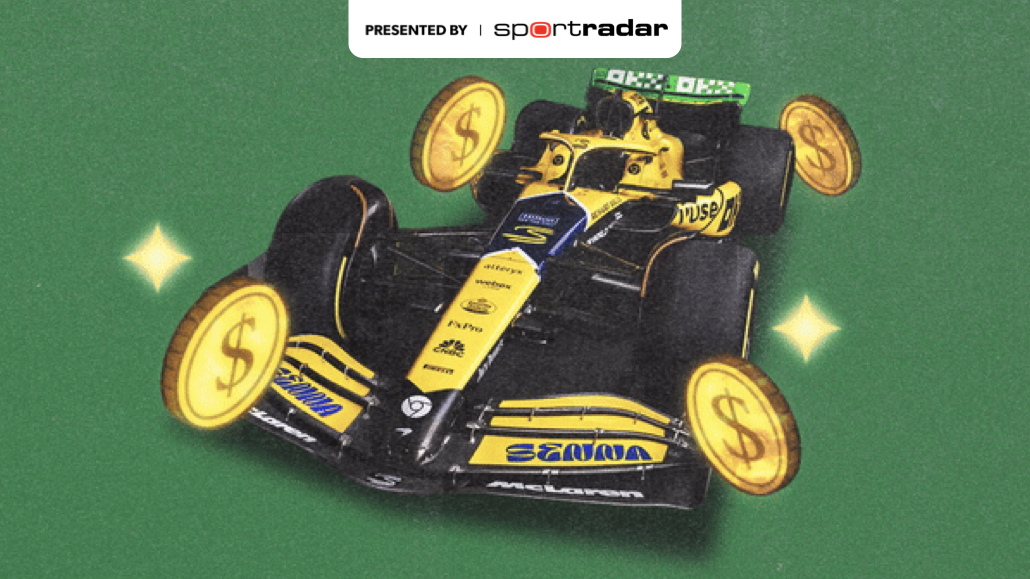
Top-shelf whisky — and whiskey — brands are reaching for a familiar combination of ingredients as they seek to recruit younger consumers into category customers.
Premium blended Scotch brand Chivas Regal, a sponsor of Ferrari’s Formula 1 team since 2024, recently launched a new ad built around driver Charles Leclerc.
Running across TV, paid social and out-of-home, it showcases a limited edition of the whisky (aged for 16 years, a reference to Leclerc’s driver number) and a board game specially designed and manufactured for Leclerc; the driver is a chess nut when he’s away from the track.
Chivas isn’t a stranger to sports. The marque has been active in soccer for several years, backing first Manchester United and more recently, Arsenal. But Formula 1 presented the brand with an opportunity to “talk to fans in a different way,” and make a virtue of the category’s relegation to off-pitch spaces, according to global brand director Oyin Akiniyi.
“Our strategy has always been to be additive and add value to fan experiences, to fan culture, and give them something that they can’t get anywhere else,” she said.
Dubbed “SE!ZE” — another reference to the number 16 — the board game will be on show at series of pop-ups staged at Grand Prixes later this season and will eventually be made available to fans, according to Rebecca Lewis, co-founder and partner at Baby Teeth, the creative and production company behind the campaign.
Kentucky bourbon brand Maker’s Mark, meanwhile, has been working with Olympian and Los Angeles Sparks guard Kelsey Plum for a campaign boosting the brand’s presence around the WNBA; Maker’s Mark produced a bespoke edition of the whiskey in collaboration with Plum.
“Younger audiences specifically are driving really big engagement and cultural relevance around women’s sports,” said Regan Clarke, U.S. vp of American Whiskey Brands at Suntory Global Spirits.
The partnership is part of its ongoing “Perfectly Unreasonable” brand campaign. Clarke said (without revealing exact figures) that the brand had leant heavily into social in order to promote the team-up, putting paid budget behind ads on Instagram and Facebook, as well as running creator activity spanning over 80 creators.
As well as Chivas and Maker’s Mark, Irish whiskey Jameson, in its second year as the official whiskey of Major League Soccer (MLS), is running a campaign emphasizing its connection to the sport ahead of the World Cup. It enlisted J Balvin to star in an ad running across CTV and Meta channels, plus TikTok and YouTube. The plan also includes inventory on linear TV specifically aimed at Hispanic consumers, a key aim of the campaign according to Kristen Colonna, Jameson’s vp of marketing.
Tennessee whiskey brand Jack Daniel’s has been running a collaboration of its own; this time with Ferrari rival McLaren, with which it’s launched a limited edition “Halo Mk1 bottle.” Jim Beam is running a campaign featuring former U.S. soccer and Manchester United player Tim Howard, emphasizing its relevance to fans (it’s the official spirits partner of the U.S. Soccer Federation); again, there’s a limited edition bottle available for collectors. Jim Beam’s also sponsoring F1’s newcomer team Cadillac and its driver Sergio Pérez. And Johnnie Walker is running a campaign in Brazil ahead of the World Cup, also featuring a star player (former Seleção captain Cafu) and a limited edition bottle.
Grains, maturation times and differences in barrel provenance aside, there’s a clear pattern being followed by each brand. Each of these brands must recruit fresh customers if they’re to grow. And each of them must find those new drinkers from a pool of consumers that’s less inclined towards alcohol (or just doesn’t have the disposable income for top-shelf booze) than the generations that preceded them.
“On a brand as big as Jameson, you’re constantly retaining your base while recruiting the next generation of fans,” said Colonna.
With few secure avenues available to find anything like a mass audience, sporting sponsorships and celebrity partners represent a reliable combination for marketers. A focus on premium brands and on marketing around large sporting moments like the Olympic Games and World Cup recently helped turn around a years-long decline in beer sales for AB InBev.
Live sports don’t just provide an audience, but an occasion for communal drinking, said Ryan Barton, senior strategy director at brand strategy consultancy Redscout. “It’s not about the sport, it’s about fan culture,” he said. “[Distillers] aren’t marketing whiskey through sports. They’re really selling fandom that happens to be 80 proof.”
“Sports is the last place where drinkings is expected, not just accepted. They’re buying [the] occasion,” Barton added.
As this spring’s glut of spirits campaigns shows, marketers must also consider how they’re going to stick out among the crowd of advertisers rushing to reach audiences.
F1-adjacent advertisers must face off against dozens of other sponsors attached to each of the sport’s 11 teams, each competing for share of voice at 24 races spread across the year. Sponsors collectively punted $2 billion toward the sport’s teams last year. “Suddenly that’s starting to look quite crowded, and it’s all coming through the same feed,” said Lewis.
Maker’s Mark, which also began sponsoring the Unrivaled 3-3 women’s basketball league in December, Has pursued a sponsorship strategy that attaches the brand to the culture underpinning women’s basketball, rather than passing media moments, Clarke said. “Women’s basketball isn’t niche culture anymore. It is culture,” she added.
Barton argued that limited edition spirit expressions, another feature common to each campaign, could be used to sidestep category saturation. Rather than competing with peers on price and taste, he argued, distillers could compete with “jerseys and hats and memorabilia.”
“The brands gaining traction right now are acting less like traditional liquor companies and more like modern cultural brands,” Ami Lawson, managing director of specialist food and beverage agency Quench. “They’re tapping into passion points, showing up in entertainment and sports culture and creating experiences consumers actually want to engage with,” she added.
In Chivas’ case, Akiniyi said the distiller set out to “flip the sponsorship rule book” by working to create its own IP around F1, rather than merely taking up a passenger seat.
“We’re not on the car [but] that enables us to be more creative, to push boundaries,” she said. Such an approach is a specialism of Baby Teeth, founded just over a year ago by Lewis and former Droga5 exec Chris Watling and Lynsey Atkin, previously of 4creative.
Atkin argued sports sponsorships only stand a chance of cutting through by capitalizing on spaces where a brand and its team partner or player overlap. Chivas Regal’s board game was a result of such a border-crossing, she said
“It doesn’t make sense without Chivas, and it doesn’t make sense without Charles,” she added.


More in Marketing
‘Mission and capital can coexist’: Golden State Valkyries’ Jess Smith on pitch to sponsors
The WNBA’s newest team must navigate measurement demands and marketers wanting to share in the ‘mission’ if it’s to establish a commercial foothold.

Future of Marketing Briefing: Why top creators are taking fewer brand deals
The biggest creators are cutting their brand rosters and asking more of the partners they keep.
‘There’s nothing wrong with being a heritage brand’: How Revlon is updating its image by looking to the past
Revlon named musician and actress Teyana Taylor and country music star Megan Moroney as the faces of its “Revlon Be Unforgettable” campaign.