Future of Marketing: For the source of Nike’s decline, ignore the easy answers
This Future of Marketing Briefing covers the latest in marketing for Digiday+ members and is distributed over email every Friday at 10 a.m. ET. More from the series →
There’s a sneaker shop in my neighborhood where troops of lithe, late 20-somethings congregate for a weekly running club. The wall opposite the front door is dominated by long shelves holding 80 different running shoes and, by the bottom left corner, beneath the pairs of Adidas, Brooks, Hoka, On, New Balance, Salomon and Saucony sneakers, you’ll find the shop’s five pairs of Nikes.
Running, a hobby and a category that Nike once ruled, is a huge retail concern once again; the U.S. running equipment market was valued at $12.9 billion last year, and U.S. sales of performance footwear increased 13% in the first half of 2026, according to Circana. But Nike hasn’t been able to capitalize on the underlying trend as well as its rivals On, Hoka or Brooks have; the latter saw revenues ramp up 14% in the first half of this year.
At the time of writing Nike’s share price sits at a 12 year low, after being downgraded by a JPMorgan analyst earlier this month. Despite promising signals posted last year, it seems the market has lost faith in CEO Elliott Hill’s turnaround plan.
This isn’t just a markets story, however, but a marketing one. Nike’s fall from grace provides a convenient cipher for all manner of marketing and advertising causes. For some observers, it’s evidence that direct-to-consumer is a distribution dead-end; for others, it’s a consequence of poor product development or a lack of upper-funnel ad spend; for those still annoyed by Colin Kaepernick’s NFL protest, it’s another nail in the woke coffin. All these explanations overlook the brand’s adverse competition in China, historic supply chain issues and the growing number of rivals on home soil.
“There are far more factors at play than just the one of the four Ps,” said Shane O’Leary, a former Droga5 and GroupM strategy and marketing director. “It’s one small part of a much, much bigger pie.”
Nike’s history and advertising heritage means, like fellow American turnaround case study Starbucks, that it’s seen as a stand-in for the very concept of the legacy brand.
“It’s being treated as a bit of a bellwether in the industry,” noted Rob Baiocco, chief creative officer at indie creative shop the BAM Connection. “If one of the greats can falter, what’s the future for the rest of brands?”
The truth is inevitably more nuanced. Nike’s previous “Consumer Direct Offense” lean into DTC sales, led by former CEO John Donahoe, and its subsequent re-embrace of secondary retailers used up cash and time that could have been invested into each of its marketing muscles, a headwind that will hold the company back for at least the next two years, per JPMorgan.
“When you’ve got a whole company redirected towards trying to build up a DTC business and then going back the other way to a hybrid [model]… you can’t imagine the amount of infrastructure, time, resource, and just attention that it requires to do that,” said Justin Cox, chief strategy officer at ad agency MSQ North America.
That turn toward DTC also cut ties with the people converting brand and cultural power into sales, pointed out Leila Fataar, founder of creative marketing and communications company Platform13. “Those relationships weren’t just commercial. They were part of Nike’s cultural intelligence system,” she said. “When you remove the people and places closest to the culture, you don’t just lose distribution, you lose information, relationships and the ability to see what’s coming.”
In the meantime, the way consumers connect with sporting celebrity has changed radically. Superstars now run their own media operations, while cultural capital exists within niche communities with their own orbiting influencers.
Nike has attempted to restart its brand-building activity in recent years. At this year’s soccer World Cup the brand invested $41.7 million on U.S. media alone, outspending FIFA sponsors like Adidas, which staked its summer on riding the competition to commercial success, and ended up penalized for the attempt by the market.
But even as sporting moments and live sports have taken on a greater role in what remains of the national marketing conversation, up-and-coming stars are now creators as much as they are contenders, thanks to structural changes like the growth of the NIL sector as an annex to the creator economy.
“Nike built their brand through star athletes and great creative storytelling at a time when athletes needed both brands and advertising to connect with other people,” said Cox. “Nike and Wieden+Kennedy were masters in creating those personas. [Athletes] no longer needed Nike to tell their story.”
The old script written by Nike and Wieden+Kennedy for Michael Jordan and the previous century is now long out of date. “We’re not living in the same world we were 20 years ago,” said Michael Pavone, the CEO of full-service agency Pavone Group. “Back then, a brand like Nike could have a much bigger piece of the cultural conversation.”
While Nike’s 2018 decision to support Colin Kaepernick cost it goodwill among consumers opposed to his position, the brand’s standing among those shoppers has recovered entirely.
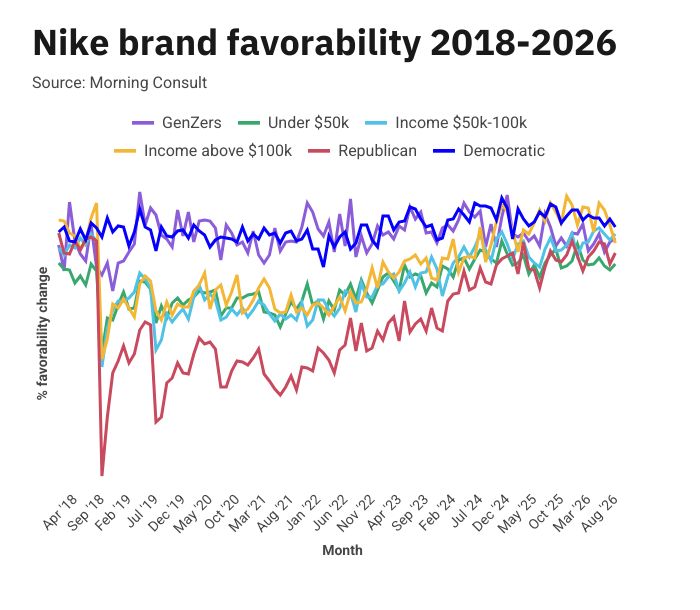
Survey data from Morning Consult shared with Digiday showed that favorability toward Nike among registered Republicans dropped 73% by September 2018, while purchase consideration dropped 54.8%. But by March 2025, favorability and purchase consideration among that same cohort had climbed back upwards.
Nike’s woes have far more to do with the sheer variety of options in front of shoppers, and where those shoppers pick up their gear. Even as CEO Hill pursued a course to restore the brand’s prominence on retail shelves the company’s share of the running market fell to 22.9% last year. Meanwhile the newer category entrants that took Nike’ storefront position at the beginning of the decade have proven more adept at insinuating themselves with emerging cultural powerbrokers, such as athletics influencers and running clubs like the one that criss-crosses my neighborhood on weekday evenings.
Neither Wieden+Kennedy nor Kaepernick are to blame for Nike’s decline. And advertising can’t, on its own, reverse its commercial fortunes. The company’s fate has more to do with the other Ps of marketing’s compass.
“We probably overestimate the actual effect of advertising,” said O’Leary. “It’s called a weak force for good reason.”
What we’ve heard
“We are not evaluating success simply through exposure. The question is whether the partnership makes the brand more meaningful and distinctive, and whether it increases future consideration and usage. That’s the framework we use to assess the long-term value of the partnership.”
—Giovanna Bressane Gomes, global vp, and head of fabric cleaning at Unilever
Numbers to know
50%: The number of marketers comfortable with AI agents making decisions without human oversight, per a StackAdapt survey.
85%: The number of AI search categories with no clear, consistent brand showing up in responses, according to Semrush. ChatGPT’s opinions remain up for grabs, in other words.
80%: The size of WPP’s rebate on principal media deals in China, according to a Sony investigation revealed in court filings this week.
90%: The share of Baller League’s audience that watches via YouTube, according to its CEO upon the league being cut by Sky.
What we’ve covered
The winners and losers of YouTube’s view count and monetization overhaul
YouTube is changing how it counts views, upending the platform’s internal economy of creators and streamers. Alyssa Mercante tracked who’ll be affected most and why.
Creators are moving into brands’ AI search playbooks
Brands are looking to creators to help them drive up their AI visibility scores, according to Kimeko McCoy, though measuring their impact is anything but straightforward.
Divine, Vine’s spiritual successor, won’t rule out ads
Short-form video app Vine was only around for a brief time, but it’s cast a long shadow since it was shut down by owner Twitter almost 10 years ago. Now a new social network app aims to rekindle the magic, while selling ads, per Mercante.
Brand marketers are adopting fan-first social media strategies
More top marketers are working to appeal to fans over Joe Public, at least in their organic social efforts. I spoke to Poppi and a range of experts about the shift.
What we’re reading
Travis Kelce Teams Up with Publicis to Tame the College NIL Scramble
Publicis has launched an NIL business with Travis Kelce of KC Chiefs and Taylor Swift-marrying fame, as it attempts to get ahead of the growing name, image and likeness market, reports the Wall Street Journal.
We Tracked a Shipment of Rare Books. It Ended at an Amazon AI Training Facility
AI companies are going to extreme lengths to obtain fresh material for LLMs to crunch. A secretive Amazon facility appears to be involved in shredding books bought for that purpose after they’ve been scanned, according to 404 Media.
Bumble Tried to Change Dating, but the Dating Market Forced It to Change Instead
The dating app was once defined by its policy of giving women the first move, but a saturated market and shifting expectations around the use of apps have prompted a rethink, per Wired.
Brands Suddenly Care About Reddit. Redditors Don’t Return the Feeling
Convinced it’s the key to turning around the AI visibility woes, marketers are rushing to spend on Reddit’s paid opportunities and extend their organic operations to the site, allowing a cottage industry of subreddit specialists to pop up, per WSJ.


More in Marketing
Indie agencies want The Trade Desk and Amazon DSP to acknowledge their buying power with negotiating leverage
Indie agencies say DSP giants block direct seats and fee relief despite spend commitments.
Nearly 30% of holiday budgets expected to be spent by the end of October
Per a new report from Deloitte, 28% of shoppers’ budgets are expected to be exhausted by the end of October.
Apple finally explains its Safari block, and identity companies are in its sights
As Apple spells out its case for blocking identity companies in Safari, its job board shows an ads business with big plans.