for the Digiday Programmatic Marketing Summit, May 6-8 in Palm Springs.
Advertisers aren’t happy about picking up Meta’s European tax tab

Meta advertisers have had a week to sit with the news that they’ll be picking up the tab for the digital service tax on the platform. So far the reaction has been unease.
Before digging into why, here’s a recap.
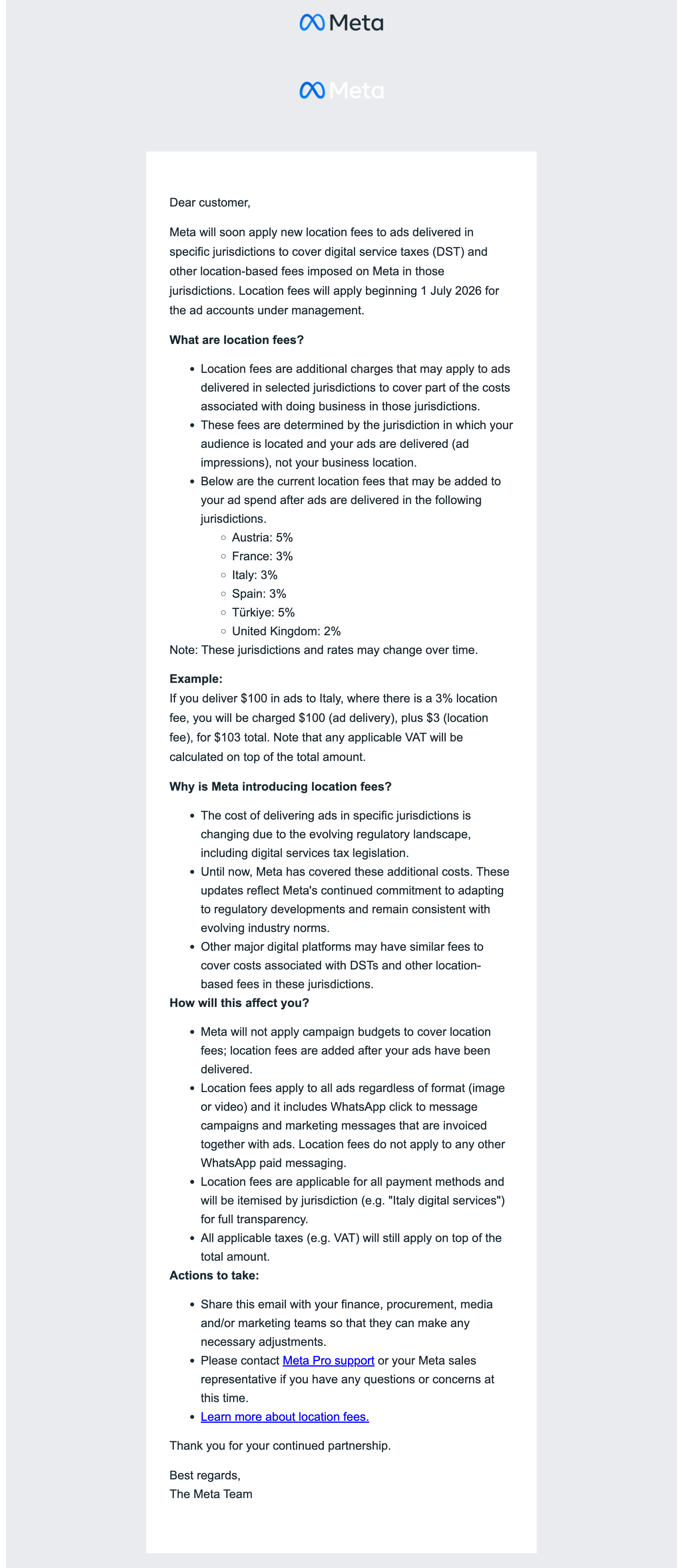
As of July 1, Meta is introducing what it’s calling “location fees” to pay for the current digital services tax (DST) and other similar location-based fees the company faces in certain European countries. Until then, Meta will continue to absorb and pay those fees, as it is legally liable for the tax.

That tax targets large tech companies that generate revenue from users in a given country, regardless of where the company is based. There is no single European Union-wide version of the tax — at least not yet — so individual states have introduced their own. Come the summer, it will effectively function as a tax on advertisers.
Currently, the following countries are subjected to the location fee, which will work as a percentage of ad costs. In Austria and Turkey its 5%: in France, Italy and Spain its 3%: and in the U.K. its 2%.
For instance, if an advertiser spent $100 on ads to reach an audience in Austria (which currently requires a 5% fee), they will be charged $100 for the ad delivery, plus $5 for the location fee. So the total charge becomes $105 for those ads. And any applicable VAT will be added on top of the new $105 charge.
According to an email from Meta viewed by Digiday, these jurisdictions and rates “may change over time.”
Marketers are understandably, worried.
Rimzan Faiz, client success manager, Meta at RoarADX (part of mar-tech venture platform Roar Global) said that for small brands or startups, the additional fee is a big hit.
“They now have to bear this additional cost to target in those locations, which could be their core markets and might not be feasible,” he said.
Prospect Knight’s co-founder Luke Knight, agreed that no matter the size of a brand, a 2% to 5% fee might not sound like a lot, but if they’re spending hundreds of thousands to reach audiences in those markets, it all adds up.
“It’s another area where retailers and advertisers are being squeezed,” he said. “It becomes another thing to try and tackle, and we’ve got to become even more efficient with advertising. And for smaller brands especially, the question becomes is it worth it being in this market anymore, if we can’t absorb the cost.”
As things stand, Meta hasn’t provided any communication to ad execs, beyond the email shared with Digiday. So it makes sense why advertisers have lots of questions, and a lot to figure out.
Knight said that he’s already had clients ask what to do, how this fee factors into their reporting on media spend, and if they need to reassess their marketing budgets, and start re-forecasting for the rest of the year.
“It makes forecasting really challenging, especially since they’re different percentages in different markets,” he added.
And speaking of those different percentages per jurisdiction, Zeno Group’s svp paid social Shamsul Chowdhury noted that the rate variations almost seem to be inverse to the Meta spend in the market — for example, the U.K. currently has the lowest fee, but the highest Meta spend.
“There isn’t much advertisers can do as the tier 1 markets (U.K. and France) drive a lot of volume so they will be forced to continue to spend there,” he said. “Some of the other markets which have historically been more cost effective (i.e. Austria and Turkey) may see their increase in costs result in budgets being reallocated to other markets.”
In some ways, this was always coming. Google has been passing DST costs to advertisers in Europe since 2020. Meta was eventually going to follow. The mechanism keeps the company’s margins intact in each market while remaining compliant with local law.
Editor’s note: In response to a request for comment, a Meta spokesperson sent this comment after the article was published: “In line with industry standards, we will apply location fees to ads delivered in specific jurisdictions. These fees cover Digital Service Taxes (DST) and other location-based fees imposed on Meta in those jurisdictions.”


More in Marketing

Ipsy joins the WNBA craze as the official beauty partner of the Las Vegas Aces
The three-year partnership will see Ipsy’s logo show up on the Aces’ jerseys, on the free-throw line of the court and on the backboard of the Aces’ home court.

Ford, Nissan and State Farm are embedding their brands in sports as they chase fandoms
Advertisers are rewriting the branded entertainment playbook for a sports-focused media landscape.

Possible expands not only its area but also its marketer presence, aka ‘gold dust’
Besides taking over an adjacent hotel, the conference is holding more events on the beach as it ramps up its meetups between marketers and vendors.