Join us Dec. 1-3 in Nashville for the Digiday Programmatic Marketing Summit
This Future of TV Briefing covers the latest in streaming and TV for Digiday+ members and is distributed over email every Wednesday at 10 a.m. ET. More from the series →
This week’s Future of TV Briefing looks at recent data indicating that people may be getting rid of their cable boxes but they’re not exactly getting rid of cable TV.
- Cordless TV
- Creator usage rights, the new “60 Minutes” and more
Cordless TV
Remember cord-cutting? OK, dumb question; it’s still a thing. But the way that it’s happening now underscores how people may be getting rid of their cable boxes but they’re not exactly getting rid of cable TV.
First, let’s look at the current rate of cord-cutting. The number of people cutting the cord is still growing, though a majority of U.S. households still have access to traditional TV. More than 30% of U.S. households are streaming-only households, according to the Advertising Research Foundation’s DASH TV Universe study.
More to the point, the rate of cord-cutting is easing a bit and in a pretty telling way, based on the latest quarterly earnings report from major U.S. pay-TV providers.
- Charter lost 21,000 subscribers in the second quarter of 2026, vs. a loss of 80,000 a year ago.
- Comcast lost 280,000 subscribers, vs. a loss of 325,000 a year ago.
- EchoStar lost 241,000 subscribers, vs. a loss of 261,000 a year ago.
Across the three companies, while the pay-TV subscriber losses have continued, they’ve decelerated. Actually, in the case of Charter, they’ve really decelerated. Why? Well, because Charter has been bundling major streaming services like ESPN Unlimited, Fox One, Paramount+ and Peacock into its pay-TV subscriptions. As a result, it can be more cost-effective to just pay for traditional TV than to cut the cord and pay for the streamers a la carte.
As Charter said in its quarterly earnings announcement, that cord-cutting deceleration was “driven by simplified pricing and packaging and benefits from the inclusion of programmers’ streaming applications in Spectrum’s expanded basic video packages.”
The streaming services that cord-cutters sign up for immediately after canceling cable is also telling. To be clear, most of them – 72% – already subscribe to some streaming services, but 31% of cord-cutters sign up for a new streaming service in the first month after canceling their traditional pay-TV subscriptions, according to research firm Antenna.
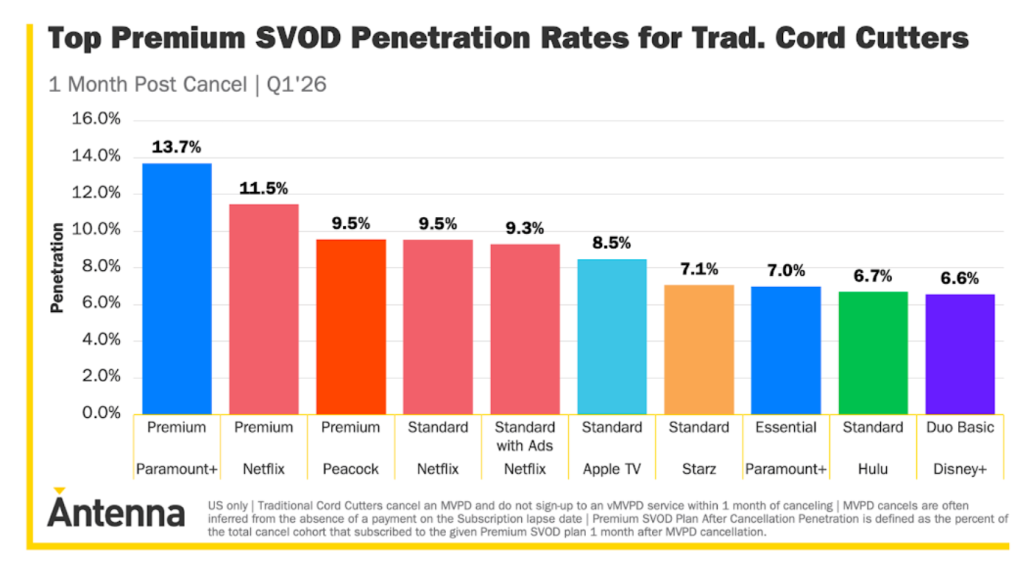
Paramount+’s premium tier being the biggest winner of cord-cutters may owe to cord cutters not wanting traditional pay-TV subscriptions but still wanting traditional pay-TV programming, like CBS’s live sports broadcasts, which are available on the streamer’s premium tier. That would also help to explain NBCUniversal’s Peacock premium tier – which carries “Sunday Night Football,” the NBA, Olympics, etc. – ranking third. Netflix taking the second, fourth and fifth slots seems just a function of Netflix being Netflix.
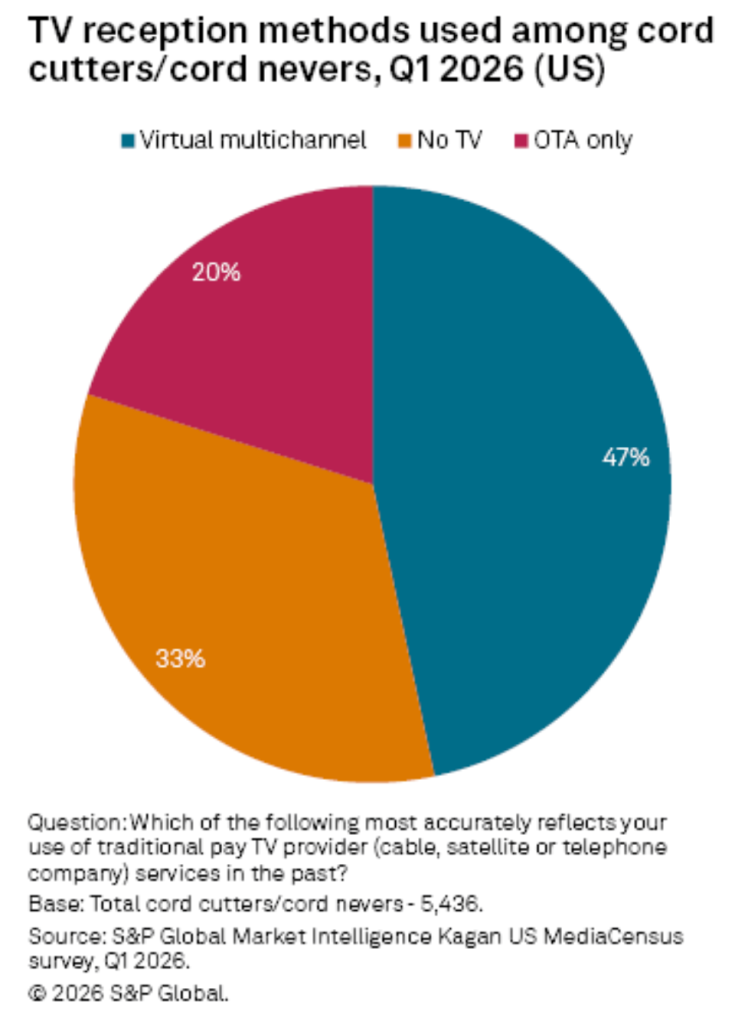
But maybe the biggest tell that cord-cutters aren’t cutting themselves off from traditional TV is the share of them that still get traditional TV in some form. According to S&P Global Market Intelligence Kagan, 47% of cord-cutters or cord-nevers – folks that never paid for traditional TV in the first place – have streaming pay-TV subscriptions, while 20% still get broadcast TV through free over-the-air signals.
What we’ve heard
“They just don’t want the hassle of the usage rights conversation.”
— Open Influence’s Aundrea Leckie on brands asking for perpetual usage rights from creators
Numbers to know
18%: Percentage increase in the number of minutes of ads aired per hour on major streaming services this year.
2014: The year that Amelia Dimoldenberg premiered “Chicken Shop Date,” her YouTube show that will end after its upcoming season.
40%: How much higher YouTube’s new public viewcounts are compared to the previous version after the platform lowered the threshold for counting a view.
6: Number of NHL teams that will stream local games exclusively via Amazon Prime Video.
What we’ve covered
Back-to-school brand spending on TikTok rises:
- Advertisers bumped up their TikTok spending 20-40% over the summer months as they worked to tempt consumers to open up wallets during the annual back-to-school sales period.
- TikTok’s share of overall social spending by Tinuiti clients increased 55% between July and August.
Read more about advertisers’ back-to-school TikTok spending here.
Brands want creators who can win over humans and machines at once:
- With Reign Maker, AI visibility has been the first or second thing raised with every client for six months straight running.
- Ogilvy is further along with some accounts: a handful of its more advanced clients are already setting explicit KPIs around discoverability, credibility and culture, rather than waiting to see how the conversation plays out.
Read more about creators’ influence on brands’ AI visibility here.
Marketers say usage rights are driving up the price to work with creators:
- Usage rights have become a major part of every creator partnership, dictating how the content will be used, where it will appear (locally or globally), and how long it can be used.
- Aundrea Leckie, director of account management at creator marketing company Open Influence, said she’s finding more brands lately are trying to get usage rights in perpetuity, something she believes isn’t advantageous for them.
Read more about creator usage rights here.
Why brands are turning to older creators for authenticity AI can’t fake:
- Elder millennial and Gen X creators bring mortgages, burnout, parenting, health scares, and mid-career pivots into their feeds: real-life problems that are hard to fake and increasingly valuable to brands looking for credibility with older, higher-spending audiences.
- The trends for elder creators reflect a broader move toward longer-term partnerships over one-off campaigns, and a renewed focus on grounded storytelling that builds community and drives engagement.
Read more about brands’ interest in older creators here.
What we’re reading
This coming Sunday marks the premiere of a new-look “60 Minutes” under CBS News chief Bari Weiss and new producer Nick Bilton, replete with “dozens of small changes” that are meant to modernize the decades-old show, according to The New York Times.
MrBeast’s diversifying media company:
The challenge for creators like Jimmy “MrBeast” Donaldson that are building media companies around themselves is that their companies cannot be overly reliant on their founding creators, which is why Beast Industries is trying to diversify its business beyond its centrifugal creator, according to Business Insider.


More in Future of TV
Future of TV Briefing: TikTok Shop success = small creators + more videos
This week’s Future of TV Briefing looks at how “more videos from smaller creators” is the recipe for success on TikTok Shop.
Future of TV Briefing: Hispanic TV-and-streaming viewership in 4 charts
This week’s Future of TV Briefing looks at how Hispanic audiences spend their time between traditional TV and streaming.

Future of TV Briefing: TV ad industry’s measurement currency frustrations hit (another) boiling point
This week’s Future of TV Briefing looks at a new task force being formed by the Coalition for Innovative Media Measurement to tackle the TV ad industry’s measurement currency conundrum.