for the Digiday Programmatic Marketing Summit, May 6-8 in Palm Springs.
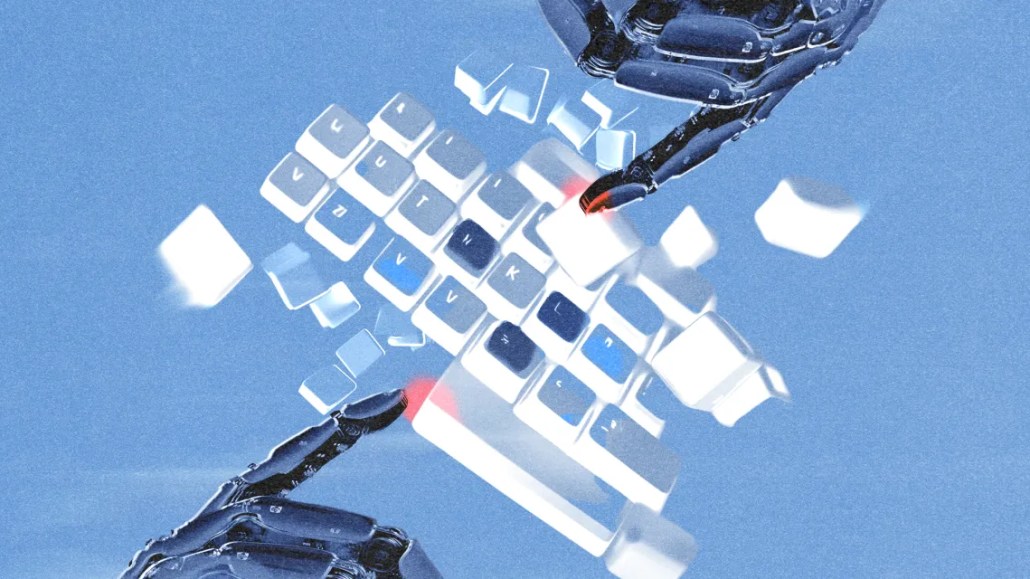
Generative AI is everywhere, whether you like it or not. Content creation is no exception, with AI influencers signing brand deals and real-life influencers using AI tools to help plan their content schedules or write scripts. The latest trend? Vibe coding, a new way for creators to build advanced computer programs without knowing how to code.
Vibe coding has leapt from developer forums into mainstream buzz, making it one of the fastest-growing AI tools for creators today.
One of the major vibe coding platforms, Base44, is even advertising in this year’s Super Bowl. Let’s break down all you need to know about this new way to code.
What is vibe coding?
Vibe coding leverages AI to write code for products including apps, one-off digital experiences, websites, and SaaS tools. Creators enter plain-language prompts (in some cases they even use text-to-speech tools so that they can speak these prompts) to describe what they’re looking for, and a vibe coding platform like Bolt or Emergent will program it for them.
Vibe coding as a term was first coined by computer scientist Andrej Karpathy, who wrote on X last February: “There’s a new kind of coding I call “vibe coding”, where you fully give in to the vibes, embrace exponentials, and forget that the code even exists. It’s possible because the LLMs (e.g. Cursor Composer w Sonnet) are getting too good. Also I just talk to Composer with [voice-to-text app] SuperWhisper so I barely even touch the keyboard. I ask for the dumbest things like “decrease the padding on the sidebar by half” because I’m too lazy to find it. I “Accept All” always, I don’t read the diffs anymore. When I get error messages I just copy paste them in with no comment, usually that fixes it.”
It’s simplistic and fast and removes the need for specialization — as many generative AI tools do. But just like those other tools, it’s fallible.
How is it different from traditional coding?
Well, the obvious: you don’t need to know how to code to do it.
Traditional coding requires you to manually write code in one of several code languages (like C++, Java, or Python), offering detailed instructions in that language for how to run the computer program you’re designing. It requires much more skill, as not only do you have to write in a specific coding language, but you have to be able to manually debug programs that go awry.
What are the benefits of vibe coding?
Like many generative AI tools, the benefits of vibe coding are its speed and its removal of traditional barriers (i.e., you don’t know how to do something and don’t feel like, or have the time to, learn it).
For creators, it’s about “removing intermediaries” between them and their audiences, according to a spokesperson from Base44. “Creators no longer need to hire developers or compromise with generic tools. They can build software that truly fits their business and evolve it as they grow,” they told Digiday.
How are content creators using it?
First, if you’re someone who isn’t into using generative AI for ethical reasons (particularly the threat to job stability for designers, writers, and, in this case, coders), you may not want to try out vibe coding.
If you’re fine with it, ethically, creators should be aware that vibe coding isn’t always a smooth process. A Stack Overflow blog about vibe coding written by Pheobe Sajor with Bolt describes “45 minutes of troubleshooting” that offered detailed descriptions on how to find errors, but “wasn’t useful” to a “non-coder.”
“I’m sure if I had any understanding of what exactly was happening inside my app, I could ask it to dig deeper, but the whole point of this experiment was that I didn’t,” Sajor wrote. Despite the issues, Sajor still managed to make a functional app with no knowledge of coding — it just didn’t stand up to scrutiny. The app’s code was apparently “messy” and it was “ripe for hacking” as it lacked security features.
Creators should make sure the app or tool they’re creating doesn’t leave doors open for nefarious actors, either by uploading their code to a platform like GitHub or hiring a coder as an advisor.
Vibe coding has seeped into the world of content creation and is only gaining more traction.
“Creators are building highly specific products that existing templates and off-the-shelf tools don’t support,” the Base44 spokesperson told Digiday. “That includes membership platforms with unique monetization models, content management systems tailored to individual workflows, community tools, and custom storefronts designed around how they actually operate.”
Creators who focus on teaching their audience about AI tools and technological advancements use vibe coding in their content, like YouTubers trying to build apps “better than a pro developer,” and building entire video games with vibe coding, or data scientists who use AI tools in their everyday teaching viewers how to vibe code.
Then there are content creators, particularly journalists, using vibe coding to build tools that supplement their reporting — like helping locals calculate the cost of a referendum in their town or building a map of wildfires in Europe.
Like all things generative AI, the hype for vibe coding seems to be rapidly increasing. But as more and more people play around with the tool, cracks may begin to show, as they have in other generative AI initiatives.
But if Base44’s upcoming Super Bowl ad means anything (considering the company is barely a year old), vibe coding could become a staple in creators’ toolkits in the coming months.
“I think we’ll see vibe coding get deeply embedded into existing products and workflows, not just ‘build an app,’ but “improve this process,’ ‘optimize this UX,’ or ‘reduce this cost’,” Jovy Yu, talent lead at AI education company Lonely Octopus, told Digiday. “We’re not fully at ‘set it and ship it’ yet. But I genuinely think within the next year or two, models will be able to generate code that’s maintainable, secure, and scalable enough to ship with confidence. The big trend? Complex things become accessible through good prompts. And that’s pretty exciting.”


More in Media

Media Briefing: Another AI threat emerges for publishers: the third-party scraper
A growing network of third-party web scrapers is fueling an AI content licensing market, where publisher content is scraped and sold.
The Washington Post’s Arc XP adds TollBit to help publishers make money from AI bot traffic
The Washington Post’s Arc XP adds TollBit to help smaller publishers monetize AI bot traffic, offering a path into AI licensing revenue.

Digiday+ Research: Publishers apply AI to streamline tasks and improve audience experience
Publishers increasingly embed AI tools into daily functions, especially streamlining tasks and improving the audience experience.