for the Digiday Programmatic Marketing Summit, May 6-8 in Palm Springs.
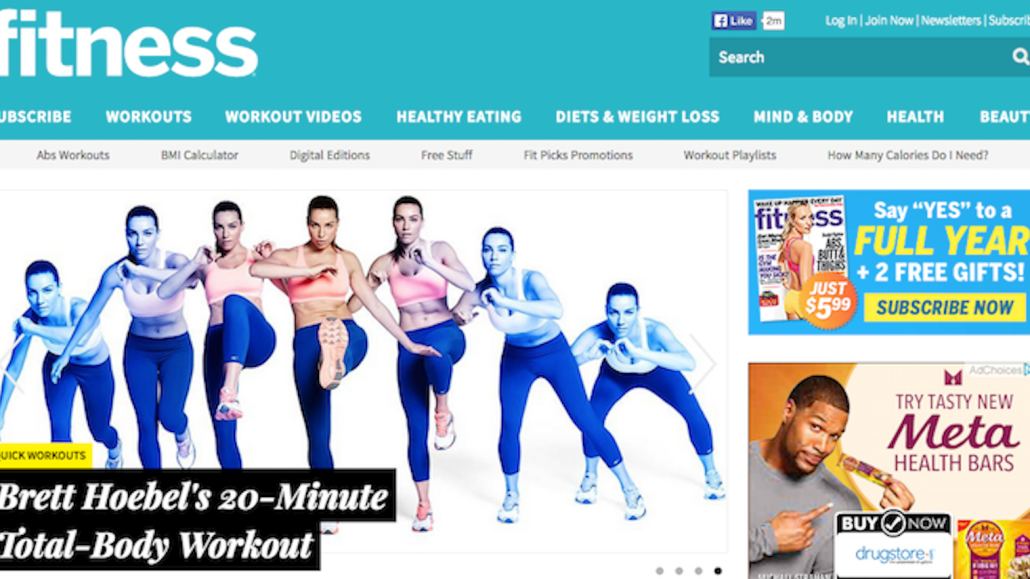
Like many publishers, Meredith Corp.’s financial performance has been depressed by the rise of automated ad buying. Now it’s fighting back with the tool of publishers everywhere: native ads.
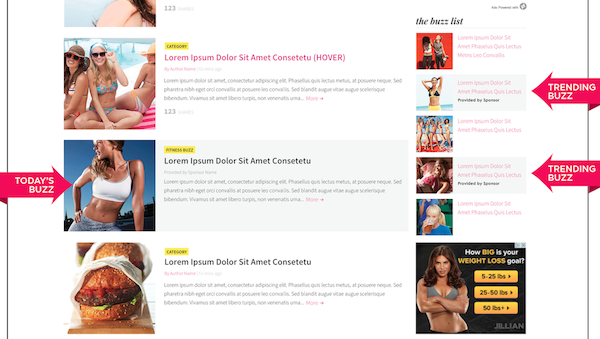
Meredith’s first such ads will appear later this month on FitnessMagazine.com, which is set to relaunch Wednesday. The ads take the form of editorial-style headlines that direct people to advertiser content in the form of branded recipes, articles, videos and slideshows. As shown in this mockup below, the sponsor placements appear within the stream of editorial content on the page, in columns called “Buzz” and will be delineated from editorial content with gray shading and be labeled “provided by” the sponsor in question. Meredith is not naming advertisers that have signed up for the new units.
Over the next four to six weeks, Meredith plans to roll the units out across its top 10 sites, including those of Better Homes and Gardens, Allrecipes and Parents.
Andy Wilson, svp and chief digital officer at Meredith, said that with the Buzz units, for the first time advertisers will be showcased on Meredith’s sites “in a way that they can be seen.”
While other publishers have had to create new divisions under the sales department to meet advertisers’ demand for native and other branded content, Meredith has a head start in that it already owns an established content-creation agency, Meredith Xcelerated Marketing, which has had blue-chip companies like Chrysler and Kraft as clients. The native ad offering augurs a closer working relationship between Xcelerated and Meredith’s National Media Group, which houses its magazine brands.
“This is an opportunity to work more closely together on a more regular basis,” Wilson said. “They have a really core competence in that kind of work, so we feel like we can go to the market and be able to execute it.”
But Wilson said the company wasn’t ruling out having editorial staff participate in the content creation. Other publishers including Hearst Corp., Say Media and Dennis Publishing have done so, counter to industry practice that keeps editorial and advertising separate.
”We’re continuing to look at what involvement we have from the editorial side,” he said. “We’re keeping an open mind.”
Accountability metrics are part of the new ad offerings. Advertisers are starting to demand assurances that their ads have been in view. In that vein, Meredith will be using Moat analytics firm to measure whether the ads are in view, how long readers spend with the ads, and if they shared them. Meredith will guarantee the ads will meet the IAB’s viewability standard, and Wilson said that down the road, it may guarantee engagement as well.
With ads just starting to be bought and sold based on viewability, a common complaint among publishers is that the vendors who are measuring viewability have widely divergent results for publishers and that advertisers often demand that their own vendor be used to measure if the ad was seen, at the publisher’s expense. Meredith hasn’t been immune to these issues.
“We have that battle every week,” Wilson said. “We’re a no-nonsense, high-quality audience. So we really like to be judged on a performance basis. And viewability is important. I’m not saying it’s not. But if we can’t be measured by a tool that’s not ready, that’s where we struggle.”
The so-called units that mimic the look and feel of publishers’ sites and command premium rates have been a popular way for publishers to combat falling CPMs and banner blindness. According to a survey by native ad platform Polar, 40 percent of publishers expected native advertising to represent one-fourth of their revenue this year.


More in Media

Ozone’s platform tries to simulate how publisher content appears in AI answers
Ozone’s new simulation platform aims to crack AI’s black box to let publishers model how their content gets surfaced in AI answer engines.

CNN builds in-house agent infrastructure as it prepares for AI-driven media trading
In Q3, it plans to test one or two properties to see how they’re interpreted by LLMs, before turning in Q4 to buyer behavior and whether budgets are being allocated toward agent-to-agent trading experiments.

How a ‘TikTok doctorate’ made 26-year-old Griffin Johnson a venture capitalist
Griffin Johnson made it big on TikTok back in 2019, now he runs a VC firm and uses his marketing expertise in the Derby world.