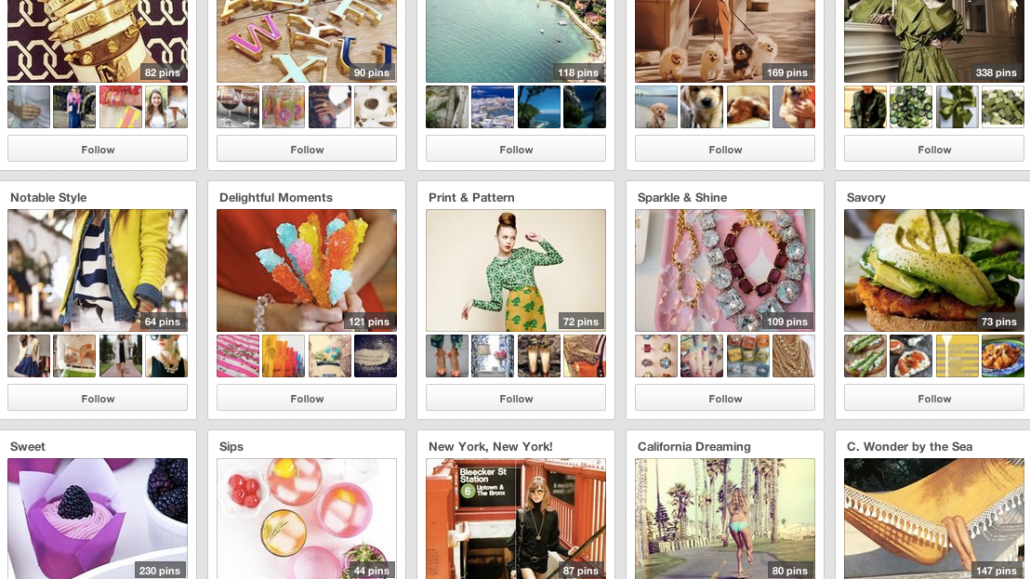
It’s no secret that Pinterest drives a quarter of retail referral traffic. Marketers and retailers are developing integrated e-commerce strategies with Pinterest in mind to drive sales.
At the Digiday Retail Summit, taking place on Laguna Beach, Calif., this week, Digiday’s Saya Weissman spoke with Micahel Chao, the director of social and mobile engagement at women’s lifestyle brand C. Wonder, alongside Apu Gupta, the CEO of Curalate, a Pinterest consulting firm.
“Pinterest is our second or third highest revenue driver for our social platforms,” said Chao. “But we as a brand think about Pinterest broadly. Brand building and brand awareness is just as important for us.”
Chao and Gupta explained how Pinterest has generated sales for C. Wonder by developing content on the platform as a thematic experience, rather than a temporal one, which would be relevant for Facebook or Twitter.
Here are their recommendations for a successful retail Pinterest campaign:
Know your market.
“Pinterest is particularly important for us because it’s a great way to reach a broad audience.” said Chao. “For us in particular, we’re trying to reach women, and we know that women are very active on the platform. The key topic areas are fashion, home, and style; key topics for our business.”
Integrate Pinterest with e-commerce.
“On our e-commerce site, CWonder.com we make sure it’s super easy to share on Pinterest,” explained Chao. “We also encourage that behavior by offering incentives like free shipping for pinned products.”
Do something human.
“We’re a new brand so we’re really trying to increase awareness of the brand,” said Chao. “We do that by pinning things that inspire us, and by doing that we create a voice and persona people can relate to.”
Think natively.
Brands need to start speaking in a visual language specific to Pinterest. “It’s a channel where you can’t just approach it like you did Facebook,” explained Gupta. “You have to start thinking about this in a much more native way.”
Think thematically.
“When we talk about Pinterest, we talk about how Pinterest is a thematic platform,” said Gupta. “On Pinterest, you have an opportunity to tell a story and build themes around a color or a product launch.”
Avoid cheesy pin-to-wins.
“Our measure for success for our pin-to-win was, ‘Would people do this if the contest wasn’t there?’ and we took great care in making really compelling assets,” explained Chao. “We’re just really thoughtful about encouraging a native behavior instead of forcing someone to do something they wouldn’t organically want to do.”
Watch the full session below.
Retail’s Interest in Pinterest from Digiday on Vimeo.


More in Marketing

‘Predictability has become a luxury’: As the Iran war drags on, ad markets are starting to sweat
Whatever hope remained that this would be a short war is fading. And with it, the assumption that the economic damage would be too.

Walmart-Vizio’s CTV measurement faces incrementality hurdle
Walmart’s Vizio deal promises closed-loop CTV measurement, but brands are waiting for data clean rooms and proof of incrementality.

How E.l.f. Beauty is using AI to alleviate the workload of its workforce
E.l.f. Beauty’s chief digital officer, Ekta Chopra, shared the four pillars that guide the beauty brand’s approach to AI implementation.