Secure your place at the Digiday Publishing Summit in Vail, March 23-25
HBO’s ‘Silicon Valley’ is planting fake news stories in Google search results

“Silicon Valley” is a scripted HBO comedy that so brilliantly satirizes the real-life tech industry it’s hard to tell what’s real and what’s a joke. Now it’s blurring the lines between fact and fiction online as well.
Searching “Silicon Valley” or “Silicon Valley HBO” on Google pulls up fake news stories tied to events in last Sunday’s third season premiere, with authentic-looking headlines situated on top, as seen below:
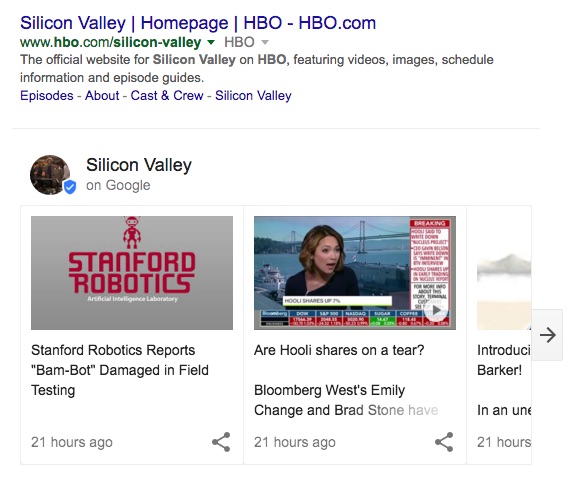
One headline reads “Are Hooli shares on a tear?” with a link to a Bloomberg video with real anchor Emily Chang playing a role for the show and another links to a post about an accident at Stamford Robotics — both fictional companies featured in the show. The headlines read like they could have been pulled straight from TechCrunch, but they are of course fictional.
The posts are published on Google Posts, a tool rolled out earlier last year for presidential candidates, that lets brands or publishers post directly to Google rather than linking externally. Google Posts is not an ad product, and HBO appears to be using the tool as a free way to cleverly promote the show.
“We’re continuing to experiment with the look and feel of this feature, including exploring other potential use cases,” a Google spokesperson told Digiday. Posts have been used in the past a promotional tool, including for Jimmy Kimmel Live and Game of Thrones.
The partnership is just another way the show ties in its fictional work with the non-fictional: This season’s revamped credits features logos from real tech companies, like Uber and Lyft, along with Amazon Prime drones.


More in Marketing

In graphic detail: How Anthropic’s Pentagon refusal is paying off in downloads, brand trust and enterprise deals
OpenAI’s Pentagon deal seemed to spark uproar among its users, many of whom were against it. Anthropic’s refusal to agree to the terms was seen by users as the more trustworthy alternative.

How AI could disrupt retail media’s $38 billion search ad market
ChatGPT and other AI chatbots could divert shoppers from retailer sites, putting the $38B retail search market at risk.

‘Brand safety is moving from fear to curiosity’: Zefr’s Raddon on content-level accreditation – and what it exposes about the industry
The threat is no longer a discrete piece of bad content that a keyword list or a domain block can catch. Its volume.