Want to reach millennials? Target social issues, not social climbing
A lot has been written about millennials, as the media and marketers grapple to better understand what makes them tick. With this generation accounting for one-third of the American population — they are the nation’s largest demographic — marketers would be wise to consider what really motivates this increasingly powerful consumer segment.
Painting any group with broad strokes is inherently problematic, of course. But, based on our experience encouraging creativity and outside-the-box thinking (not just among millennials, but all generations), we’ve determined that millennials are, indeed, motivated by social good. And millennial makers, more so.
Impossible is just a question of dedication
Since its earliest days as a loose collection of DIY communities, “maker culture” has been driven by meaning. A number of factors spurred its growth throughout the ‘00s and into ‘10s, including the democratization of the Internet, the rise and ubiquity of social media and increased access to new resources and tools, such as a 3D printers.
Not coincidentally, millennials are natives in this world: The Internet is their second home, and no new gadget is deemed impossible. Makers fundamentally believe that every challenge can be overcome. Even if this optimism can be chalked up to youthful enthusiasm, marketers must take note of their real-world achievements.
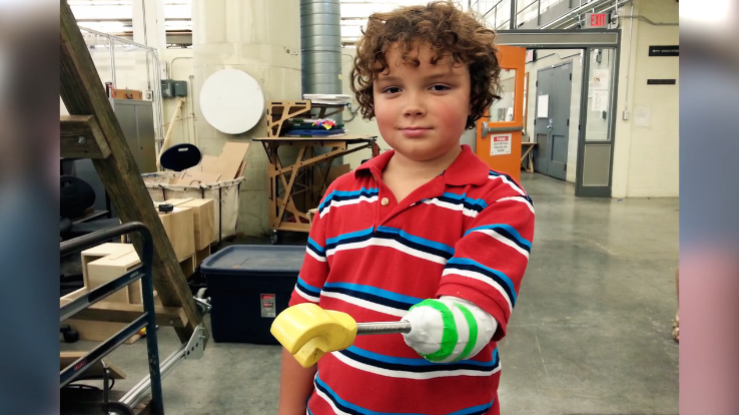
Consider Coby Unger, a “professional amateur” product designer and Autodesk Artist in Residence. Inspired by nine-year-old Aidan Robinson, who was born with a left arm that ends just below his elbow, Coby prototyped a new kind of prosthetic arm.
The pair met at the Superhero Cyborbs workshop at the 2014 KidMob summer camp, where children are encouraged to design their own prosthetic and orthotic devices. Aidan was frustrated by his prosthetic’s limitations when it came to daily life. His prototype featured a threaded metal rod that allowed him to attach different parts, including his Wii remote, a fork and a life-size version a LEGO figurine hand.
Inspired by Aidan’s vision, Coby then created a more sophisticated version that uses 3D-printable parts. As Coby told The Atlantic, “I thought it was a unique perspective on prosthetics I hadn’t seen before. And it had great potential for changing what prosthetic means and what it could mean.”
The final design of the prosthetic is featured on Coby’s Instructables page, and has received more than 20,000 views to date as well as international media coverage.
Hack the halo effect, but do so carefully
Also intrinsic to the millennial maker ethos is the concept of hacking: finding new, unconventional ways to make parts fit with each other or substituting unexpected materials to make a project come together. Whether it’s hacking the trajectory of traditional corporate employment or finding new ways to reduce food waste, millennial makers are scrappy, hands-on experimenters.
For marketers, this suggests an audience that is both confident and curious. Perhaps more than their forebears, this generation has a high tolerance for trial-and-error.
This tolerance can be applied to advertising messages, but they must be related to be real-world issues. Globally, more than three-quarters of millennials believe they should be involved in social issues. Nearly two-third of the projects coming out of TechShop (an Autodesk partner) are focused around some form of social good.
There’s no question that millennial-driven maker culture will continue to permeate new platforms and communities. Even President Obama is on-board: Earlier this year, he launched the first White House Maker Faire, which challenges makers to work on society’s pressing problems.
Likewise, the urge to impact society positively will only grow; their stories will be told through examples set forth by Coby Unger and Aidan Robinson. Millennials are shown to prefer social issues to social climbing, and communities like Instructables and TechShop are dedicated to fueling this collective interest and passion.


More from Digiday

‘The processes are continuing forward’: Advertising’s dealmakers press on with M&A despite Iran uncertainty
War in the Middle East is a problem for advertising’s dealmakers. Just not yet.
Inside The Daily Mail’s creator-led content playbook
Inside the structure, strategy, and metrics of the Daily Mail’s creator-led content push.
In graphic detail: The numbers making the case for what holdcos could be
What the data says about the CMO-agency relationship — and none of it is comfortable.